

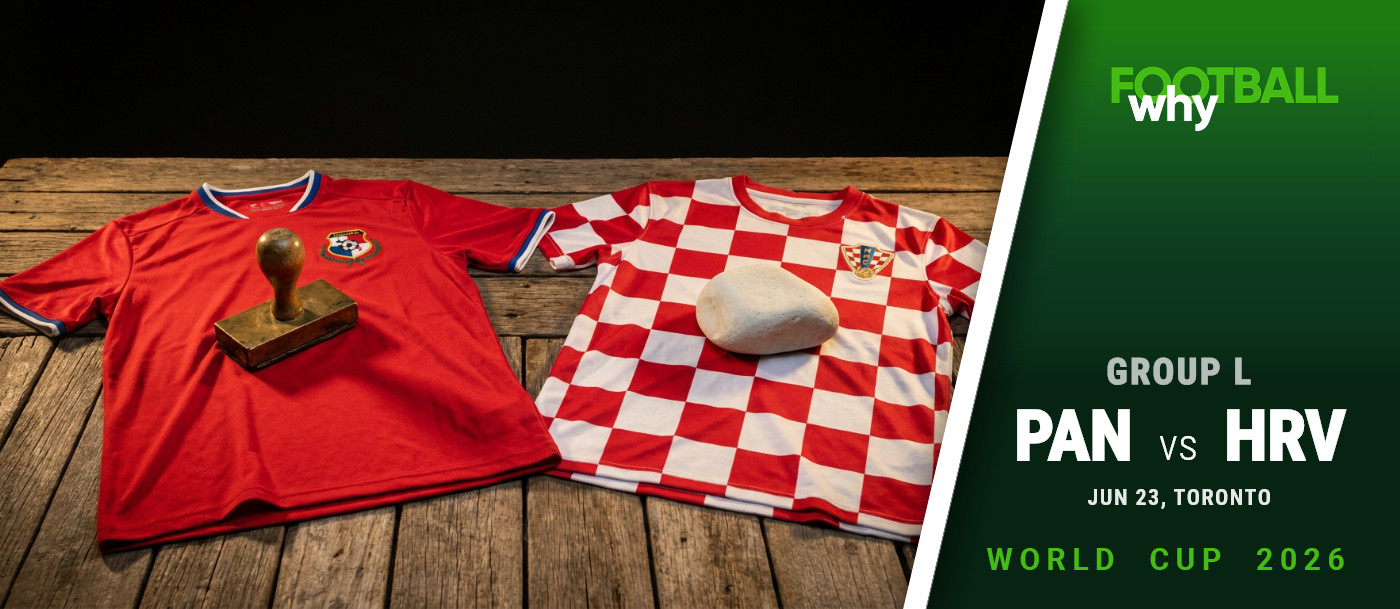
The World Cup Qualification Decider
Tuesday, 23 June

BMO Field, Toronto

Panama vs Croatia FIFA World Cup 2026 Group Stage Match Bureaucratic Patience Survives the Dockside Brawl Forecast generated:

A claustrophobic dockside brawl meets bureaucratic obstinacy. Discover how a single 54th-minute overlap pierced through a gruelling stalemate that produced just 0.11 combined expected goals. Dive into the mechanics of this brutal tactical grind.
Panama vs Croatia Structural Collision

What was it?

Claustrophobia defined the afternoon. The European veterans absorbed the Central American aggression like a heavy iron hull taking the brunt of a choppy dockside swell. Panama hurled bodies down the flanks with frantic, breathless energy. Yet the official statistics recorded a combined expected goals total of just 0.11. The opening forty-five minutes provided nothing but heavy friction and dead ends.

Zlatko Dalić refused to endure the stalemate indefinitely. At half-time, he introduced Ante Budimir and dropped Ivan Perišić deeper to alter the attacking geometry. The adjustment worked immediately. Josip Stanišić overlapped on the right and delivered a low cross for Budimir to finish at the back post. That single, clinical sequence essentially ended the competitive argument.

Panama possessed immense physical drive but absolutely zero central craft to bypass the block. Their wingers operated in total isolation. Viewers who skipped the broadcast missed an absolute masterclass in tactical chloroform, interrupted only by one moment of genuine panic. In the 67th minute, a sudden flurry of Panamanian headers and rebounds forced Dominik Livaković into a sprawling triple-save. He smothered the chaos instantly. The veterans simply packed away the tools, closed the ledger, and quietly walked off with the victory.

Why not go for the win?

Panama

Panama lost because their attacking infrastructure relies almost entirely on a single logistical hub, and that hub was missing. Without Adalberto Carrasquilla to process the ball through the middle, the midfield simply stopped functioning.

Every possession was forced into a severe bottleneck. The tactical setup deployed five defenders and four midfielders, inherently pushing the play out toward the touchlines.

This wide bias works when there is a central playmaker to switch the angles. Without one, Panama’s wingers found themselves running into cul-de-sacs against a set Croatian defence.

The forwards were left entirely stranded. They had to feed off hopeful, low-percentage crosses rather than engineered through-balls.

This structural dead-end points to a broader generational issue. The squad leans heavily on a veteran core to manage the game state, masking a lack of emerging technical directors.

The domestic development pipeline prioritises athletic endurance and transition speed. It produces players who can sprint all day in the tropical heat but struggle to pick a lock in tight, congested spaces.

When an opponent refuses to leave gaps for counter-attacks, the absence of close-quarters passing education becomes glaringly obvious.

They ran with immense, admirable pride, but ultimately tried to clear a landslide with a garden spade.

How did they clinch it?

Croatia

Croatia secured the points by deliberately suffocating the match's oxygen supply. They recognised early on that engaging in a chaotic footrace with Panama would only invite unnecessary risk.

Instead, the European side opted for total tempo suppression. They circulated possession at walking pace in the first half, testing the opponent's defensive spacing without over-committing bodies forward.

When the structural stalemate dragged on, Zlatko Dalić triggered a pre-planned manual override. Shifting Ivan Perišić deeper and introducing a traditional target forward altered the pitch geometry.

This simple realignment created the necessary overload on the right flank. Once the lead was established, the team immediately reverted to a low-variance preservation mode.

This instinct to hoard a narrow advantage stems directly from the squad's heavy veteran presence. The senior core dictates decisions on the pitch, actively discouraging frantic transitions in favour of settled, compact shapes.

It reflects a national footballing ecosystem that values technical retention and spatial awareness above raw athleticism. The academies focus heavily on tactical geometry and decision-making under pressure.

With a tiny demographic pool, they cannot out-muscle the world. Instead, they export players who understand how to navigate the psychological friction of tournament football.

They built a lead with calculated precision, and then simply folded up the scaffolding and went home.

Match hero...

Amir Murillo
Amir Murillo acted as the sole functioning bypass when Panama’s central logistics completely seized up. With the middle of the pitch clogged by static bodies, the wing-back simply rerouted the traffic down the right flank. He bypassed the congestion by timing his overlapping runs just as the Croatian midfield shifted their weight inward. It was pure, pragmatic problem-solving. Lacking a playmaker to stamp the paperwork, Murillo took the cargo himself, driving hard to the byline and dumping deliveries into the box through sheer physical persistence.

...and one more

Dominik Livaković
Dominik Livaković provided the structural ballast that kept the Croatian vessel upright during a sudden, violent squall. When Panama finally breached the defensive perimeter, the goalkeeper dropped his anchor. His triple-save sequence relied less on acrobatic flair and entirely on elite biomechanical positioning. He reads hip rotations and shoulder drops to anticipate the strike trajectory before the boot connects. By maintaining a perfectly compact base, he absorbed the chaotic energy of the penalty box, sealing the cracks in the masonry just as the storm peaked.