

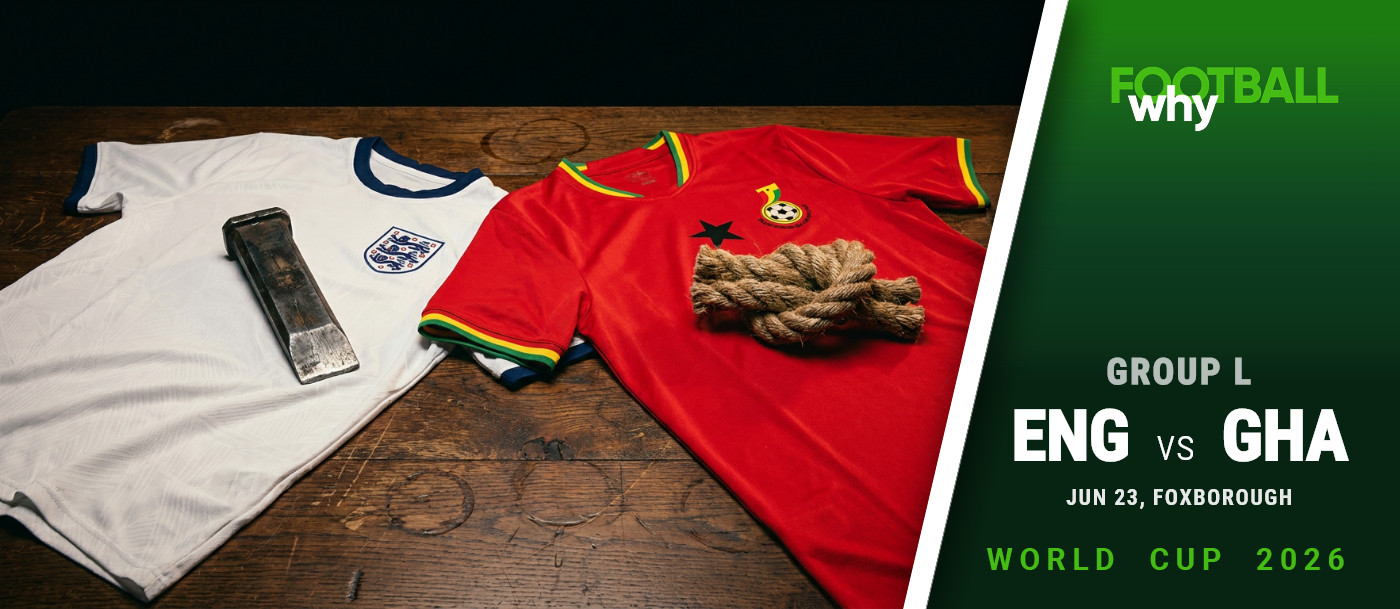
The World Cup Qualification Decider
Tuesday, 23 June

Gillette Stadium, Foxborough

England vs Ghana FIFA World Cup 2026 Group Stage Match A blocked pipe of sterile dominance Forecast generated:

England hoarded seventy-nine percent of the ball like an overly cautious sorting office, entirely failing to deliver. Discover how Ghana's desperate defensive grit and a shocking late miss from Harry Kane turned a sterile audit into a frantic stalemate.
England vs Ghana Structural Collision

What was it?

The damp air in Foxborough felt like a blocked pipe slowly backing up. Seventy-nine percent of the territory belonged to one side, yet the first forty-five minutes produced zero shots on target.

England operated like a postal sorting room checking the weight of every envelope before sending it sideways. They forced nine corners and pinned their opponents deep. Ghana simply absorbed the pressure, filtering the wide crosses through a dense central mesh.

The defining anomaly was the utter lack of central penetration despite total territorial monopoly. Without natural left-sided combinations, the European attackers just recycled possession out to the wings, refusing to force the issue.

The entire structure almost collapsed at 78 minutes. Prince Adu tumbled under a challenge from Ezri Konsa, sparking frantic appeals that the referee waved away.

That scare finally triggered a frantic late surge. Nico O'Reilly rattled the crossbar with a back-post header. The rebound fell to Harry Kane, who hacked the decisive finish into the stands, leaving the synthetic, risk-free control entirely unrewarded.

Why stopped just short of victory?

England

England strangled their own attacking intent by prioritizing absolute territorial control over vertical risk. The circulation slowed to a cautious crawl, funneling out to the flanks because the central lanes were heavily congested by the opposition.

This wide bias was exacerbated by an improvised left-back profile. Without natural, overlapping combinations on that side, the team lacked the mechanics to cut the ball back cleanly. They relied instead on predictable crosses into a packed penalty area.

The squad is bursting with elite athletic conditioning, yet they played as if terrified of a sudden mistake. The creative hierarchy stalls when multiple star players defer responsibility, opting for sensible, horizontal passes rather than line-breaking gambles that might invite a counter-attack.

When the game demanded a sudden change of tempo, the players looked to the tactical manual rather than their own intuition. The fear of public failure outweighed the desire for creative success.

This hesitation stems from a deeper institutional anxiety. Raised under the relentless glare of intense public scrutiny, the national team defaults to a safety-first policy. Academy systems have produced tactically flawless players, but this environment suppresses raw, improvisational instinct in favour of avoiding the catastrophic error.

They built a perfectly engineered, weather-proof shelter, only to realize they had locked themselves inside.

Why stopped just short of victory?

Ghana

Ghana secured a draw by actively accepting their territorial deficit and deliberately compressing the pitch. They abandoned the flanks to protect the high-value central zones, relying on veteran discipline to absorb a constant barrage of crosses.

This deep-block resilience was a pragmatic response to their own attacking limitations. Lacking the intricate passing structures to hold the ball for long spells, the team leaned on their physical endurance. They used tactical fouls to manage the clock and disrupt the European rhythm.

Their actions were a collective hoarding of energy. When the team did occasionally break forward, it was with sudden, hungry bursts. This reliance on individual breakouts and second balls reflects a tactical framework that prioritizes sudden impact over sustained control.

Instead of trying to match the synthetic routines of their opponents, they embraced their raw vitality. Every clearance and blocked shot reinforced a defiant unity that compensated for their lack of systemic polish.

It is a survival mechanism born out of necessity. The national setup often operates amidst administrative volatility and intense local expectations. In tournaments, this translates into a fierce, communal defensive effort. The players pool their energy, treating the penalty box as a shared asset that must be protected against wealthier, more structured opponents.

They survived the industrial flood by standing shoulder to shoulder and simply refusing to let the water wash them away.

Match hero...

Marc Guéhi
Marc Guéhi operated like a mild-mannered committee chairman gently but firmly keeping the agenda on track. Winning twelve of his fourteen duels, he did not rely on aggressive lunges; he simply cited precedent, stepping into the exact spaces where Ghana intended to counter. His circulation was flawless, stamping and filing passes with bureaucratic calm. He maintained the boundary lines of England’s rest-defence, ensuring that even when the sorting room up front lost its focus, the back gates remained politely but securely locked.

...and one more

Thomas Partey
Thomas Partey governed the central lanes with the quiet authority of an elder managing a communal fund. He did not chase the play; he forced the play to come to him, absorbing pressure and redistributing the physical toll across his midfield. Winning his ground duels, he acted as a physical backchannel, mediating England’s attempts to force the issue before they could spark public panic. His positioning alone cooled the tempo, proving that you do not need the ball to dictate the rhythm of the room.