Group E
What to expect?
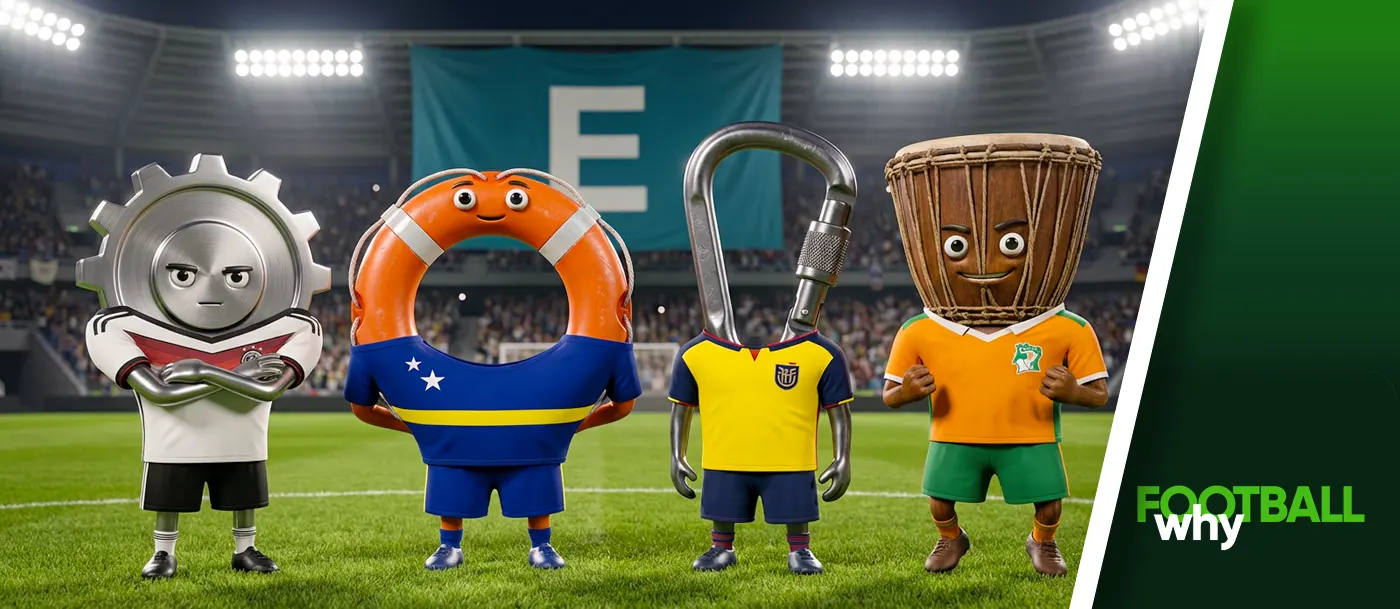
Modern life is stripped of friction, but Group E offers a glorious collision of incompatible methods. Watch methodical European procedure clash with raw African power, Caribbean cunning, and South American stoicism.
DEU • CUW • ECU • CIV World Cup | Group E | Preview Harbour Drills and Heavy Cranes in Group E
Miguel del Cosso
whyFootball group prediction
AI SIM
| # | TEAM | G | PTS |
|---|---|---|---|
|
1
|

|
7:3 | 7 |
|
2
|

|
5:3 | 5 |
|
3
|

|
4:4 | 4 |
|
4
|

|
1:7 | 0 |
How it will be?
We live in an era obsessed with smoothing out the edges. Everything from our daily commutes to our diets is fiercely optimised to avoid friction. Yet, what we secretly crave is the glorious, unscripted mess of completely incompatible methods colliding in public.
Imagine a chaotic harbour emergency drill. Germany arrives with clipboards to run incident command. They dictate the tempo and log every movement. Ecuador quietly bolts the perimeter gates shut, refusing to waste a single breath on unnecessary sprints.
Then the heavy-lift cranes swing. Côte d'Ivoire tears through the bottlenecks with sheer, terrifying athletic force. Meanwhile, Curaçao steers the nimble tugboats through the undertow, waiting for the perfect second to deliver a sharp, disruptive nudge.
It is a beautiful clash of temperaments. Methodical European procedure meets Caribbean survivalism, African surges, and South American stoicism. The result is pure, jarring theatre.
Imagine a chaotic harbour emergency drill. Germany arrives with clipboards to run incident command. They dictate the tempo and log every movement. Ecuador quietly bolts the perimeter gates shut, refusing to waste a single breath on unnecessary sprints.
Then the heavy-lift cranes swing. Côte d'Ivoire tears through the bottlenecks with sheer, terrifying athletic force. Meanwhile, Curaçao steers the nimble tugboats through the undertow, waiting for the perfect second to deliver a sharp, disruptive nudge.
It is a beautiful clash of temperaments. Methodical European procedure meets Caribbean survivalism, African surges, and South American stoicism. The result is pure, jarring theatre.
Physics vs Combinative: Blueprints against brute force
CIV
4
CUW
6
DEU
7
ECU
3
Ecuador (3) and Côte d'Ivoire (4) bring heavy lifting and bruised ribs. Germany (7) and Curaçao (6) prefer drafting blueprints. We get two bouncers trying to corner a pair of architects. Physical disruption will constantly test the passing rhythm.
Côte d'Ivoire
African power tearing down the flanks is a terrifying spectacle, but the final delivery often boils over into pure impulse. Côte d'Ivoire tends to rush the killer pass against organised defences, leading to cheap turnovers and frustrated, retaliatory fouls.
Their ultimate tactical shift would involve treating the opponent’s penalty area like a bustling Abidjan street market. In those informal economies, rushing the stall and shouting never secures the best deal.
They could empower a veteran midfielder to act as the chief negotiator, deliberately slowing the transaction until the overlapping fullback is perfectly positioned. The stars accept the delay to guarantee a higher-quality chance.
The spectacle remains, but the chaos vanishes. Fans would finally see their raw, joyous intensity paired with the quiet, ruthless control of a master merchant.
Their ultimate tactical shift would involve treating the opponent’s penalty area like a bustling Abidjan street market. In those informal economies, rushing the stall and shouting never secures the best deal.
They could empower a veteran midfielder to act as the chief negotiator, deliberately slowing the transaction until the overlapping fullback is perfectly positioned. The stars accept the delay to guarantee a higher-quality chance.
The spectacle remains, but the chaos vanishes. Fans would finally see their raw, joyous intensity paired with the quiet, ruthless control of a master merchant.
Collective vs Individual: One soloist and three choirs
CIV
6
CUW
4
DEU
3
ECU
4
Germany (3), Curaçao (4), and Ecuador (4) operate as unionised labour. Côte d'Ivoire (6) relies on leading-man inspiration. We have one flamboyant frontman facing three rehearsed backing bands. If the soloist cannot break the structure, collective weight simply swallows him.
Curaçao
Defending the penalty area against European pressing or African muscle usually turns into a frantic brawl. Curaçao often reacts by wildly hacking the ball into the stands, inviting an immediate, punishing second wave of attacks.
Their way out of the storm would be to apply their island’s strict water conservation habits directly to the football. In an environment where every drop of resources is precious, waste is a cardinal sin.
They could view a blind clearance as pouring a bucket of fresh water down the drain. Instead, they secure the loose ball, absorb the physical hit, and execute a miserly two-pass exit.
The watching world loves a plucky underdog, but they revere a poised survivor. This cold-blooded thrift would transform chaotic scrambles into sharp, stinging counter-punches.
Their way out of the storm would be to apply their island’s strict water conservation habits directly to the football. In an environment where every drop of resources is precious, waste is a cardinal sin.
They could view a blind clearance as pouring a bucket of fresh water down the drain. Instead, they secure the loose ball, absorb the physical hit, and execute a miserly two-pass exit.
The watching world loves a plucky underdog, but they revere a poised survivor. This cold-blooded thrift would transform chaotic scrambles into sharp, stinging counter-punches.
Control vs Passion: Boiling kettles and ice baths
CIV
7
CUW
7
DEU
4
ECU
6
Germany (4) desperately wants to keep the room temperature down. Curaçao (7), Côte d'Ivoire (7), and Ecuador (6) will happily let the kitchen catch fire. It places one sensible accountant among thrill-seekers. If the Europeans cannot freeze the tempo, emotional heat will melt their procedures.
Germany
When faced with stubborn Caribbean or South American barricades, German patience snaps. They suddenly start lumping hopeful, panicked crosses into the penalty area after barely three passes. It leaves their midfield completely exposed to swift counter-attacks.
Their ideal fix would be to treat the match tempo exactly like a municipal safety audit. They possess a deep cultural reverence for rigorous, unbending procedure and official certification.
They could simply appoint a designated midfield inspector with the authority to fail any rushed attack that lacks proper defensive scaffolding. A strict, bureaucratic veto on adrenaline.
Fans would stop chewing their nails at end-to-end chaos. Instead, they would witness a ruthless, wave-like suffocation. It turns anxious rushing into the terrifying, grown-up inevitability of an industrial press.
Their ideal fix would be to treat the match tempo exactly like a municipal safety audit. They possess a deep cultural reverence for rigorous, unbending procedure and official certification.
They could simply appoint a designated midfield inspector with the authority to fail any rushed attack that lacks proper defensive scaffolding. A strict, bureaucratic veto on adrenaline.
Fans would stop chewing their nails at end-to-end chaos. Instead, they would witness a ruthless, wave-like suffocation. It turns anxious rushing into the terrifying, grown-up inevitability of an industrial press.
Structure vs Freedom: Jazz solos in a factory
CIV
6
CUW
4
DEU
4
ECU
3
Ecuador (3), Germany (4), and Curaçao (4) strictly follow the floor manager’s schematic. Côte d'Ivoire (6) lets their wingers tear up the instructions. We watch a jazz musician wandering into a regulated assembly line. That improvisation can shatter rigid defensive blocks, but it leaves their own backdoor wide open.
Ecuador
Ecuador constructs a magnificent defensive shelter, but they rarely leave the porch to hunt. Against disciplined European or Caribbean blocks, their attacks stall because they refuse to commit bodies into the penalty area.
A sudden leap forward would require them to weaponise the minga — their ancient tradition of communal labour. Usually reserved for harvesting or building local infrastructure, this collective duty could easily be dragged into the final third.
They simply need to mandate that one extra midfielder joins the attack as a non-negotiable community chore. The defensive base stays firmly anchored while the collective shares the burden of finishing.
Supporters are tired of noble, scoreless draws. Sending a second wave of runners provides a bolder, opportunistic face that proves stoicism does not have to mean starvation.
A sudden leap forward would require them to weaponise the minga — their ancient tradition of communal labour. Usually reserved for harvesting or building local infrastructure, this collective duty could easily be dragged into the final third.
They simply need to mandate that one extra midfielder joins the attack as a non-negotiable community chore. The defensive base stays firmly anchored while the collective shares the burden of finishing.
Supporters are tired of noble, scoreless draws. Sending a second wave of runners provides a bolder, opportunistic face that proves stoicism does not have to mean starvation.