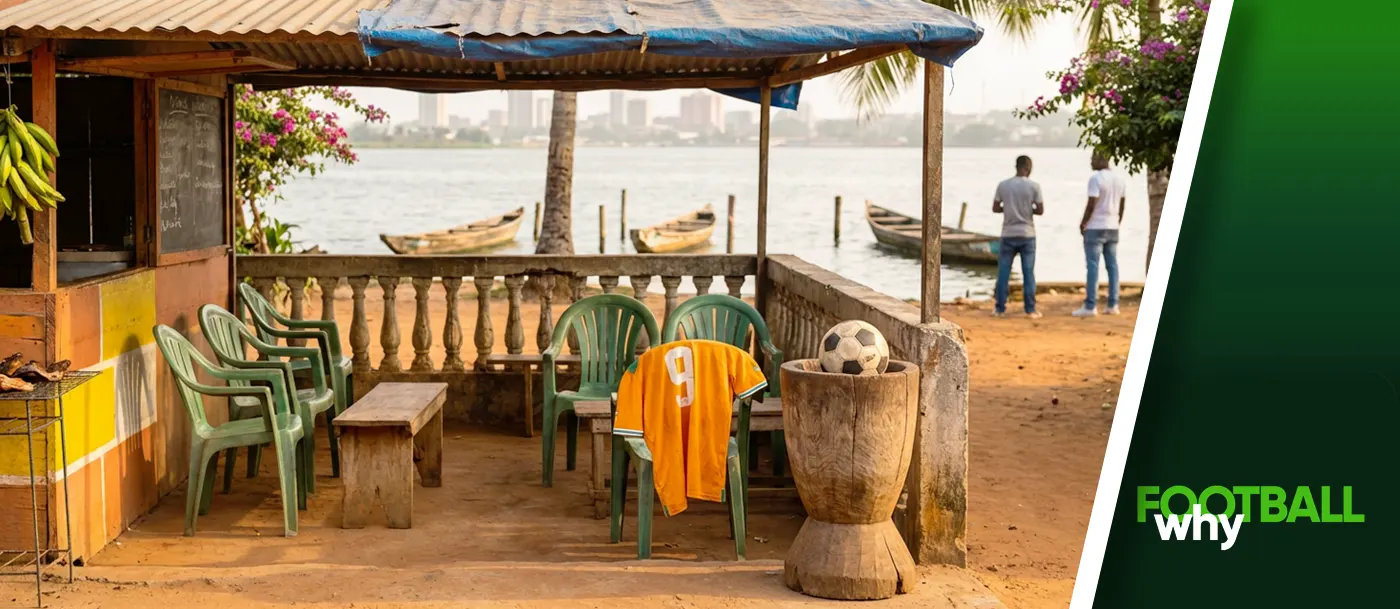
Heavy tropical heat forged a legacy where the orange shirt acts as a mandate for national peace. Yet, the exhausting weight of being emotional healers collides with their own chaotic instincts. The urge to play the lone hero constantly threatens to shatter the collective blueprint. Watch them bypass the script entirely, erupting into explosive, staccato sprints down the flanks. The storm is coming, and they intend to master it.
Team at a Glance
What do they want?
To shed their reputation for chaotic drama and secure a ruthless knockout win without giving their fans heart palpitations.
What are they strong at?
Unscripted market-hustle agility mixed with terrifying physical power. Plus a stubborn reliance on one towering target man.
What will they show?
Breathtaking, staccato wing play and explosive sprints that completely ignore the tactical script to hunt for late-game glory.
Why are they as they are?
When your history demands football acts as a peacemaker, emotional catharsis easily overrides cold tactical discipline.
What are their title chances?
12%. Very possible, provided their desperate urge to play the hero doesn't completely sabotage their own game management.
Where it hurts?
Côte d'Ivoire: current status and team news
Ermine Robes And A
Bandaged Defence
The Ivorian squad gathers like a grand parliamentary chamber settling into ancient procedural loops, masking a sudden lack of authority. Emerse Faé steps up to the dispatch box selling fearlessness. Yet, an injury crisis has quietly hollowed out the team's defensive benches just days before kickoff.
Sebastien Haller sits awkwardly in the spectator gallery, relegated to the reserve list after months of being hailed as the saviour. His absence sparks fierce debates across Abidjan about merit versus reputation. Meanwhile, Evan Ndicka nurses a hamstring strain, leaving the starting centre-back pairing entirely unresolved.
Opponents will undoubtedly target this makeshift arrangement, treating the left channel as an open invitation to bypass the ermine-draped midfield. Ousmane Diomandé is thrust into provisional command of the back line. He must rapidly establish chemistry with his full-backs to prevent runners from exploiting the space behind.
You will see a side oscillating between sweeping, aristocratic wing play and sudden, panicked retreats to protect their fragile core. Franck Kessié will cap his forward bursts to sit deeper. It is a thrilling, flawed display of raw power trying desperately to remember its own rules.
The Headliner
Côte d'Ivoire: key player and his impact on the tactical system
Serene Authority in the Box
As the chaos of the penalty area reaches boiling point, his pulse seems to drop. Sébastien Haller resolves high-stress scrambles by choosing the absolute simplest finish, projecting a serene authority that instantly settles his teammates. He acts as the ultimate anchor for the Ivorian attack — a silent wall who absorbs the frantic energy of midfield surges and redistributes it through perfectly timed near-post darts. The system relies heavily on his magnetic hold on defenders. He routinely points to his feet, holds off a centre-back with one arm, and lays the ball off to an onrushing midfielder. Without this unhurried hold-up play, wide crosses lack a definitive conversion point, and the team’s forward momentum evaporates. Defenders constantly test his durability with attritional aerial contact, raising valid fears about wear-and-tear dulling his timing. Yet, his economy of touches remains pristine. Having returned from severe illness to orchestrate a continental coronation, he stands as an optimised modern focal point, whose calm resilience commands profound respect across the global footballing landscape.
The Wild Card
Côte d'Ivoire: dark horse and player to watch
A Staccato Rhythm of Chaos
Every touch he takes generates an immediate, anticipatory hum from the stands. Simon Adingra navigates the pitch with a springy, staccato cadence, utilising micro-accelerations and hip-feints to unbalance full-backs in the tightest of spaces. He drops his shoulder, hesitates for a fraction of a second, and then explodes past his marker, translating wide isolation into genuine penalty-box chaos. This movement draws multiple defenders, which frees up the central striker and late midfield runners. If his initial duels fail, a lingering habit of slipping into tunnel-vision dribbling occasionally surfaces, causing him to lose the wider tactical picture. Opponents will undoubtedly attempt to show him the touchline, doubling up early to block his lethal cut-back lanes. Yet, when he successfully isolates his man, his explosive first ten metres turn static possession into high-yield scoring chances, promising a spectacular display of joyous, unpredictable wing-play on the global stage.
The Proposition?
Côte d'Ivoire : Tactical guide - how to identify their movements and game variations on the pitch
Assertive Wing Power
on a Razor's Edge
The defending continental champions arrive with a clear mission: restore absolute trust after their recent quarter-final crash in Agadir and present a rebooted, ruthless version of themselves for the World Cup. Emerse Faé’s side is built on high-press, width-first dominance. Maintaining this aggressive tempo without suffering the concentration slippages and game-management lapses that haunt them under knockout stress forms their central tactical challenge.
Faé deploys a 4-3-3 that aggressively morphs into a 4-4-2 press out of possession. They rely heavily on a single pivot for circulation, allowing their wingers and fullbacks to stretch the pitch with an assertive tempo.
What to look at: If the defensive line holds high and the ball-near winger steps onto a centre-back within the first ten minutes, forming a front two, the Ivory Coast is compressing the build-out. They are forcing rushed long balls to capture second balls and set up early wide isolations.
This aggressive setup is designed to isolate dynamic wingers like Simon Adingra or Amad Diallo. The primary attacking vector flows through these wide channels, using the single pivot to find players on the half-turn.
What to look at: If Adingra receives the ball on the touchline with Ghislain Konan overlapping, or if the holding midfielder bounces a third-man pass into Franck Kessié, expect a rapid cut-back to the penalty spot or a near-post dart toward the striker.
The entire system hinges on the physical pull of their reference number nine, Sébastien Haller. He pins the centre-backs, stabilises the first contact, and dictates the timing of the midfield runners.
What to look at: When Haller receives the ball, watch the wide men immediately widen their lanes. If Amad or Adingra trigger an early delivery and the opposition centre-backs step up to compress, a pocket opens at the top of the box for Kessié to strike a second ball.
To facilitate this, the team fluidly alters its shape in possession. The right-back toggles between tucking in and overlapping, while the holding midfielder drops to form a secure base.
What to look at: If Ibrahim Sangaré drops to split the centre-backs or Wilfried Singo tucks in to create a back three during the build-up, they are bypassing the first line of pressure to isolate Adingra one-on-one while maintaining cover against direct counters.
However, this width-first aggression carries a severe price. The space behind the advanced full-backs and around the single pivot is frequently exposed, leading to variable compactness between the lines.
What to look at: If an opponent breaks the counter-press and hits a fast diagonal ball behind Konan or Singo, the rest-defence stretches violently. The left centre-back is dragged wide, opening a lethal cut-back lane across the six-yard box — the exact pattern that destroyed them in Agadir.
When the game demands preservation, Faé is pragmatic, shifting into a survival block.
What to look at: If the block drops deep after the 70th minute and the full-backs completely halt their overlaps, the Ivory Coast is conceding territory to gain box density, trading possession for time management and accepting direct counters to the striker as their only outlet.
Despite the defensive tightrope, the Elephants remain a thrilling spectacle. Their sheer physical power, combined with the electric, improvisational genius of their wingers, guarantees a breathtaking, high-octane display on the global stage.
The DNA
Côte d'Ivoire: football's importance and what we will see in their game at the 2026 World Cup
The Market Confederacy and
the Peacemaker's Momentum
Step into the sprawling Adjamé market in Abidjan at midday. The tropical heat feels physically heavy, slicking the skin with sweat, while the sheer volume of humanity overwhelms the senses. Navigating this maze with a rigid, pre-planned itinerary is impossible. A local buyer dodges a speeding handcart, bargains for yams with three different vendors simultaneously, and reads the crowd's shifting mood to secure a deal. Status here belongs exclusively to the person who adapts fastest and delivers a tangible, immediate gain.
Inside the national team’s dressing room, the coaching staff mirrors this exact logic. Rather than handing out exhaustive, fifty-page tactical dossiers, the manager stands before the squad demanding visible courage to win the immediate physical duel.
On the pitch, this market agility translates into unscripted, vertical power. Facing a compact defensive block, the players refuse to circulate the ball in endless, repetitive passing loops. A winger simply bypasses the script, dropping a shoulder and utilising staccato hip-feints to shatter the defensive line before feeding rapid diagonals into a powerful target striker.
Global audiences watching these frantic surges often miss the profound moral weight woven into the orange shirt.
During the bitter civil conflicts of the 2000s, football became a vital tool for national truce. When a fierce dispute erupts between neighbours today, the immediate response is rarely calling a distant, faceless magistrate. The neighbourhood summons a charismatic local elder. The community gathers in the humid evening air, demanding a visible, emotional display of reconciliation to restore the collective peace.
Before a match, the captain stands in the centre of the locker room, looking teammates in the eye, appealing directly to this mythos. He frames the upcoming ninety minutes not as a sporting exercise, but as a moral mandate to heal the country.
Consequently, the team surfs on pure emotional momentum. Trailing by a goal, the response is rarely a quiet tactical shift. Propelled by the roaring, drum-fueled chants from the terraces, players launch themselves into broken-field exchanges, desperately hunting cathartic turnarounds.
This emotional overreach explains why their game-management often fractures late in tournaments, perfectly illustrated by their recent quarterfinal exit against Egypt. The powerful urge to play the hero frequently overrides the tactical structure.
A quiet counter-movement is now brewing. European-schooled leaders and a data-literate staff are actively injecting strict rest-defence protocols during training camps, attempting to fuse this improvised brilliance with cold knockout maturity.
True strength lies not in avoiding the chaos of the storm, but in navigating it with enough fearless flair to make the ancestors proud.