

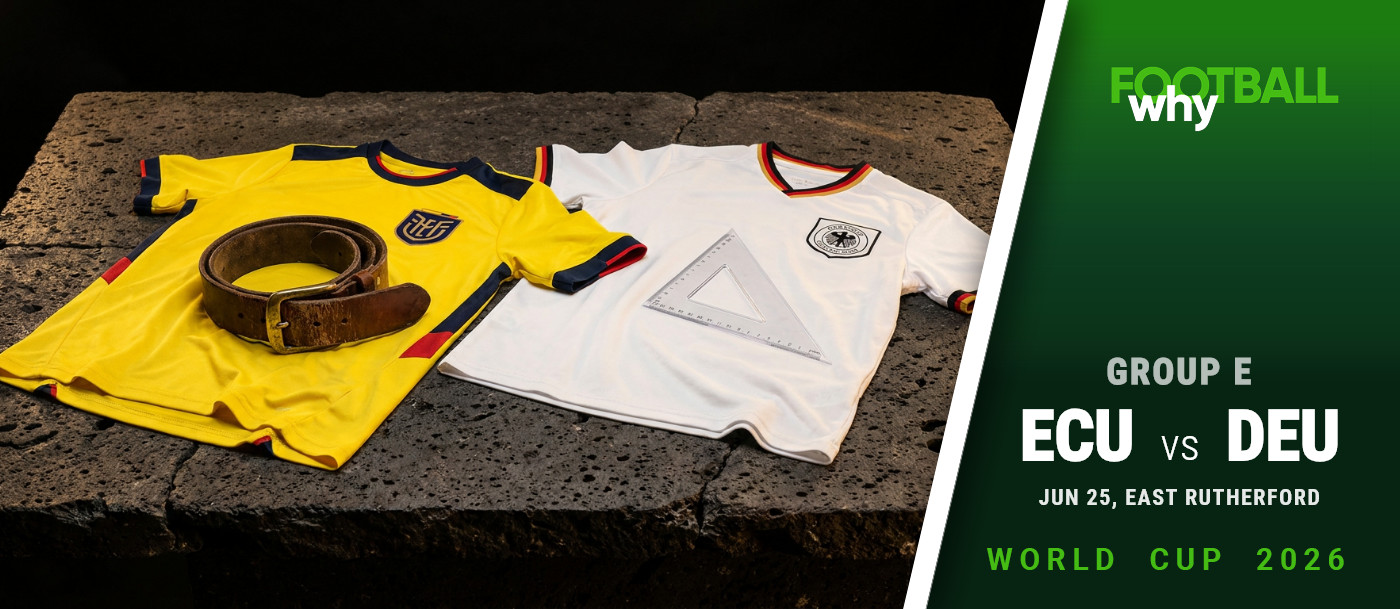
The World Cup Qualification Decider
Thursday, 25 June

MetLife Stadium, East-rutherford

Ecuador vs Germany FIFA World Cup 2026 Group Stage Match Unbolting the Engine on a Gravel Driveway Forecast generated:

Germany paraded 61 percent possession, but Ecuador unbolted their pristine engine on a driveway of pure friction. Discover how a 77th-minute corner left Manuel Neuer stranded and tore up the tactical blueprints.
Ecuador vs Germany Structural Collision

What was it?

The afternoon felt like dragging heavy tweed through a briar patch. Germany started with procedural perfection, scoring inside two minutes when Leroy Sané finished a crisp right-sided routine. Yet the pristine engineering was immediately stripped for parts. Nilson Angulo equalised seven minutes later after Pedro Vite forced a turnover high up the pitch.

Viewers hoping for tactical fluidity missed an hour of glorious, attritional vandalism. Ecuador simply unspooled the European rhythm through sheer friction. Alan Franco and Piero Hincapié collected bookings while stalling the midfield to a crawl. The visitors held 61 percent possession but generated mostly harmless lateral passes. Julian Nagelsmann attempted to bypass the congestion by shifting to a back three on the hour mark.

Then came the fatal miscalibration. Nagelsmann withdrew Florian Wirtz, snapping his own thread of creativity. Four minutes later, Ecuador struck. A rehearsed corner saw Kevin Rodríguez flick the cross onward. Manuel Neuer hesitated in the crowded penalty area like a tourist caught in a postal sorting office, allowing Gonzalo Plata to toe-poke the winner. The final whistle brought a roar of pure, exhausted validation for the collective.

How did they clinch it?

Ecuador

The Ecuadorian victory stemmed from a pragmatic refusal to engage in a sterile possession contest. By deliberately fragmenting the rhythm and initiating aggressive duels, they denied the opposition the clean passing lanes required to function.

This tactical friction was entirely intentional. The coaching staff prioritized defensive compactness over expansive aesthetics, accepting that pressing triggers in wide areas offered higher leverage than central combinations.

Without a reliable, high-volume central striker, the technical team recognized that open-play chance creation would be scarce. Consequently, they shifted the attacking burden onto highly rehearsed set-piece routines and rapid, vertical transitions.

This approach perfectly mirrors the current generation's profile. The squad is increasingly populated by European-based athletes who combine intense physical conditioning with acute tactical discipline, blending continental rigor with their innate collective duty.

Crucially, they no longer rely on the historical crutch of high-altitude home fixtures to exhaust opponents. Instead, they leverage a rugged, export-driven resilience that travels well across any stadium.

The domestic academies are producing positionally versatile defenders who understand how to suffer without breaking. This allows the collective to absorb sustained pressure while waiting for the precise moment to execute a counter-surge.

Ultimately, it was a victory of communal labour over imported theory. They reinforced their perimeter like an impenetrable thicket, proving that synchronized grit will always dismantle a sterile blueprint.

Why not go for the win?

Germany

Germany’s inability to secure the match was rooted in a profound discomfort with uncertified chaos. Once the initial procedural dominance was disrupted by physical friction, the structural framework began to buckle.

In-game adjustments actively worsened the situation. The shift toward a back three was designed to restore territorial authority, but it inadvertently hollowed out the central progression zones.

Pushing wingbacks high without maintaining elite half-space connectors left the side reliant on predictable wide deliveries. This tactical pivot exposed a glaring squad deficiency: the absolute absence of a dominant, traditional penalty-box focal point.

When trailing, the team defaulted to crossing into congested areas. However, without a recognized target man to occupy the center-backs or contest aerial duels, these actions became mathematically inefficient.

This is a direct consequence of a systemic developmental bias. The national academy infrastructure has spent a decade perfecting the production of versatile, positionally fluid attacking midfielders.

While this unified curriculum creates highly intelligent technicians, it has systematically eradicated the classic, physically imposing striker from the talent pipeline. The system values possession metrics over raw penalty-box instinct.

Consequently, when the game state demands blunt force rather than intricate calibration, the players look toward the touchline for a tactical manual that no longer applies.

They became victims of their own exacting standards. The machinery seized up precisely because it lacked the loose tolerances required to survive an unscripted street fight.

Match hero...

Pedro Vite
Pedro Vite operated as the tireless foreman of a collective harvest. While others provided the finishing touches, his nine tackles and two interceptions anchored the heavy lifting. He possessed the 'más pilas' opportunism to recognize exactly when the German passing circuits were vulnerable, triggering the press that yielded the equalizer. Vite saw the structural arrogance in the opposition's build-up and simply outworked it, turning communal sweat into tangible leverage.

...and one more

Florian Wirtz
Florian Wirtz functioned as the sole certified calibrator in a system rapidly losing its procedural grip. Before his withdrawal, he consistently found the microscopic tolerances within the South American defensive block. His spatial awareness allowed him to slip into the half-spaces, providing the precise schematics necessary to unlock a deep defense. Wirtz did not just pass; he audited the spatial gaps, proving that true mastery lies in navigating the chaos rather than stubbornly ignoring it.