

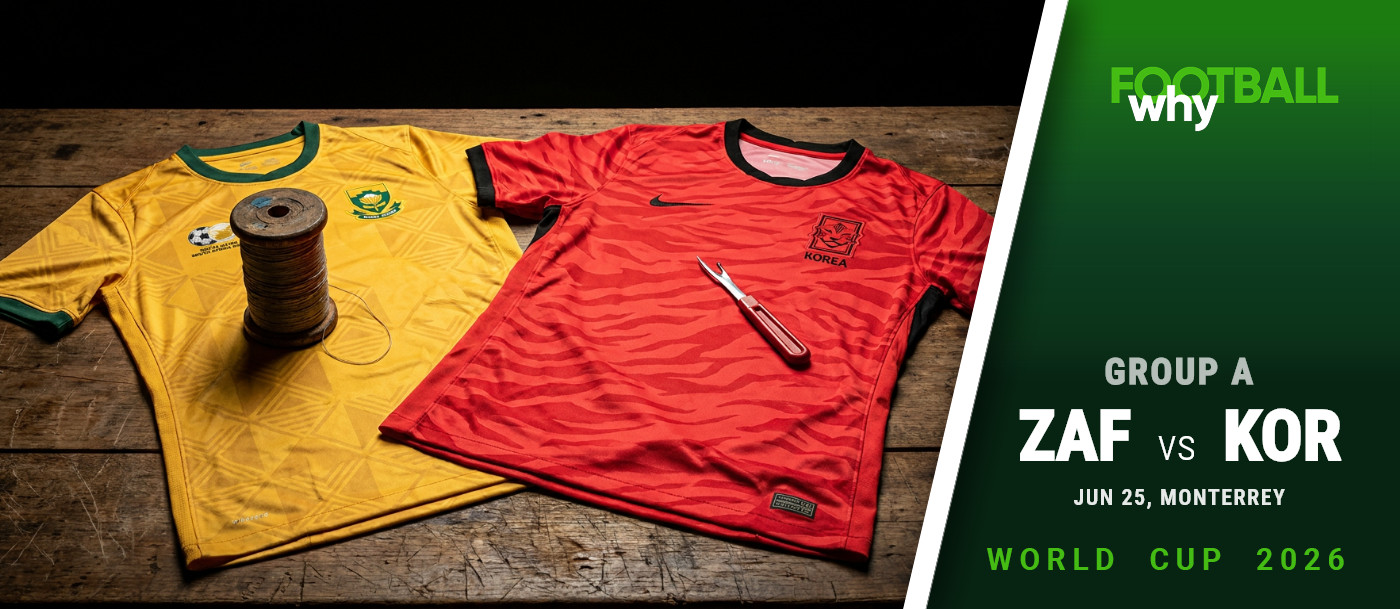
Group A, Matchday 3, Match #54
UTC

Estadio BBVA, Monterrey

Prediction by whyFootball readers

ZAF
DRAW
KOR
18%
25%
57%
Not a recommendation for betting
Tap [+] to cast your expert forecast.
SCORE BY AI PREDICTION: 0:2 SEE SIMULATION

South Africa vs South Korea FIFA World Cup 2026 Group Stage Match The Desperate Unstitching of a Heavy Communal Seam Forecast generated:

A fascinating collision of cultural imperatives awaits. The communal, survivalist spirit of the Stokvel faces the unrelenting, high-speed mandate of an anxious hierarchy. It is a raw test of collective neighbourly resilience against the clinical, unforgiving weight of public expectation.

South Africa: One side's prayer...

South Africa approach this final group fixture with their bags packed but their pride heavily bruised. Eliminated after two defeats, the mandate is simply to avoid a closing humiliation. The squad is largely fit, with Ronwen Williams ready to anchor the defence and Teboho Mokoena managing his temperament after earlier booking scares. Unburdened by qualification anxiety, they will focus on stitching their defensive ranks tightly together, aiming to frustrate a desperate opponent and salvage some quiet dignity before the flight home.

South Korea: ...head-on with the other.

South Korea arrive at the absolute wire, requiring not just a victory, but a multi-goal margin to secure progression. The public mood in Seoul is mutinous, leaving the squad under suffocating scrutiny. While Son Heung-min is fully primed, both Hwang Hee-chan and Hwang In-beom are carrying minor knocks, meaning their minutes must be managed carefully. They have no choice but to crank the offensive pressure valve to its absolute limit from the first whistle, knowing any hesitation will result in a catastrophic early exit.
South Africa vs South Korea Structural Collision

South Africa: How we will host...

Dream
The tournament is effectively over, but dignity is still firmly on the table. Amidst the usual administrative noise back home, the absolute baseline is avoiding a humiliating collapse and putting points on the board. They desperately want to leave the pitch with their pride intact.

Strength
Their resilience comes from a deeply ingrained, collective familiarity. Built heavily on a domestic club core, they play like a group of neighbours who know exactly how to cover each other's shifts. This peer-validated structure is anchored by an ice-cold, commanding goalkeeper.

Plans
The manager intends to clog the edge of the penalty area to stop the opposition's trademark cutbacks. When they win the ball, the idea is to bypass the midfield scrap entirely, launching quick, disguised passes into the spaces left by overlapping full-backs.

Fears
The creeping dread is their vulnerability to a high-speed, coordinated press. If the opposition turns up the heat and forces early turnovers, the team's pragmatic shape could easily fracture under the pressure, leading to the exact sort of chaos they want to avoid.

South Korea: With what we arrive...

Dream
The mandate is blunt: win, and win by a margin. With qualification hanging on goal difference and public scrutiny at a fever pitch back home, they need a commanding performance to silence the noise and validate their status.

Strength
Their core asset is a drilled, industrious collective ethic paired with elite European experience. They operate with a strict vertical hierarchy, executing high-speed, patterned transitions that funnel the ball directly to their star finishers with mechanical precision.

Plans
The strategy involves relentless micro-rotations to unpick the opponent's defensive seams. They will push their wing-backs high to deliver waist-high cutbacks from the byline, while maintaining a rigid five-man defensive structure behind the ball to sweep up any loose counter-attacks.

Fears
The anxiety lies in their response to frustration. If the breakthrough doesn't arrive early, their deference to hierarchy can lead to a lack of improvisation, resulting in rushed clearances and a desperate over-reliance on their captain to pull off a miracle.

How it will be...

The contest should resemble a high-pressure valve testing a rather battered, communal dam. South Africa will likely hunker into a compressed mid-block, prioritising peer-validated solidity over expansive risk. Their defensive scheme hinges on denying the half-spaces, effectively daring their opponents to navigate the crowded flanks.

South Korea will answer with a mandate of rapid, patterned acceleration. We might witness Lee Kang-in threading disguised, low-trajectory passes into the penalty area, seeking Son Heung-min's darting, diagonal runs. The Asian side's hierarchy demands swift execution rather than lingering possession. They will repeatedly probe the seam behind the African left-back.

A sudden fracture could occur if Ronwen Williams spills a heavy shot into the central slot, testing his defenders' fatigue. Should South Korea force an early concession, the African side's Ubuntu-led composure might unravel into disjointed, desperate chasing. However, if the Korean forwards snatch at their chances, their own public anxiety could bleed onto the pitch, sparking frantic, unscripted chaos.

South Africa: Why not go for the win?

South Africa succumbed because their stoic barricade eventually ruptured at the seam between full-back and midfield. Once breached, they were compelled to abandon their safety-first shape to chase parity. This exposed a fundamental dearth of elite chance creation, leaving them fatally open to clinical counter-pressing.

South Korea: How did they clinch it?

South Korea triumphed by ruthlessly executing their drilled, byline-seeking patterns. They exploited the wider channels to engineer the crucial opening goal, forcing the opposition to stretch. From there, their elite European pedigree surfaced, punishing disjointed defensive lines with rapid transitions while maintaining an impenetrable rearguard shape.

Secret mastermind intent

Hugo Broos pulling the community shutters firmly down

General Strategy
Hugo Broos is setting up a pragmatic mid-block, initiating engagement around 40 yards from their own goal. The primary objective is to keep a clean sheet, frustrate the opposition, and avoid overexposure.

They want to avoid any chaotic phases. It is a sensible, safety-first approach designed to weather the storm and keep the structural seams tightly stitched together as the match progresses.
Antidote for the Opponent
Defensively, the focus is entirely on denying space in the half-spaces and blocking cutback lanes at the edge of the box. The holding midfielder will step tightly onto the Korean pivot to disrupt their passing rhythm.

In attack, the plan targets the space left behind the advancing Korean wing-backs. Broos wants his wingers to attack the seam between the full-back and the wide centre-half immediately upon regaining the ball.
Internal Task Solving
The team will rely heavily on pre-rehearsed set-piece routines to generate a tangible threat. There is a green light for specific long-range efforts from short corners to catch the opposition off guard.

They are also leaning into their goalkeeper's exceptional distribution. Disguised long drop-kicks, delayed to allow forwards to separate, serve as a vital pressure valve when the midfield gets bogged down.
Crisis Response Plans
If the opposition wing-backs manage to pin the South African wingers deep, Broos is prepared to shift into a flat five-man defence. This temporary measure is designed to absorb pressure and crowd the penalty area.

The manager is willing to sacrifice attacking width to ensure survival during heavy onslaughts. It is essentially throwing a heavy blanket over a grease fire until the immediate danger passes.
Specific Match Orders
Ronwen Williams (Goalkeeper): Delay the restarts to kill the tempo when we have the ball. Disguise the long drop-kick to the left channel after a slow count of three, giving the winger time to find space. Teboho Mokoena (Midfielder): Step immediately onto the opposition pivot's receiving foot to smother their buildup. In possession, avoid speculative long shots unless the area is clear; look for cutbacks and second balls. Relebohile Mofokeng (Winger): Attack the gap between their wing-back and wide defender on your first touch. Cut inside to deliver low crosses along the ground, and bait contact to win set-pieces near the box.
/ What if an early goal is conceded?

The immediate response is to drop the tempo completely. The team will take a minute or two of slow restarts, gather for a captain-led huddle to re-establish the mid-block, and hit direct passes to the corners to reset the territory.

/ What if the opposition star moves centrally?

If the main attacking threat drifts inside, the holding midfielder will adopt a partial man-marking role, handing him off to the nearest centre-back when necessary. The winger on that side will narrow his position to maintain a numerical advantage in the middle.

Secret mastermind intent

Hong Myung-bo tightening the tactical ratchet

General Strategy
Hong Myung-bo is deploying a mid-high press designed to suffocate the opposition early on. The focus is on generating a high volume of chances while ensuring the rest-defence remains absolutely watertight to prevent cheap run-outs.

It is a high-tempo, duty-first framework. The manager expects his players to execute their drilled patterns rapidly once they enter the final third, turning possession into clinical, high-percentage shots.
Antidote for the Opponent
The primary attacking vector targets the space behind the opposing left-back. The star forward will drift inside to pin the centre-half, deliberately opening the corridor for the wing-back to exploit with late, surging runs.

Defensively, they will aggressively shadow the opposition's deep-lying playmaker on second balls. By denying him time to turn, they intend to force the goalkeeper into predictable, long clearances that the Korean centre-backs can easily mop up.
Internal Task Solving
A crucial element is the use of pre-coded tactical triggers. A specific call from the bench will instruct the front five to lock into a frantic, five-minute pressing surge to force a mistake.

Furthermore, a dedicated analyst will monitor the other group game live. The team's risk appetite — whether to chase more goals or protect the lead — will be dynamically adjusted based on those external calculations.
Crisis Response Plans
If the opposition retreats into a deeply entrenched five-man defence, the team is prepared to shift into a highly aggressive 3-2-5 formation. This involves inverting the weak-side wing-back to create overwhelming central overloads.

Should that fail to break the deadlock, they will revert to a standard 4-2-3-1 to re-establish width. It is a systematic escalation, methodically applying different tools to crack a stubborn safe.
Specific Match Orders
Kim Min-jae (Defender): Carry the ball into midfield if the opposition striker refuses to press, then hit flat, diagonal passes behind their left-back. On set-pieces, isolate yourself at the back post against their weakest aerial defender. Son Heung-min (Forward): Start on the left but constantly rotate into the right half-space to find room. Use maximum two touches when congested, and prioritise early, low crosses across the six-yard box over dribbling into crowds. Jo Hyeon-woo (Goalkeeper): When pressed, distribute diagonally to the wing-backs only; avoid punting the ball centrally into their centre-backs. Restart play rapidly after clearing their set-pieces to catch them out of shape.
/ What if they concede against the run of play?

The protocol is to instantly toggle to a 4-2-3-1 shape for ten minutes to stabilise the midfield. They will then execute a pre-scripted set-piece sequence within five minutes to forcibly wrench momentum back their way.

/ What if the live group standings demand a wider margin?

If goal difference becomes critical, the manager will authorise an all-in surge. A second striker will be introduced, both wing-backs will be permanently fixed high up the pitch, and they will flood the penalty box while leaving only three men back.

MAIN SIMULATION 0'-25'

South Korea will likely establish a mid-high press from the off, rotating Son Heung-min and Lee Kang-in to prize open South Africa’s compact mid-block. The African side will respond by dropping Teboho Mokoena onto Hwang In-beom, effectively cutting the power to Korea's main midfield engine. Denied easy central progress, Korea will funnel play wide, attempting to exploit the space behind left-back Aubrey Modiba. South Africa will sit deep, plugging the cutback lanes and relying on Ronwen Williams to launch disguised long balls. The shape holds. It’s a tactical stalemate.

MAIN SIMULATION 25'-45'

The pressure will eventually tell. Korea will accelerate their patterns down the right flank. Centre-back Kim Min-jae will step into midfield to fix a marker, releasing wing-back Seol Young-woo on an underlapping run. Seol will deliver a cutback for Hwang Hee-chan to finish first-time. It’s a drilled, mechanical sequence. South Africa won't panic after conceding. They will drop the tempo, use tactical fouls to break the rhythm, and look to force corners to reset the territory.

MAIN SIMULATION 45'-65'

Korea will look to kill the game with a five-minute surge straight after the break, bombarding the penalty area. Williams will be forced into a string of crucial saves to deny Lee Kang-in and Son. South Africa will try to push back, occasionally shifting to a two-striker system to chase the game. However, Korea will aggressively foul high up the pitch to stop any breakaways before they start, while man-marking Mokoena to stifle the African side's distribution. The game becomes a gritty slog.

MAIN SIMULATION 65'-90'

Chasing the game, South Africa will stretch their shape, committing bodies forward and leaving gaps. This late-phase desperation plays into Korean hands. From a swift counter-press on 74 minutes, Lee Kang-in will slide a pass through the disjointed defence for Son to finish across the goalkeeper. With the two-goal cushion secured, Korea will shut up shop, dropping into a back five to protect their lead. South Africa will continue to swing crosses in, but without the precision to trouble a set defence.

And it will come to...

If the game follows the script, South Korea’s drilled, patterned attacks will eventually grind down South Africa’s stubborn resistance. The African side would rely on collective discipline and their goalkeeper, an honest but limited approach. Korea would likely find the breakthrough via their trademark wide cutbacks, before sealing the win on the counter-attack as South Africa are forced to open up. It’s a probable victory for systemic precision over spirited, but blunt, defiance.
end of Game