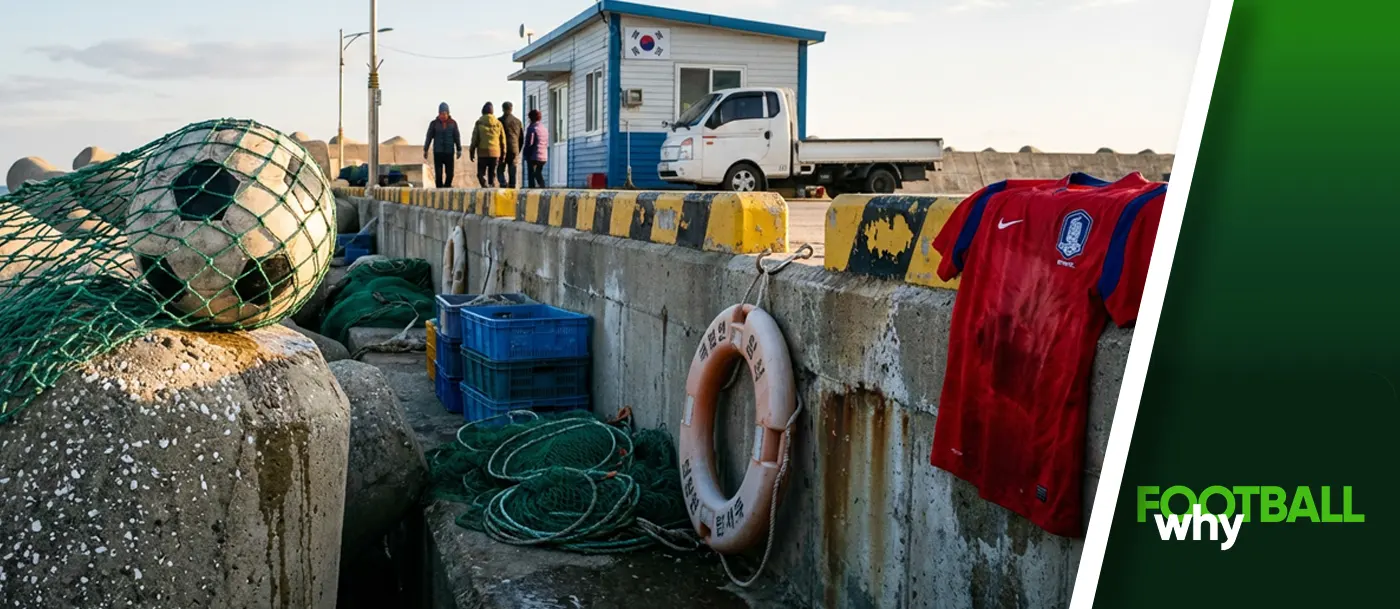
Synchronised drumbeats echo across monsoon-slicked grass, demanding absolute perfection. They carry the exhausting legacy of an industrial miracle where endurance is a civic duty. Now, paralyzed by boardroom scandals and terrified of public shame, the collective suffocates its own creativity. Yet, watch them swarm as a single, breathless organism to trap their prey. The machine will run relentlessly, waiting for a lone star to ignite.
Team at a Glance
What do they want?
To silence domestic boardroom scandals by proving their robotic endurance can actually produce a World Cup semi-final.
What are they strong at?
Terrifyingly synchronised wave pressing, fuelled entirely by a deep, collective fear of stepping out of line.
What will they show?
A flawlessly shifting defensive block that runs for ninety minutes, desperately praying their captain scores a worldie.
Why are they as they are?
Decades of corporate hierarchies and military conscription forged a squad that views improvisation as absolute treason.
Chance of winning the title?
5%. Completely guaranteed if their European-based forwards can somehow play all eleven positions simultaneously.
Where it hurts?
South Korea: current status and team news
Creaky Floorboards and
Headmaster Edicts
South Korea lines up for morning assembly with perfectly pressed uniforms, desperately trying to ignore the headmaster’s pending resignation. Qualification arrived smoothly last summer, yet a lingering administrative hangover overshadows their journey to Guadalajara. The public demands a modern, merit-based syllabus rather than out-dated tactical lectures.
Whispers of rebellion echo across the assembly hall regarding the stubbornly retained three-man defence. The hashtag #축협OUT circulates fiercely online as fans protest the omission of Lee Seung-woo. Hong Myung-bo stands rigidly at the lectern, insisting high-altitude friendlies in Utah will validate his deeply unpopular defensive blueprints.
Opposing teams will immediately test the creaky floorboards out wide, dragging wing-backs out of position before attacking the empty space. Jens steps in as a naturalised prefect to police these vulnerable flank corridors. His presence provides essential transition cover, though purists question this reliance on imported discipline.
Kim Joo-sung’s knee injury leaves a glaring vacancy in the backline seating chart just days before the opener. Lee Ki-hyuk takes the empty chair as emergency depth, tasked with sweeping up messes when the shape collapses. Meanwhile, late arrivals Son and Lee Kang-in must instantly memorise the revised routines.
Global spectators will watch a deeply respectful collective running themselves into the ground to protect their shared dignity. The players will absorb heavy pressure before launching sudden, breathless sprints towards the opposition goal. It is a beautiful, exhausting display of human devotion pushing back against institutional noise.
South Korea: key player and his impact on the tactical system
Kinetic Precision in the Half-
Spaces
Diagonal out-to-in surges across the half-spaces define the absolute sharpest edge of the South Korean attack. Before the ball even arrives, Son Heung-min adopts a coiled-spring stance, ready to launch into the blindingly fast transitions that terrify elite defensive lines.
He converts low-margin breaks into high-yield strikes through an utterly ruthless, two-footed finishing technique. His initial touches are deliberately deceptive. He shifts instantly from a controlled, upright glide into a sudden blur of unyielding shot-power, punishing anyone caught ball-watching.
When the tactical structure bends under elite opposition, he channels the rising pressure into disciplined execution rather than erratic heroics.
The squad actively utilises his raw pace to stretch the pitch, relying heavily on his late-game dead-ball bite to salvage stalled possessions. Yet, the immense cumulative mileage of constantly carrying these decisive moments exposes him to severe fatigue and form-variance during dense tournament schedules. Through sheer technical refinement and his trademark arms-wide sliding celebrations, he has forged a legacy as a world-class predator carrying a nation's heavy expectations with remarkable grace.
The Wild Card
South Korea: dark horse and player to watch
Sleight of Hand and Tempo
The trajectory of the delivery always seems to arrive a fraction late, deliberately evading the opposition's zonal timing. At twenty-five, Lee Kang-in manipulates the entire match tempo from the right half-space, operating with an upright carriage and constantly scanning eyes.
He receives the ball on the half-turn, employing a sudden, sharp hip-feint before threading disguised left-foot through-balls that instantly unjam congested central lanes.
This specific creative profile seamlessly binds a mobile forward line and massively elevates the squad's dead-ball threat. To neutralise his constant orchestration, opposing managers must instruct their players to physically deny his half-turns immediately. They have to shade him inside and deploy a dedicated, mobile tracker to aggressively monitor his blindside.
If the spatial geometry collapses around him, he faces the genuine danger of over-elaboration, occasionally retreating into safer, lateral passing choices.
Yet, when the rhythm flows, his dipping outswinging crosses and audacious final-third entries dictate the entire attacking sequence. The upcoming tournament offers the perfect canvas for this left-footed maestro to completely monopolise chance-creation against the world's elite.
The Proposition?
South Korea : Tactical guide - how to identify their movements and game variations on the pitch
Three-Back Stability and the Left-
Lane Funnel
The immediate objective for South Korea at the 2026 World Cup is forging a stable three-back identity capable of surviving immense knockout stress. The central conflict lies in balancing this defensive solidity against a persistent midfield underload, all while attempting to insulate the squad from a deeply hostile domestic mood.
Manager Hong Myung-bo, frequently projecting a stoic, arms-folded presence on the touchline, relies on a 3-4-2-1 base that morphs into an aggressive 3-2-5 in possession.
What to look at: If the opening fifteen minutes feature the defensive line dropping below the halfway line and the team settling into a compact 5-4-1 block, they are deliberately laying a trap. They want to funnel the opponent’s build-up toward the touchlines, fiercely protect the central area directly outside their penalty box, and prepare for wide regains to instantly launch Son Heung-min down the left-inside transition lanes.
When building from the back, the first line of progression hinges entirely on the centre-backs taking initiative.
What to look at: If midfielder Paik Seung-ho drops between the centre-backs while Kim Min-jae steps forward into the left half-space with his head up, South Korea is bypassing the first line of pressure. This specific movement opens a clean diagonal passing lane to Lee Kang-in in the right half-space while maintaining a secure rest-defence behind the ball.
Once the ball crosses halfway, the attack relies heavily on wide-to-inside passing chains to physically stretch the opposition.
What to look at: If the ball-carrier pauses to draw pressure just past the halfway line, watch Lee Kang-in check into the right half-space pocket while Son Heung-min pins the far centre-back and curves into his blindside. The team is trying to slip a diagonal pass to Son for an across-goal finish or deliver a waist-high cutback to late arriving runners.
Everything in the final third revolves around isolating their premier attacker.
What to look at: Upon Son taking his first touch facing forward in the left half-space, the left wingback will completely freeze his run to hold the width, while the striker drops to screen. They actively drag the opposition right-back out of position, creating a pure 1v1 isolation for Son or a free underlapping lane for Seol Young-woo.
When the system is forced into survival mode, Hong immediately signals a retreat.
What to look at: If the defensive block drops entirely into their own third and the pressing shifts to a passive wait-and-react stance, they are ceding territory to pack the penalty box. Goalkeeper Jo Hyeon-woo will begin prioritising long, diagonal clearances specifically to bleed the clock.
However, this 3-4-2-1 system carries a heavy structural price against elite, possession-heavy midfields.
What to look at: If an opponent pins the near-side wingback high and executes a rapid switch of play, the wide centre-back is left completely isolated in a 1v1 footrace. Because the double-pivot is already engaged centrally, a delayed recovery leaves the cutback lane at the penalty spot totally unprotected.
Despite these transitional vulnerabilities, sheer defensive discipline and undeniable attacking genius ensure South Korea remains a lethal, highly organised threat capable of dismantling elite opponents on the counter.
The DNA
South Korea: football's importance and what we will see in their game at the 2026 World Cup
Corporate Rhythms on a Monsoon-
Slicked Pitch
Humid summer air presses down heavily on the monsoon-slicked grass. From the stands, the synchronised beat of the 'Dae-han Min-guk' drum cadence echoes from the Red Devils supporters. It is a flawless, hypnotic rhythm. Yet, during a recent goalless draw against Palestine, that same drumbeat felt like a metronome ticking toward systemic collapse, spawning a flood of "Dark Era" internet memes across domestic social media.
South Korean pressing operates as a strict moral duty rather than a simple tactical instruction. In a society historically shaped by mandatory military conscription and the highly synchronised project sprints of Chaebol corporate hierarchies, coordinated order ensures collective survival. A player simply does not step out of line.
On the pitch, this cultural blueprint manifests as aggressive wave pressing. When an opponent receives the ball, the Korean block shifts rapidly, boots splashing on the wet turf as they move as a single, breathing organism to trap the ball-carrier against the touchline.
However, this mechanism requires absolute, unquestioning compliance. If one midfielder decides to break protocol and gamble on an unscripted, individual interception, the geometric shape shatters immediately. The rest of the team cannot cover the sudden gap, and the defensive structure collapses — a vulnerability brutally exposed when Brazil tore through their disjointed lines in a heavy 5-0 thrashing.
Currently, this fear of breaking shape is amplified by boardroom chaos. The national federation is navigating intense parliamentary grillings and ministry probes, creating an environment heavy with opacity and distrust.
When players sense this institutional instability, their aversion to losing possession spikes dramatically. They instinctively retreat into a compact defensive block. Defenders clear the ball long into the stands first and ask questions later, terrified of making a visible error that will invite a vicious media pile-on.
To bypass this rigid, risk-averse caution, the domestic system completely outsources its creativity to a few European-based elites. The collective midfield engine runs the gruelling marathon, but they rely almost exclusively on Son Heung-min to provide the lethal vertical surge into the box.
It is an uneasy marriage: a domestic engine built on post-war industrial endurance, waiting for a foreign-honed star to deliver the final product. When opposing defenders cut the passing lanes to that star, the team endlessly recycles the ball across the halfway line without ever threatening the penalty area.
The tension between demanding modern, proactive football and aggressively punishing any deviation from the collective script carries a heavy emotional toll. After the final whistle, a player simply bows deeply to the stands, wipes the sweat from his forehead, and trusts that enduring the gruelling shift alongside his teammates remains the only honourable way to weather the storm.