
South Africa (Bafana Bafana) - National flag

South Africa National Football Team

Bafana Bafana

What to look for?

The heavy echoes of isolation and the golden memories of a unified nation still reverberate through the dressing room. Now, they fight a constant battle against the chaotic noise of their own boardroom and the suffocating weight of domestic expectation. Watch them absorb wave after wave of pressure, only to shatter the siege with a sudden, syncopated burst of rhythm down the wing. Defiance has never danced so beautifully.

Team at a Glance

What do they want?

To prove they are more than just fantastic tournament hosts by actually surviving a knockout game without administrative self-sabotage.

What are they strong at?

Extreme risk-aversion, anchored by an ice-cold goalkeeper who prefers to slowly drain the opponent's will to live.

What will they show?

A deeply stubborn defensive shell that occasionally cracks open to reveal a dazzling, syncopated township dance down the wing.

Why are they as they are?

Decades of surviving systemic chaos taught them that collective safety always trumps the reckless vanity of the lone hero.

Chance of winning the title?

3%. Entirely possible if every single knockout match goes to a penalty shootout and the boardroom stays completely quiet.
SOUTH AFRICA | Structural Collision

Where it hurts?

South Africa: current status and team news Boardroom Tremors Above a Goalkeeper’s Blueprint

The blinding lights of the Azteca stadium illuminate South Africa’s return to the World Cup after sixteen years, while a chaotic national boardroom threatens to cast a long, distracting shadow over the pitch. A recent three-point FIFA deduction for fielding an ineligible player left supporters staring at their screens in disbelief. Endless court delays surrounding SAFA leadership have layered a heavy administrative fatigue over a cautiously proud public.

Hugo Broos is actively attempting to insulate his squad from this executive turbulence. The manager paces the touchline, hardening a settled, low-risk core to withstand the external noise. The team’s entire tactical architecture flows directly outward from Ronwen Williams.

Beyond his elite shot-stopping, Williams dictates the build-up tempo with crisp passes, sweeps behind a compact defensive block, and serves as the psychological anchor during chaotic transitions.

Relying on a goalkeeper to generate attacking rhythm highlights a severely low-variance frontline. To manufacture chances, Broos leans heavily on Teboho Mokoena’s precise set-piece deliveries and the final-third combinations of Themba Zwane. March friendlies are being explicitly engineered to simulate the aggressive pressing the squad will face in Group A, forcing players into rapid decision-making under physical duress.

Fans are desperate to see meritocratic selections and a team that refuses to sabotage itself before a ball is even kicked. Expect a deeply pragmatic, structurally rigid South Africa in North America, absorbing pressure deep in their own half and betting on sudden vertical breaks to secure a knockout spot.

The Headliner

South Africa: key player and his impact on the tactical system Glacial Command of the Box

A glacial stare across the penalty spot dictates the psychological terms of engagement. Ronwen Williams thrives on stripping seconds away from opponents. He plants his boots firmly on the line, using a calculating stillness to force premature decisions from nervous penalty takers. Operating as a proactive sweeper-keeper, he dictates the build-up tempo through crisp sidewinder kicks, launching sudden vertical counters from deep inside his own box. Under high-pressing stress, his predatory reading of body language turns defensive panic into calculated distribution. South Africa’s entire transitional architecture relies on his initial launch-pad passing. If his rhythm drops, the team’s build-up clarity and shootout edge instantly degrade. He carries the heavy burden of expectation every knockout night, masking the squad's low-variance attack with sheer defensive command. Ultimately, he stands as a masterful, ice-cold custodian whose real-time game management elevates a pragmatic squad into genuine tournament disruptors.

The Wild Card

South Africa: dark horse and player to watch Syncopation in the Left Lane

Standing at just 1.66m, the twenty-one-year-old winger introduces a slinky, stop-start syncopation to a highly regimented system. Relebohile Mofokeng does not break defensive lines with raw power. Instead, he drops a shoulder and slips through tight marking using a low-centre glide and impeccable balance. His head-up swagger and sudden inside-cuts provide the crucial left-lane focal point required to unpick low-chance game states. When isolated in 1v1 scenarios, his sharp first step and tight-space ball retention generate clean shots or vital cut-backs. Opposing managers instruct rangy full-backs to initiate early body-on-body contact, doubling him with a shielding midfielder to force him onto his weaker foot. This physical attrition threatens to spike his workload and dull his decision-making speed. However, an early competitive grin after heavy contact usually signals his readiness for the stage. Fans anticipate a late-game dagger from a talent perfectly wired to inject unpredictable, match-winning separation into the World Cup pressure cooker.

The Proposition?

South Africa : Tactical guide - how to identify their movements and game variations on the pitch Mid- Block Traps and the Goalkeeper's Metronome

South Africa’s return to the global stage relies on tournament pragmatism and mid-block control. Bafana Bafana continuously balances their preferred 4-2-3-1 structure against the urgent need to shift into a reactive back-five under knockout stress, especially when their low-variance finishing falters. Hugo Broos demands a controlled-direct tempo, deploying a double-pivot stagger that pairs a holding anchor like Sphephelo Sithole alongside the dynamic Teboho Mokoena.

What to look at: If the back four holds a medium height during the opening fifteen minutes while the wingers pinch narrowly inside, South Africa is setting a trap. They want to force the opposition into the wide areas near the halfway line, compress the space, win the ball, and immediately launch a vertical pass to the striker.

In possession, the shape morphs aggressively to push numbers forward.

What to look at: Watch as the holding midfielder drops late to screen the defence. Simultaneously, left-back Aubrey Modiba steps high past the midfield line, while right-back Khuliso Mudau decides whether to overlap or underlap based on his winger's position. This preserves a 3v2 rest-defence while bypassing wide pressure.

The entire system warps to elevate Mokoena's ball-striking and distribution.

What to look at: When Mokoena receives the ball between the lines, the number 10 instantly clears the central channel. Mudau darts inside, and the left winger — often the wizardly Themba Zwane — hugs the touchline. This movement baits a double-team on Mokoena, instantly opening the weak-side half-space for a third-man run.

Regains in the middle of the pitch lead to immediate verticality.

What to look at: If Mokoena crosses the halfway line with his head up, look for striker Evidence Makgopa to pin the centre-back. The far-side full-back sprints beyond the last line, anticipating a low cut-back or a reverse slip pass into the edge of the penalty area.

When clinging to a lead, the team enters a rigid survival mode.

What to look at: If the block drops deep after the 60th minute and the pressing becomes purely directional toward the touchlines, they willingly concede possession to pack the penalty area. Goalkeeper Ronwen Williams begins to aggressively manage the clock, catching crosses and holding the ball to drain the opponent's momentum.

This reliance on full-back aggression creates inherent risks in transition.

What to look at: If an opponent baits Mudau high up the pitch and hits a fast, diagonal switch to the far side, the centre-backs are dragged wide. The holding midfielder becomes isolated, leaving the cut-back lane alarmingly open for late runners.

Despite these transitional fragilities, Broos’s arms-folded restraint has forged a highly resilient unit. Anchored by Williams’s shootout heroics and the undeniable creative spark of players like Relebohile Mofokeng, South Africa’s blend of disciplined structure and sudden, syncopated attacking bursts makes them a thrilling, dangerous underdog.

The DNA

South Africa: football's importance and what we will see in their game at the 2026 World Cup Township Syncopation in a Broken Boardroom

A single clerical error signed in an air-conditioned office carries the power to instantly erase a hard-fought victory earned through sweat on the pitch. When a recent FIFA mandate stripped South Africa of three World Cup qualification points for fielding an ineligible player, the public responded with a weary, sarcastic sigh. Local media quickly captured the mood, splashing the mocking nickname "Bafunny Bafunny" across morning headlines.

This chronic institutional volatility — stretching from boardroom chaos to endlessly delayed court cases — forces the squad to manufacture their own stability entirely on the grass. Confronted with a historical vacuum of elite strikers capable of turning half-chances into goals, the team has inverted its tactical centre of gravity. Everything flows backward.

Ronwen Williams operates as far more than a traditional goalkeeper. He acts as the squad's psychological metronome. During their bronze-medal run at the 2024 AFCON, his glacial calm during penalty shootouts — standing perfectly still on the line to unnerve takers — became the ultimate national safety net. He dictates the tempo, deliberately slowing the game to an absolute crawl when the stadium's vuvuzela drone turns frantic. This deliberate deceleration effectively shields his teammates from the chaos of their own federation.

This deep reliance on collective safety stems from an ancestral blueprint. Decades of apartheid repression and the brutal, synchronized physical labour of the gold mine shafts taught a hard lesson: the lone actor does not survive. Deep underground, a missed cue meant disaster. In the densely packed townships, mutual-aid networks called stokvels pooled scarce financial resources to keep families afloat.

In the modern dressing room, this history manifests as a collective-first decision bias, deeply rooted in the philosophy of Ubuntu — I am because we are. In high-stakes knockout phases, a South African player will almost always choose the safe, peer-validated square pass over a risky solo dribble into the box. Betraying the group's trust for personal glory represents the ultimate social sin.

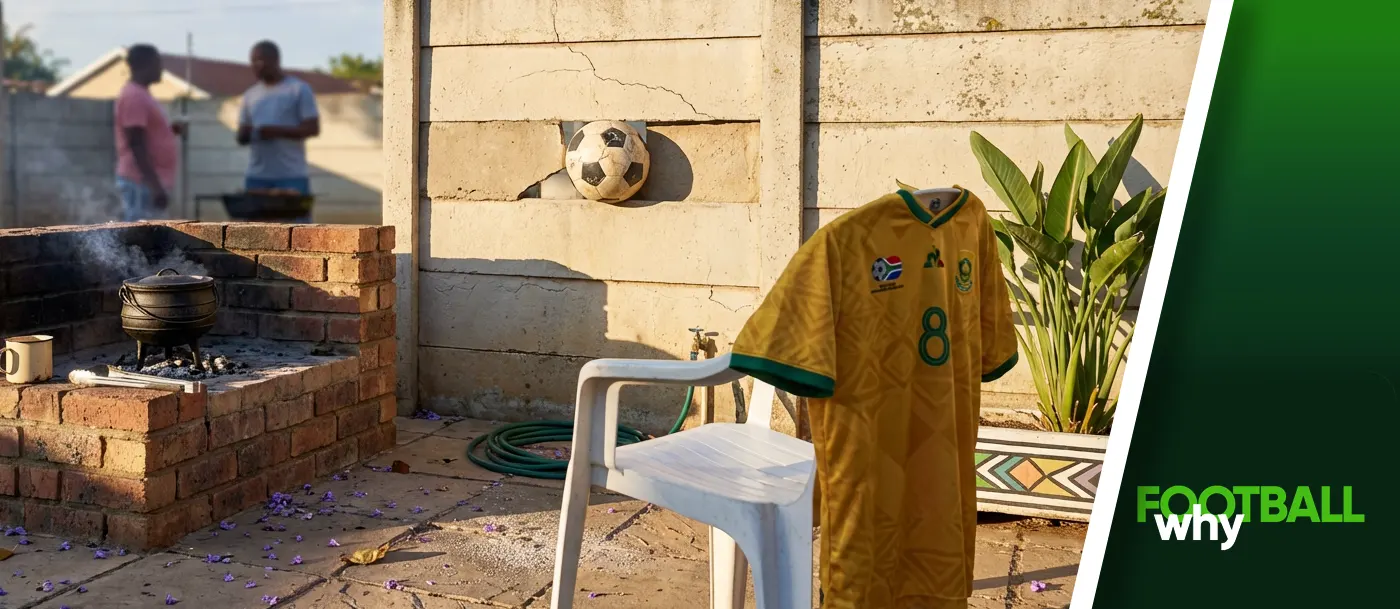
Within this austere, low-risk defensive block, sudden flashes of sanctioned joy still break through. The Diski dance — a rhythmic, syncopated movement born in the township streets — appears in quick, wide accelerations down the flanks and highly choreographed corner-flag goal celebrations. Thanks to sponsor-backed professionalisation and the pragmatic discipline installed by Hugo Broos, these moments of flair serve as sharp tactical weapons rather than defensive liabilities.

Watching this team requires a constant negotiation between the looming threat of systemic collapse and the defiant rhythm of the grassroots. It evokes a wry, unshakeable smile, acknowledging a simple truth: the bus driver might be completely lost and the engine might be smoking, but the passengers will keep singing together until they somehow arrive at their destination.
Character