

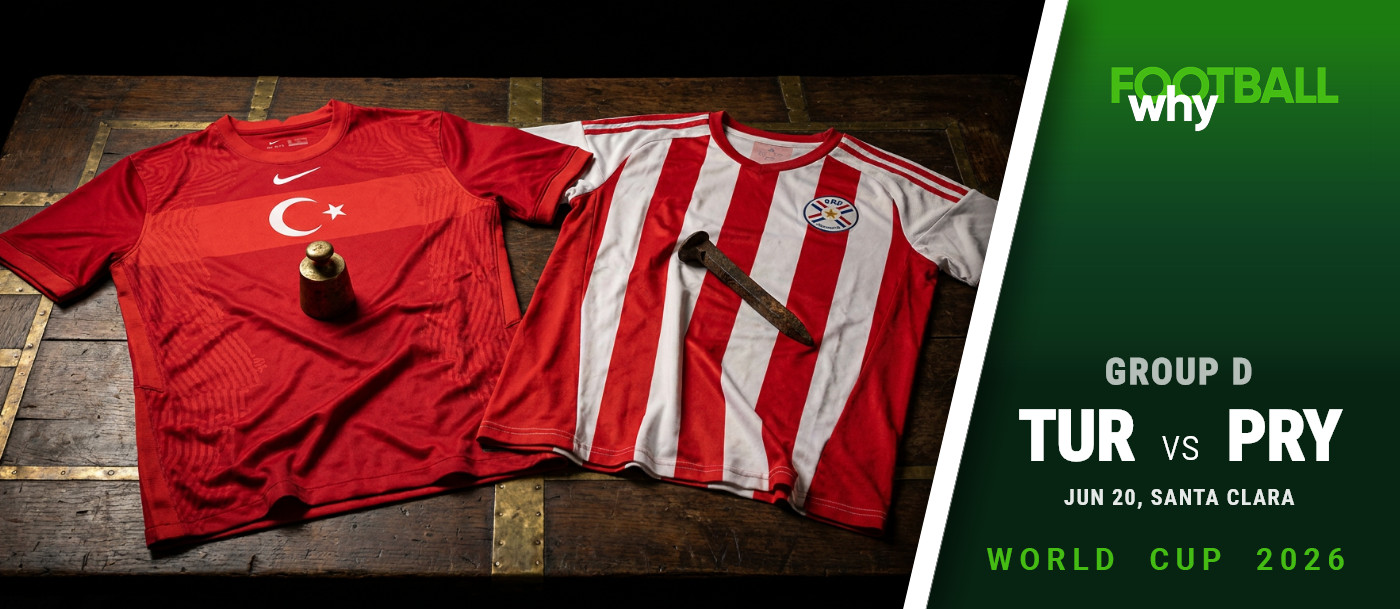
The World Cup Qualification Decider
Saturday, 20 June

Levi's Stadium, Santa-clara

Turkey vs Paraguay FIFA World Cup 2026 Group Stage Match Thirty-Two Shots and One Clogged Drain Forecast generated:

Thirty-two shots battered against a ten-man South American rearguard, all triggered by a frantic 65-second opener. Discover how an exhausting, claustrophobic siege ended with the statistics entirely divorced from reality.
Turkey vs Paraguay Structural Collision

What was it?

Sometimes the numbers simply refuse to behave. Thirty-two shots flew toward the penalty area, and twelve corners looped into the six-yard box. It looked like watching a frantic homeowner wrenching at a clogged U-bend while the water keeps rising.

The chaos stemmed from a single, sharp shock at 65 seconds. Matías Galarza drilled a low effort from distance to establish an immediate lead. Miguel Almirón then received a straight red card in first-half stoppage time under the new dissent directives.

Those skipping the broadcast missed a gruelling instructional video on surviving with ten men. The South Americans compacted into a narrow 4-4-1, absorbing crosses as though standing on a crowded commuter train refusing to make eye contact. Orlando Gill logged five saves.

Vincenzo Montella reacted by throwing bodies at the problem. He sacrificed a centre-back for Orkun Kökçü, abandoning patient midfield sequences for rushed, hopeful deliveries. Mert Müldür rattled the woodwork twice from set-pieces, but the sheer volume of attackers merely congested the space further.

By the final whistle, you could only feel a deep, aching sympathy for the Turks. They had pushed until their lungs burned, doing absolutely everything right except the one thing that actually counts.

Why not go for the win?

Turkey

The Turkish collapse originated in the opening moments, instantly forcing them to chase a deficit against a deep, entrenched Paraguay.

Vincenzo Montella’s subsequent tactical adjustments — stripping the defence to stack the forward line — merely congested the final third. They flooded the box with bodies, yet this volume only produced predictable, easily cleared deliveries.

Montella’s decision to sacrifice a centre-back for an extra passer late on theoretically increased supply. However, it simply funneled the play into crowded central zones, playing directly into the opposition's aerial strengths.

This structural bottleneck highlights a broader squad imbalance. The current generation overflows with gifted creators who thrive in the half-spaces, but glaringly lacks a ruthless, instinctive finisher to convert that territorial dominance.

Consequently, the side relies heavily on emotional momentum. When initial combinations fail, patience evaporates. The collective psyche defaults to a frantic, rushed verticality, driven by the intense demands of a public desperate for heroic defiance.

This cycle reflects a deeper systemic volatility within the national setup. A chronic mistrust of long-term planning forces managers into reactive, crisis-mode thinking.

Youth academies produce brilliant technicians and fierce fighters, but often neglect the cold, calculating positional discipline required to unpick elite defensive blocks.

Ultimately, the collective effort resembled a frantic neighbourhood mobilization, throwing endless buckets of water at a fire that had already burned itself out.

How did they clinch it?

Paraguay

Paraguay’s survival hinged entirely on securing an immediate advantage, which instantly validated their deepest tactical instincts against Turkey.

Once ahead, the side instinctively contracted. The subsequent numerical disadvantage simply formalized a shape they were already adopting: a remarkably narrow defensive block that happily surrendered the flanks to protect the central penalty area.

This extreme contraction is a feature, not a bug. The current squad is built around the commanding authority of veteran centre-backs, masking a severe, ongoing deficit in open-play chance creation.

When pressed, the midfield readily abandons complex possession. They prioritize positional discipline, logging an exceptionally high volume of blocked shots, and trusting their backline to manage the resulting influx of aerial deliveries.

Such a conservative approach is deeply rooted in the domestic footballing culture. Youth development heavily prioritises rugged dueling, aerial dominance, and transition readiness over fluid, progressive passing networks.

The national identity is explicitly tied to the concept of enduring suffering. Absorbing relentless pressure without breaking is viewed not as a tactical limitation, but as a profound moral victory against larger, better-resourced opponents.

They survived by turning their own penalty box into a cramped, airless trench where sheer physical endurance systematically suffocated technical grace.

Match hero...

Arda Güler
Arda Güler operated like a shrewd merchant in a crowded bazaar, constantly negotiating for an extra inch of turf. While his teammates rushed the penalty area, he anchored the half-space, demanding the ball and drawing fouls to reset the frantic tempo. His ability to delay the final pass forced the opposition to pause and commit. He treated the shrinking pitch as an elastic commodity, bargaining with defenders until the very last second to manufacture an opening.

...and one more

Orlando Gill
Orlando Gill assumed the quiet authority of the cebador pouring the morning tereré, dictating the pace of survival. While the penalty area descended into chaos, he simply absorbed the heat, claiming high crosses and slowing the restart to a crawl. His command over the defensive line was the steady, rhythmic presence of an elder guiding the group through a familiar siege. He didn't merely stop shots; he cooled the collective pulse of a team pushed to its limit.