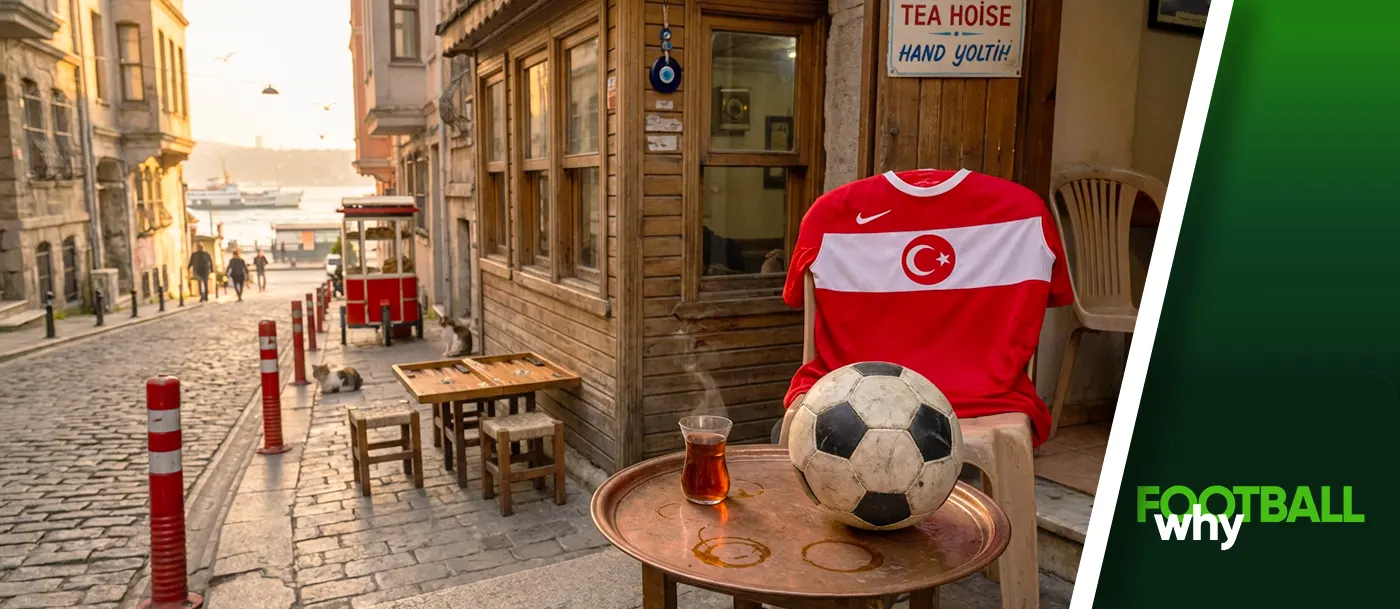
Where it hurts?
Turkey: current status and team news
Broken Gears and
Sudden Fiery Surges
The national camp operates like a grand, overheating clock-tower, ticking loudly under the heavy weight of recent humiliations. Vincenzo Montella clips his answers during press briefings, actively bargaining with a volatile public over squad selections. The six-goal collapse against Spain still burns in the collective memory.
Fans dissect every training ground decision, searching for hidden slights against creative youth. Hakan Çalhanoğlu acts as the central escapement mechanism, completely dictating the tempo and emotional temperature. He requires constant physical monitoring, taking frequent breaks from the heavy demands of the central midfield.
Any slight restriction in his movement forces the entire shape ten metres deeper into their own half. Zeki Çelik returns to provide a sturdy, reliable hinge on the right flank. He is asked purely to survive the transitional storms and clear the immediate danger.
Opponents will cast long cover-shadows over the midfield, waiting to sprint through the broken gears of a fractured shape. The spectacle will be one of strained, breathless endurance. Expect sudden, fiery surges of emotion as they attempt to steal a narrow victory from the chaos.
The Proposition?
Turkey : Tactical guide - how to identify their movements and game variations on the pitch
The Regista's Anchor
in the Emotional Storm
The Turkish camp approaches 2026 attempting a delicate tactical balancing act. They must fuse a lethal set-piece edge and deep-lying control with a highly volatile, youthful core. Vincenzo Montella wants to dictate tempo, but that ambition constantly fights against late-game physical drop-offs and the complex puzzle of unleashing Arda Güler without destroying the rest-defence.
The team utilises a 4-2-3-1 formation that shifts into an aggressive 3-2-5, dictated entirely by Hakan Çalhanoğlu acting as the regista fulcrum.
What to look at: If the centre-backs push inside the opponent's half early, with wingers narrowed and full-backs high, expect a territorial squeeze. This is designed to harvest corners and script wide counter-pressing traps.
What to look at: On Çalhanoğlu’s forward-facing receive, if the near midfielder vacates the lane and Güler steps into the right pocket, the aim is to freeze the opposing pivot. This movement opens a weak-side underlap for Ferdi Kadıoğlu.
To bypass pressure safely, Kadıoğlu frequently steps inside to form a 3-2 base.
What to look at: If the left centre-back initiates play and Kadıoğlu inverts outside the cover-shadow, watch how it unlocks a sudden diagonal pass into the right channel while maintaining transition insurance.
This left-tilted progression relies heavily on Barış Alper Yılmaz's penetrating depth runs.
What to look at: Upon crossing the halfway line, if Çalhanoğlu opens his body and Güler arrives between the lines, anticipate a low cutback to the penalty arc or a sweeping far-post diagonal.
Pushing both full-backs high inherently leaves the back-post severely exposed.
What to look at: If the opponent circulates quickly to the far side and hits an early cross behind the advanced full-back, watch for a collapsed defensive path. The centre-backs are frequently left outnumbered against blindside runners.
When fatigue sets in, Montella signals for a compact 4-5-1 survival mode.
What to look at: If the block drops deep and pressing triggers pause, Turkey deliberately concedes possession to pack the penalty area. They rely heavily on Uğurcan Çakır's time management to survive the final minutes.
Despite walking these structural tightropes, their blend of cerebral midfield orchestration and sudden, passionate wide surges makes them a captivating, high-stakes tournament threat.
The DNA
Turkey: football's importance and what we will see in their game at the 2026 World Cup
The Humid Geometry
of the Siege
A blanket of suffocating humidity presses down on the training pitch in Asunción. Even before the session begins, sweat darkens the training tops. In this climate, unnecessary sprinting is not merely inefficient; it acts as an act of foolish self-sabotage.
Observe a dispute over a property boundary in a rural Guaraní-speaking village. The men do not immediately shout or draw weapons. They sit in the shade, slowly passing a gourd of ice-cold tereré (yerba mate). The rhythm of preparing the drink, the deliberate sipping, and the patient silences serve to cool the blood. Decisions are reached through shared communal agreement, ensuring the group remains intact. A unilateral, aggressive move is a social sin.
This precise communal patience dictates the team's defensive architecture. When facing a superior opponent, the players do not attempt a frantic, high-risk counter-press. They construct a suffocating, low-variance mid-block.
Watch the wingers. They do not gamble on high interceptions. Instead, they track opposing full-backs deep into their own territory, creating narrow, impenetrable distances between the lines. It represents a collective agreement to absorb pressure, conserving energy for the exact moment the opponent over-commits.
This stoicism is rooted in the garra guaraní — a culturally sanctioned persistence forged by the devastating War of the Triple Alliance. A besieged nation learned that survival meant collective endurance, not individual heroics.
On the pitch, this translates to a profound comfort with low-event, trench warfare. They will cynically but carefully foul to break transitions, slowing the game to a crawl. The goalkeeper acts as the emotional metronome, dictating the tempo of restarts, much like the elder serving the tereré.
However, this deep-seated loss aversion directly starves their attack.
The domestic export economy monetises reliable, combative defenders, leaving the national side devoid of elite, spontaneous playmakers. Consequently, the attacking blueprint remains painfully predictable. They absorb pressure, launch a long diagonal to a target man, and wait for a set-piece.
What happens when this defensive purity is challenged?
A recent kit launch attempted to modernise the national image with a corporate, 'tierra colorada' design. The public reaction was instantaneous, merciless mockery — dubbing it the 'camiseta crayola.' Fans fiercely protect their symbols against sterile corporate branding.
Yet, a counterforce is brewing. The integration of dual-nationals and dynamic young forwards is beginning to inject much-needed final-third craft. The coaching staff is attempting to map modern pressing triggers onto this ancient bedrock.
It remains a delicate balance. You can teach a man new geometry, but you cannot ask him to forget the heat, the siege, and the deep, quiet rhythm of the water.
Character