

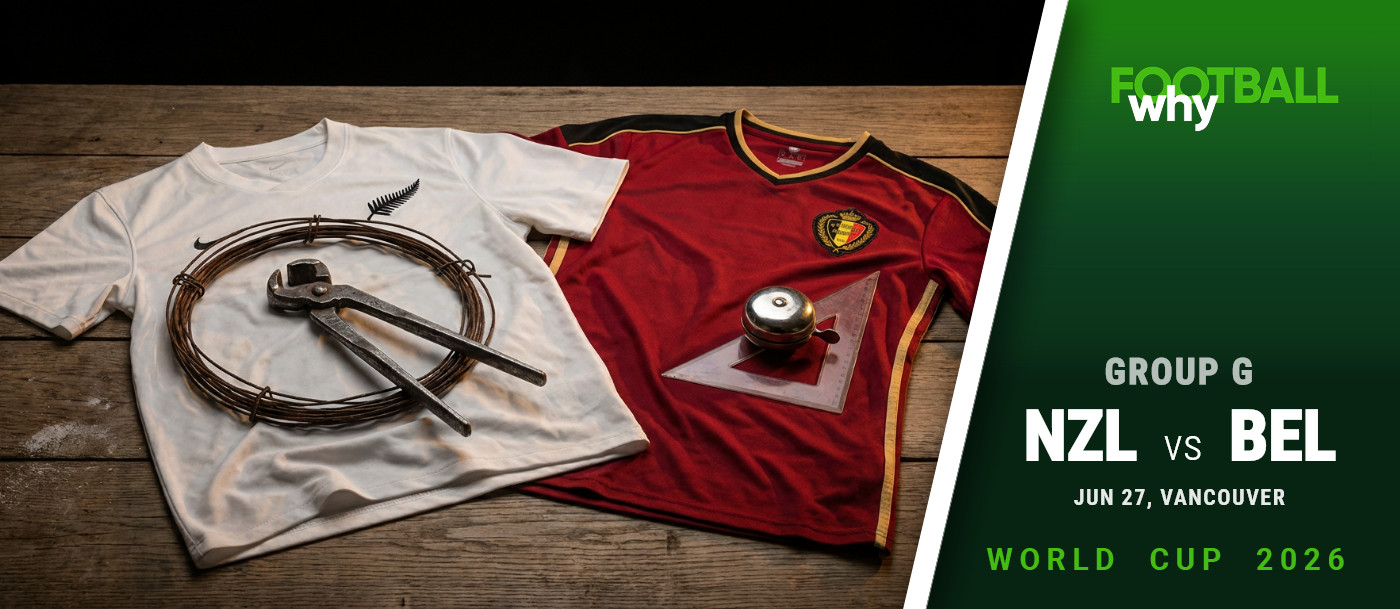
The World Cup Qualification Decider
Saturday, 27 June

BC Place, Vancouver

New Zealand vs Belgium FIFA World Cup 2026 Group Stage Match Thirty-Four Shots and a Shattered Defensive Sealant Forecast generated:

Belgium subjected New Zealand to a relentless industrial stress-test, firing 34 shots to shatter their defensive plywood in a 5-1 rout. Discover how a late bench cameo turned a methodical siege into a clinical demolition.
New Zealand vs Belgium Structural Collision

What was it?

The defensive sealant finally gave way under industrial pressure. Thirty-four shots rained down on the penalty area, probing every overlapping joint and fraying edge of a desperate block. Leandro Trossard simply hovered in the debris, sweeping up second phases with grim, bureaucratic efficiency.

The statistics paint a brutal picture of territorial monopoly. The Europeans registered twenty-two attempts inside the box, restricting their opponents to a microscopic 0.24 expected goals. Marko Stamenic picked up a caution immediately after the interval, effectively stripping his midfield of any remaining friction.

Forced to retreat, the Kiwis sank deep into their own penalty area. Kevin De Bruyne gleefully accepted the vacated real estate, drilling a low finish from the edge of the box to make it three.

Then came a fleeting, romantic illusion. Thibaut Courtois flapped wildly at a late corner, allowing Elijah Just to volley home. The stadium roared, briefly intoxicated by the idea that raw, unvarnished graft could defy technical superiority.

The romance lasted exactly two minutes. Romelu Lukaku stepped off the bench, bullied his way through the fractured defensive line, and headed in a fourth. Alexis Saelemaekers added a fifth shortly after. Honest sweat is a beautiful thing, but it shatters against clinical, heavily armed mechanics.

Why not go for the win?

New Zealand

New Zealand’s defensive structure ultimately fractured because they lost the physical right to engage in the middle third.

Once the midfield pivot picked up an early caution, the imperative to avoid a dismissal forced them to back away. Surrendering that central friction allowed Belgium to orchestrate overloads in the half-spaces without facing a single disruptive tackle.

This passive retreat highlights a glaring limitation in the current squad design. When pinned deep, the Kiwis lack a press-resistant creator capable of carrying possession out of danger and resetting the tempo.

Instead, they default to launching early, desperate deliveries toward an isolated target striker. That mechanism might suffice to bully regional opponents, but it merely returns possession to elite European center-backs.

The root of this disconnect lies in geographical isolation. Coasting through the OFC qualifiers rarely stress-tests a defensive block. The domestic circuit still prizes physical industry and set-piece menace over rapid, tight-area problem-solving.

While exporting young talent to overseas academies is slowly raising the technical floor, the collective reflex under severe pressure remains decidedly rudimentary. The cultural reliance on raw grit creates a hard limit when facing sophisticated passing networks.

A sturdy wooden breakwater will eventually splinter if subjected to a continuous, high-velocity industrial drill.

How did they clinch it?

Belgium

Belgium secured absolute control by treating the pitch as a strictly regulated logistical network.

Their wide rotations and patient combinations were designed to systematically exhaust the opposition. By maintaining possession and forcing continuous lateral shifts, they manufactured the severe physical fatigue required for the final phase.

Crucially, the coaching staff did not panic when the tempo occasionally dropped. They utilized their substitutes not merely to rest tired legs, but to deliberately escalate the tactical complexity against a crumbling defensive line.

This measured deployment of resources points to a squad that finally trusts its collective depth over individual heroics. The historical anxiety of relying on a few star names has been replaced by a more sustainable, procedural approach to breaking down deep blocks.

Such technical fluency stems directly from a highly calibrated, cross-regional academy system. The domestic league functions as an elite incubator, schooling youth in advanced positional play and rapid decision-making before they are exported to major clubs.

This shared pedagogical foundation allows players from different linguistic backgrounds to seamlessly integrate. They speak the exact same tactical language, executing complex passing circuits without needing explicit instruction.

The result was a flawlessly executed logistical timetable, delivering heavy freight exactly on schedule.

Match hero...

Elijah Just
Elijah Just operated like a deckhand refusing to let the rigging snap. His late volley required no grand design, just the raw instinct to punish a goalkeeper’s misjudged punch. He spent the afternoon absorbing heavy physical weather, tracking back relentlessly, and taking a tactical booking to plug a gaping leak. That quiet, head-down industry bypasses the need for elite playmaking. He simply read the prevailing wind, threw himself into the chaotic second ball, and secured a brief, fiercely honest reward for the collective.

...and one more

Leandro Trossard
Leandro Trossard approached the penalty area with the detached precision of a municipal auditor reviewing zoning permits. His brace was a triumph of spatial administration. Instead of forcing the issue, he drifted into the half-spaces, waiting for the defensive structure to buckle before quietly filing his shots into the corners. This ability to calibrate his runs — arriving exactly as the cut-back materializes — turns chaotic rebounds into predictable outcomes. He bypassed the physical friction entirely, processing the final third as a logistical timetable that always runs to schedule.