

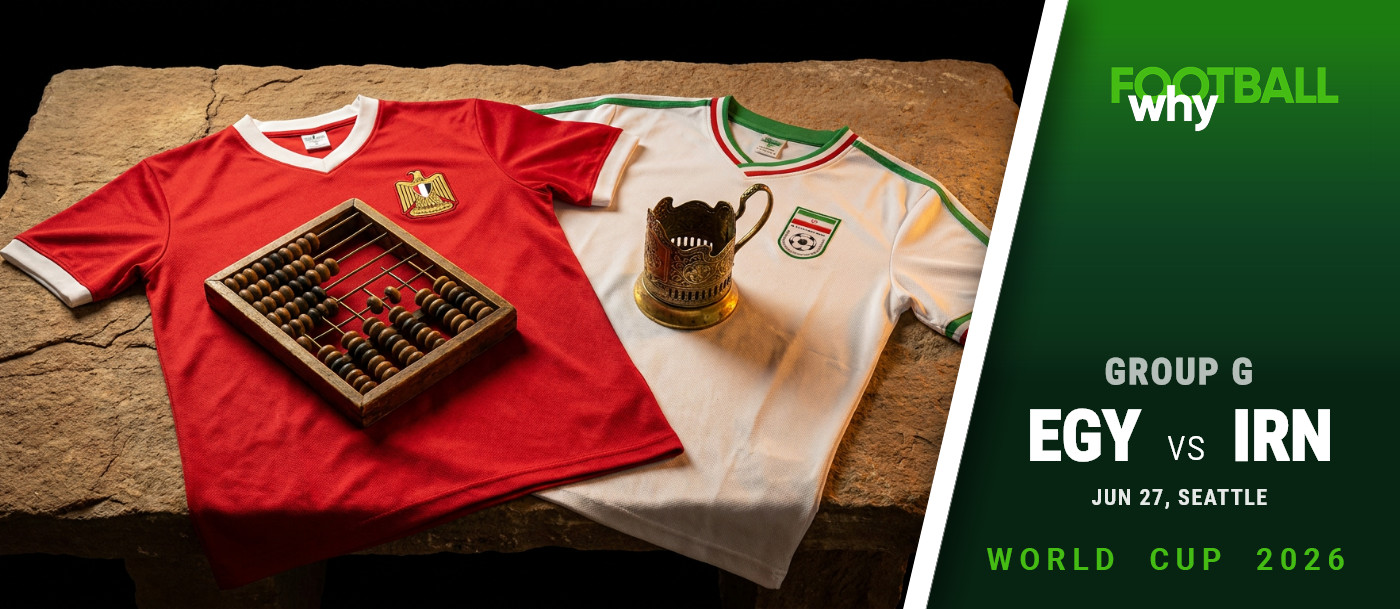
The World Cup Qualification Decider
Saturday, 27 June

Lumen Field, Seattle

Egypt vs IR Iran FIFA World Cup 2026 Group Stage Match Fourteen minutes of panic, seventy-five of municipal silence Forecast generated:

Fourteen minutes of frantic noise collapsed into a suffocating, seventy-five-minute tactical silence. Discover how a 93rd-minute VAR intervention salvaged a point in a match that promised fireworks but delivered municipal paperwork.
Egypt vs IR Iran Structural Collision

What was it?

Fourteen minutes of sheer, unscripted panic abruptly gave way to the suffocating quiet of a municipal planning meeting. Mahmoud Saber drilled a low shot home. Mostafa Shobeir parried a penalty. Ramin Rezaeian smashed in the rebound. Then, twenty-two men collectively checked their watches, nodded at one another, and filed away the adrenaline.

Egypt hoarded sixty-one percent possession without ever threatening to use it. They circulated passes like a frayed commuter broadsheet, shifting the burden back and forth across the midfield. The early injury to centre-back Mohamed Abdelmonem triggered a deep, institutional reflex to protect the hull rather than test the waters.

The real structural collapse happened just before the hour mark. Mohamed Salah walked off as a precaution, and the Egyptian right flank immediately ceased to exist as an offensive concept. They managed a meagre 0.81 expected goals despite owning the turf.

Iran, meanwhile, bolted themselves into a rigid 5-4-1 shape and waited. They generated 1.83 expected goals almost entirely from dead-ball scaffolding and second-phase debris.

The final minutes provided a sudden, jagged spike of terror. Mehdi Taremi rattled the crossbar. A stoppage-time Iranian winner was meticulously scrubbed out by the VAR circuitry. Saeid Ezatolahi hammered another header against the woodwork. The whistle blew just before the rusted hinges gave way completely.

Why stopped just short of victory?

Egypt

Egypt settled for a draw because their ingrained fear of public exposure consistently overrides their attacking ambition. The early defensive reshuffle instantly triggered a deep, systemic conservatism across the backline.

Instead of pressing their territorial advantage, the defenders dropped deeper. They chose to manage the game state rather than dictate it, treating possession as a time-buying mechanism.

This caution compounded when the right flank lost its primary attacking focal point in the second half. Without that gravitational pull, the team’s forward momentum completely evaporated.

The squad lacks a progressive midfield orchestrator. Consequently, they rely almost entirely on wide, structured surges. When those lanes are blocked, the team reverts to harmless, horizontal passing sequences.

This limitation stems directly from a domestic football ecosystem that prioritizes rigid obedience over individual midfield ingenuity. The domestic giants produce resilient, physically robust players who excel in attritional tournament warfare.

However, that same system fails to develop the rapid, tight-space decision-making required against elite global blocks. The players operate under a heavy civilizational burden, where avoiding a humiliating defeat is valued more than risking an expansive victory.

They secured the point by retreating into the familiar comfort of their hierarchy, folding up their ambitions like a shopkeeper pulling the iron shutters down at the first drop of rain.

Why stopped just short of victory?

IR Iran

Iran failed to secure a victory because their entire tactical framework is built upon anticipating a siege. Even when the match state demanded urgency, they stubbornly maintained their five-man defensive trench.

This rigid structure ensured they rarely surrendered central space, but it left their forwards entirely isolated. They deliberately bypassed the midfield, opting to funnel the ball wide and negotiate for territory through sheer physical attrition.

The Iranian technical staff relies heavily on a veteran core to manage these tense situations. They trust experienced players to draw fouls and manufacture dead-ball scenarios, escalating the threat through physical volume.

This dependency on set-pieces masks a glaring lack of progressive passing patterns. The squad struggles to break down organized blocks through open play, a direct result of a highly scrutinised sporting environment.

In a system where failure carries heavy nationalistic baggage, coaches naturally default to conscription-style discipline. Integrating younger, faster players is viewed as a risk that could fracture the established hierarchy.

Therefore, the team plays with a persistent defensive anxiety, treating open grass as a dangerous liability. They prefer to grind out results through aerial dominance and collective endurance.

They survived the contest by barricading the front door and throwing heavy furniture out the upstairs windows, hoping one piece might eventually strike the opponent.

Match hero...

Mostafa Shobeir
Mostafa Shobeir did not just save a penalty; he managed the suffocating heat of a Cairo pressure cooker. When the defensive line fractured early, he became the ultimate safety net, absorbing the public scrutiny that paralyses lesser goalkeepers. He relied on sharp lateral agility and an innate refusal to lose face, reading the attacker's hips to deflect the crisis. In a team terrified of public shame, Shobeir provided the quiet, stoic authority required to keep the household intact.

...and one more

Mehdi Taremi
Mehdi Taremi operated like a seasoned merchant in a hostile bazaar, bargaining for every inch of turf. He missed from the spot, yet immediately converted that failure into a stubborn, physical martyrdom for the collective. Isolated at the tip of the Iranian spear, he used his sheer bodily mass and streetwise timing to extract fouls from Egyptian defenders. He traded blows in the penalty box, absorbing the physical debt so his teammates could remain safely fortified behind him.