
New Zealand (All Whites) - National flag

New Zealand National Football Team

All Whites

What to look for?

Battered by endless oceans and the shadow of an oval ball, they carry the quiet pride of the absolute underdog. Stepping onto the global stage, they fight a glaring lack of depth and the brutal toll of travel. Watch a fiercely egalitarian collective absorb relentless punishment before launching desperate, towering aerial bombardments. You will see pure physical grit transformed into a weapon. The frontier is ready to fight back.

Team at a Glance

What do they want?

To remind the world they play with a round ball too, and grind out a historic knockout-stage appearance.

What are they strong at?

Relentless egalitarian modesty, paired with an unapologetic strategy of simply launching the ball at their giant striker.

What will they show?

Ninety minutes of bruising, synchronised defensive suffering, entirely justified by one glorious, bone-crunching set-piece header.

Why are they as they are?

When your island is battered by endless ocean winds, you quickly learn to share the heavy lifting.

What is the chance of a title?

3%. If only they can officially convince FIFA to allow rugby tackles inside the six-yard box.
NEW ZEALAND | Structural Collision

Where it hurts?

New Zealand: current status and team news Maritime Pragmatism and the Aerial Economy

While domestic message boards exhaust themselves arguing over the #AllWhitesInBlack kit branding, the actual squad is quietly setting up camp in the San Diego heat with a far more physical problem to solve. Their historic 4-1 victory over Chile carried the awkward asterisk of a long one-man advantage, and a subsequent flatline against Finland exposed the fragility of their current blueprint.

Darren Bazeley is attempting to construct a side capable of surviving top-tier pressing. However, the entire attacking structure remains heavily tethered to the physical presence of Chris Wood.

If the giant target striker is isolated, rested, or carrying a knock, the offensive output completely evaporates. Midfielders suddenly look up, find no towering focal point to aim for, and are forced into safe, lateral passes that lead nowhere.

To mitigate this glaring vulnerability, the coaching staff is drilling highly rehearsed dead-ball routines and practicing press-bypass launches directly from the boots of goalkeeper Alex Paulsen. In midfield, Marko Stamenic operates as the primary shield, tasked with breaking lines early to feed wide deliveries before the opposition can set their traps.

Supporters huddled around pub screens at 3 AM experience a constant whiplash between cautious pride and vocal frustration over inconsistent intensity.

Expect a bruising, fiercely organised unit that maximises every single set-piece and aerial duel. They will fight with absolute honesty to prove their regional dominance can finally translate into genuine global resilience.

The Headliner

New Zealand: key player and his impact on the tactical system The Percussive Anchor of the Aerial Economy

A simple raised arm at the back shoulder serves as the only maritime signal before the physical impact. Chris Wood processes incoming aerial trajectories with an unyielding, percussive efficiency. He dominates the physical lanes, aggressively pinning centre-backs deep inside their own penalty box.

He operates as the grounded locomotive of the entire tactical setup. Thriving as a classic target striker, he turns raw first contact into clean, pressure-relieving lay-offs for the overlapping midfielders.

The entire crossing and set-piece economy relies entirely on his capacity to physically secure second balls and execute perfectly timed near-post darts. While the cumulative contact load of leading the line threatens to wear down his late-prime chassis, his stoic hold-up play remains the absolute bedrock of their attacking transitions.

Responding to constant physical battering with a calm, team-first focus, the nation’s all-time leading scorer embodies a brilliant, bruising pragmatism. He has earned enduring respect across the highest tiers of the sport purely through honest, unglamorous graft.

The Wild Card

New Zealand: dark horse and player to watch Glassy Calm in the Defensive Chop

Standing at 1.90 meters, an upright carriage and quiet, eyes-up scanning project an unnatural serenity amid the physical turbulence of the penalty area. Tyler Bindon is an economical, ball-playing centre-back who relies on precise timing rather than raw recovery pace.

The 21-year-old executes telescopic last-ditch blocks and reads early crosses with a glassy-calm demeanor. His presence seals a critical tactical leak, providing clean exits and line-breaking diagonal passes to the wing-backs even under heavy opposition pressing.

Opponents actively try to drag him wide with quick one-twos. They fire passes behind his high step, attempting to force him into repeated, exhausting recovery sprints. His first-step acceleration against world-class strikers remains largely untested.

Still, if he can sustain his dominant aerial command and progressive passing chains without reverting to rushed clearances, this composed defensive anchor will prove his undeniable top-flight pedigree on the biggest stage.

The Proposition?

New Zealand : Tactical guide - how to identify their movements and game variations on the pitch Left- Lane Overloads and the Target Man Anchor

Thrust into a grueling Group G gauntlet, the squad faces a brutal test of their underdog survival skills. Darren Bazeley’s men must reconcile their proactive ambitions with a glaring finishing deficit and travel-heavy legs. They lean heavily on their structural width and set-piece mastery to manufacture points.

Without the ball, they project disciplined minimalism.

What to look at: Notice the defensive block settling into a tight 4-4-2 around forty metres from their own goal, with the wingers tucked closely inside. Tyler Bindon and the centre-backs hold the line while the midfield pivots screen. They deliberately funnel the opposition into wide sideline traps to kill the match tempo.

In possession, the shape subtly twists.

What to look at: As the build-up begins, right-back Tim Payne narrows to form a back three, while Marko Stamenic drops alongside the centre-backs. This creates a three-versus-two numerical advantage against the first pressing line, securing possession before launching attacks down the left side.

The left flank serves as their primary attacking engine.

What to look at: Upon crossing the halfway line, Stamenic drives into the inside-left channel, allowing Liberato Cacace to overlap aggressively on the outside. Watch for Sarpreet Singh to present himself between the lines, setting up a flat cross toward the front post or a cutback to the edge of the box.

Everything ultimately converges on their iconic number nine.

What to look at: When Chris Wood posts up on a centre-back to receive the ball, Singh immediately underlaps for a wall pass while the far winger sprints toward the back post. This compresses the opposing defence, either opening the weak side or provoking physical fouls to secure high-value dead-ball scenarios.

This left-sided aggression leaves a stretched underbelly.

What to look at: If an opponent lures the press and suddenly fires a diagonal switch behind Cacace, the nearest centre-back is left totally isolated. The screening pivot simply cannot cover the width in time, frequently conceding high-probability cutbacks from the channel.

As the summer heat drains their legs, Bazeley triggers their lead-protection protocols, echoing their famous upset over Ivory Coast.

What to look at: The block drops deep into their own third, morphing into a 5-4-1. They trade territory for sheer box density, relying on goalkeeper Max Crocombe to command aerial clearances and bleed the clock.

They may lack elite depth, but their fierce collective honesty, relentless physical commitment, and lethal set-piece orchestration make them a remarkably dangerous spoiler capable of suffocating the world's best.

The DNA

New Zealand: football's importance and what we will see in their game at the 2026 World Cup Wind-Sheared Pitches and the Fencing- Wire Attack

When the national team secured a 4-1 victory over Chile at Eden Park in March 2026, the domestic elation was immediately punctured by a massive, collective caveat. Callers flooding the local sports radio stations were quick to point out that the South Americans had played with ten men for over an hour.

This relentless self-deprecation and refusal to over-celebrate forms the absolute bedrock of the national psyche.

Imagine a fallen Totara tree blocking a rural coastal road. A single farmer does not rush out with a chainsaw to play the hero. Instead, neighbours gather in the freezing drizzle, discuss the safest angle, share the heavy tools, and pull the timber together. Anyone attempting to act alone is quickly labelled a reckless liability.

This deep-seated egalitarianism translates directly into a 5-4-1 defensive block that absolutely despises solitary risk.

During their 0-2 loss to Finland, when the game state demanded an aggressive change, the players visibly hesitated. They are socially conditioned to wait for a collective agreement from their overseas-based veterans rather than breaking the defensive line to launch a solo dribble.

The reluctance to produce flashy, creative football is compounded by their geographic and sporting reality.

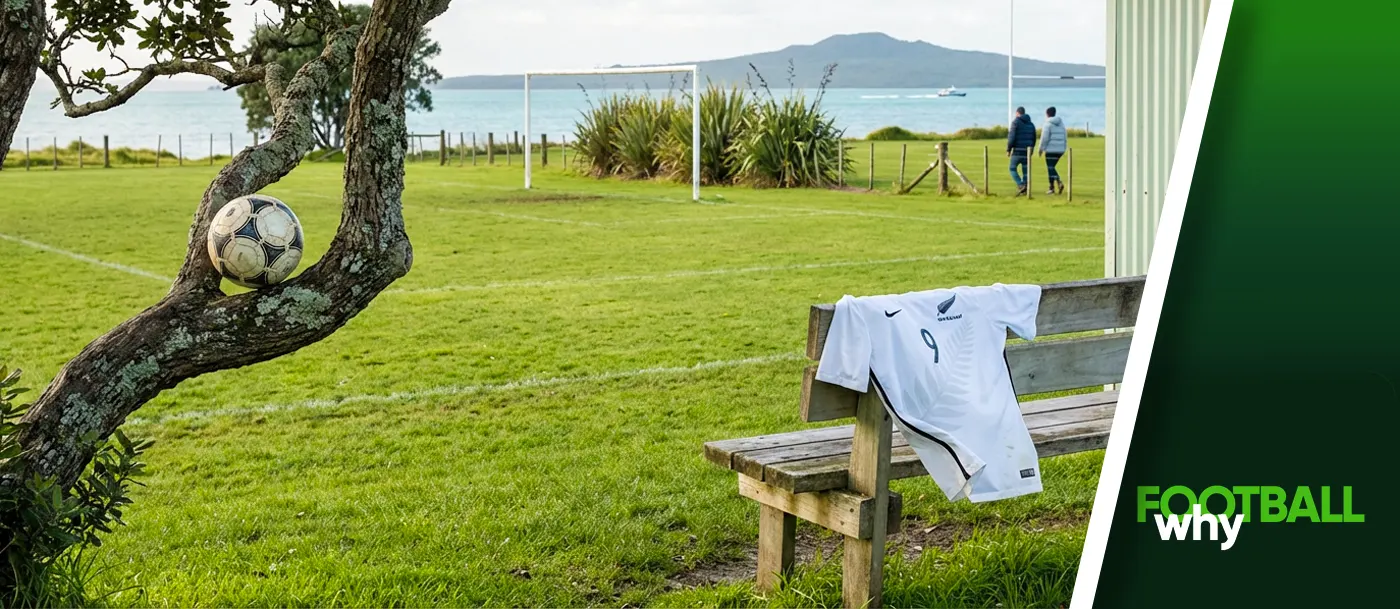
Walk into any local high school sports department. The pristine, floodlit main field is fiercely guarded for the First XV rugby team. The football squad is handed a bag of worn-out balls and pointed toward a bumpy, wind-sheared patch of grass by the parking lot.

Operating in the heavy shadow of rugby, with a thin domestic pipeline reliant almost entirely on the Wellington Phoenix academy, the team has developed a highly pragmatic, low-variance attacking model.

They deliberately bypass complex midfield build-up, relying instead on early diagonal arcs to a single, towering target striker.

Outsiders often view this as a polite, limited strategy. But it is a highly calculated adaptation to their environment.

If a tractor breaks down on a remote sheep station, the owner cannot wait three weeks for a shiny new replacement part from Europe. They grab a coil of fencing wire, bind the cracked exhaust together, and make it work with brutal, unglamorous efficiency.

This frontier resourcefulness explains why they treat set-pieces as their primary offensive weapon. They hunt second balls around the penalty area with a ferocious, synchronised work rate β€” a trait that famously allowed them to go unbeaten at the 2010 World Cup.

Grappling with intense geographical isolation and a desperate reliance on a few key diaspora stars, their football stands as a monument to honest graft. When living on islands battered by endless oceans, survival does not belong to the flashy or the proud, but to those who quietly share the heavy lifting and refuse to let the wind blow them down.
Character