

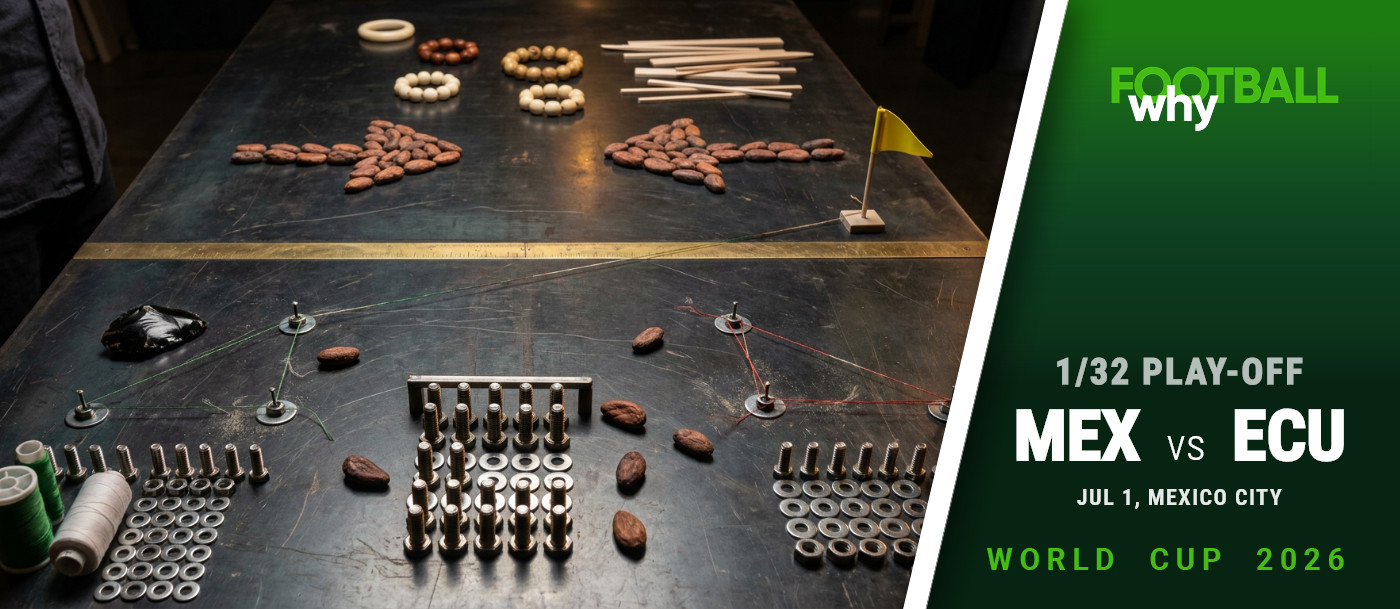
The World Cup Qualification Decider
Wednesday, 1 July

Estadio Azteca, Mexico-city

Mexico vs Ecuador FIFA World Cup 2026 Group Stage Match Thirty minutes of thunder, an hour of rust Forecast generated:

Thirty minutes of lightning raids followed by an hour of bureaucratic filing. Discover how Mexico’s two early goals turned the rest of this wet Azteca clash into a frustrating, rusted exercise in defensive closure.
Mexico vs Ecuador Structural Collision

What was it?

A torrential downpour delayed proceedings by an hour, leaving the Azteca turf slick and treacherous. Mexico used the skidding surface to accelerate like a derailed freight train through the opening half-hour.

Javier Aguirre’s men bypassed the midfield entirely, striking twice before the thirty-one-minute mark. Julián Quiñones tore into the space behind a bewilderingly high defensive line for the opener, before setting up Raúl Jiménez moments later.

Anyone tuning in after the interval missed the actual contest. Ecuador held fifty-seven percent of the possession but functioned like a rusted shipyard crane, swinging aimlessly without releasing the cargo. They delivered eight consecutive corners to the exact same near-post zone.

The defensive hosts simply cleared every cross without breaking a sweat. At the eighty-minute mark, Aguirre withdrew his wingers to form a flat five-man midfield, bolting the doors completely.

Frustration eventually rotted the visitors' discipline. Piero Hincapié earned a straight red card in stoppage time for covering his mouth to deliver an insult, a petty end to a brutally unequal evening.

How did they clinch it?

Mexico

Mexico secured the result because Javier Aguirre correctly diagnosed Ecuador's structural naivety. Deploying a 4-3-3 with a single pivot allowed direct releases into the left channel, ruthlessly exposing the high line before the defence settled.

Once the two-goal cushion was established, the hosts deliberately abandoned possession. This was a calculated retreat, introducing defensive substitutions to form a rigid 4-5-1 block that systematically choked the wide areas.

This immediate shift reflects a deeper truth about the current squad's tournament craft. They possess the technical schooling to hurt teams early, but their game-state management prioritises low-risk territorial control over aesthetic expansion.

Such extreme pragmatism stems directly from the psychological weight of the 'quinto partido' ceiling. The national expectation surrounding these matches is so suffocating that risk-aversion becomes the default survival mechanism.

Instead of chasing a third goal and exposing themselves to chaotic transitions, the team naturally defaults to a protective shell. The domestic league’s commercial pressure breeds players who understand how to protect a valuable asset, relying on hierarchical discipline to see out the clock.

Mexico simply locked the front gate, treating their early lead as a fragile family inheritance to be fiercely guarded rather than capital to be risked.

Why not go for the win?

Ecuador

Ecuador failed to compete because their initial tactical posture fundamentally contradicted their own strengths. Pushing the defensive line high against Mexico's pace-heavy forwards stripped away their usual transition-based stability.

After conceding twice, the team was forced to command the play against a deeply entrenched block. This exposed a glaring lack of central combination patterns, reducing their attack to predictable wide surges.

The reliance on dead-ball situations became absolute. They generated eight corners, yet repeatedly targeted the exact same near-post zone, crashing blindly into a meticulously prepared defensive structure without ever attempting a manual override.

This inability to improvise highlights a persistent limitation within the current generation. The squad relies heavily on a collective work-rate, but struggles immensely when tasked with unpicking a stationary lock.

The root cause lies in the national development pipeline. The academy system successfully exports elite duel-winners and physical runners to European leagues, but it consistently fails to produce nuanced, creative playmakers.

When the counter-attacking spaces disappear, the team’s structural rigidity leaves them devoid of answers. The late disciplinary collapse merely reflected the exhaustion of a group asked to solve a puzzle without the right pieces.

Ecuador brought heavy industrial machinery to perform a delicate surgical procedure, tearing at the edges without ever reaching the heart.

Match hero...

Julián Quiñones
Julián Quiñones understood that the match required bypassing the official traffic queues. With a goal and an assist, he operated like a streetwise fixer finding an unmarked detour through Ecuador’s high defensive line. He exploited the wet pitch, timing his sprints perfectly to meet direct releases into the left channel. His pace and anticipation bypassed the bureaucratic build-up, turning structural rigidities into open asphalt for Mexico’s early blitz.

...and one more

Moisés Caicedo
Moisés Caicedo carried the communal harvest on his shoulders, completing 64 passes as he tried to forge a pathway through a locked defence. He fulfilled his minga duty, anchoring the midfield and distributing the workload, but found no willing receivers in the final third. His elite ball-winning and positional discipline shielded the centre, yet his efforts rusted away without the necessary creative tools from his forwards to crack the deep block.