
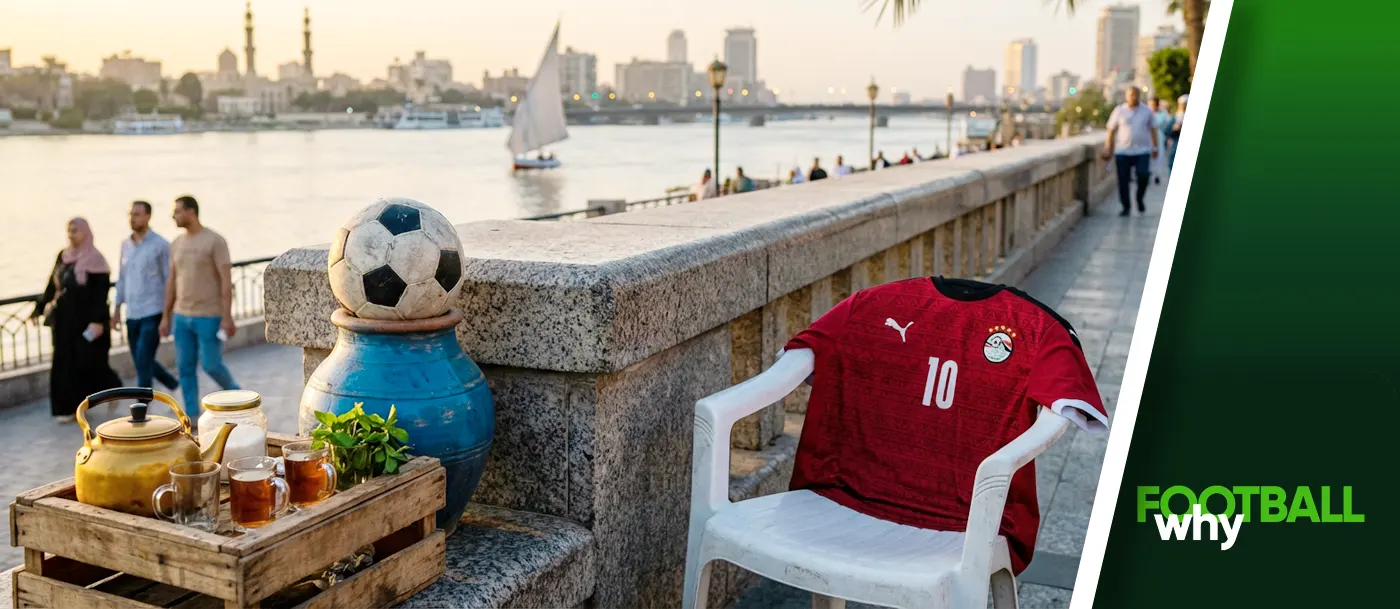
Crushed beneath the weight of continental crowns, they carry the frantic hopes of millions. Yet, endless off-pitch noise and a desperate reliance on a single saviour threaten to derail them. They fight the ticking clock and their own suffocating caution. Watch a fiercely disciplined collective absorb endless pressure in the shade. Then, witness the sudden, lightning-fast strike down the right flank. The river is finally ready to flood.
Team at a Glance
What do they want?
To finally win a World Cup match and prove that absolute bureaucratic patience eventually conquers all.
What are they strong at?
Suffocating defensive grit, paired with an unapologetic, stubborn refusal to attack down the left side.
What will they show?
Eighty-nine minutes of pure, sweat-drenched defensive suffering, entirely justified by one majestic left-footed curling strike.
Why are they as they are?
Surviving the sweltering Cairo heat teaches you to conserve your energy until the perfect moment.
What is the chance of a title?
4%. If only they can officially mandate that every single attack must go through their king.
Where it hurts?
Egypt: current status and team news
Right-
Flank Reliance in a Cairene PR Storm
The squad is packing their bags for a politically charged group stage in Seattle, but the domestic atmosphere currently resembles a chaotic Cairene street market at rush hour. Fans scroll through their phones in local cafes, exhausted by a bizarre, highly public spat between the team director and the MLS commissioner that has entirely hijacked the news cycle.
Hossam Hassanβs mandate remains stubbornly straightforward. He must secure the nationβs first-ever World Cup match win and drag the squad into the Round of 16.
Yet, the tactical design remains heavily tethered to a single, relentless focal point on the right flank. Mohamed Salah physically triggers the press, waving his teammates forward, and finishes the transitions with his trademark left-footed strikes. On the opposite side, Omar Marmoush sprints down the touchline, providing a vital vertical outlet on the left.
When Salah rested during the March friendlies, the attacking flow immediately parched. The midfield passed the ball sideways, exposing a severe deficit in central invention.
To counter this predictable funneling, Hassan is physically drilling his players through pre-rehearsed left-sided progressions on the training pitch. He is simultaneously elevating the volume of set-piece drills, instructing his centre-backs to attack the box to bypass the need for endless midfield circulation.
The public watches from the stands with a wry, guarded belief. They are drained by off-pitch PR storms and loudly demand braver chance creation.
Anticipate a relentlessly compact, safety-first unit that absorbs pressure deep in its own half before attempting to strike through lightning-fast, star-led vertical punches.
The Headliner
Egypt: key player and his impact on the tactical system
The Orbit of the Pharaoh
A kinetic blur suddenly shifts into statuesque stillness. A sudden sprint-stop feint from Mohamed Salah warps the defensive structure around him, turning elite fullbacks into off-balance spectators. He drops his shoulder, pauses for a fraction of a second, and the defender slides helplessly past.
Operating as an inverted right forward, his magnetic presence dictates the entire tactical weather system of the Egyptian squad. He no longer simply hugs the touchline. Instead, he has evolved into a half-space orchestrator, executing left-foot finishes from impossible angles and reading back-press triggers with clinical precision.
The national teamβs attacking lane is engineered entirely around this focal point. He provides the essential pivot for transition counters and penalty execution. Take him off the pitch, and the disciplined shape remains, yet the lethal cutting edge completely vanishes.
He absorbs the immense pressure of a nation, staring down the goalkeeper with focused, low-reactivity execution. Having shattered English goal-scoring records and carried his country on a bruised shoulder, his relentless, era-defining mastery commands absolute global reverence.
The Wild Card
Egypt: dark horse and player to watch
Feline Deception
on the Left Flank
The domestic crowd whispers about a generational vessel of hope, desperate for someone to lighten the heavy talismanic burden. Ibrahim Adel carries this weight with a feline first step and a compact, elastic frame.
Thriving primarily as an inside-left carrier, the 24-year-old relies on deception-first acceleration. He receives the ball on the half-turn, drops his hips, and accelerates past the first marker before they can even plant their feet, shifting the tempo within a mere two touches.
He refuses to merely circulate the ball safely around deep blocks. He actively threads disguised slips and wall-passes straight through the legs of retreating defenders.
Opponents counter this street swagger by doubling him with a fullback and a central midfielder, aiming to rush his far-post drives or force early tactical fouls. The lingering question surrounds his final delivery under compressed tournament time.
One clean combination is enough to fuel his audacity. From there, his dribble-led progression delivers the exact match-tilting spark required to unnerve top-tier tournament seeds.
The Proposition?
Egypt : Tactical guide - how to identify their movements and game variations on the pitch
Right-
Wing Magnetism and the Pharaohs' Transition
Seeking World Cup scalps to heal recent continental heartbreak, Egypt balances a pragmatic five-at-the-back setup against a clear chance-creation limit. The tactical framework demands elite defensive containment, while simultaneously channeling every attacking impulse towards Mohamed Salah. The Pharaohs deploy a 3-4-3 that shifts into a 3-2-5 in possession, anchoring their defensive base with a single pivot, Hamdy Fathi, to allow explosive vertical surges.
What to look at: In the opening exchanges, watch the three central defenders plant their feet deep in their own half while right-wingback Mohamed Hany pushes aggressively high. They are setting a mid-block funnel, deliberately baiting rushed wide passes to trigger right-channel transitions the moment they win the ball.
The trap is set.
Hossam Hassan paces the touchline, waving his arms frantically to signal a structural metamorphosis when chasing a deficit.
What to look at: On a goal-kick, Emam Ashour drops alongside Fathi while Hany sprints up the touchline. This 3-2 buildup bypasses the first pressing line, immediately freeing a direct diagonal pass into Salahβs channel.
The entire pitch geometry bends to amplify their talisman.
What to look at: When Salah receives the ball facing inside, Hany overlaps at a full sprint while Mostafa Mohamed drags the nearest centre-back away. This physical movement forces a two-on-one, opening the weak-side wingback for a sweeping switch or a layoff to the edge of the box.
Progression leans heavily to the right. Should the primary half-space isolation fail, they execute a direct secondary routine.
What to look at: As they cross the halfway line, Salah drifts inside. Expect a sharp, zipped pass into Mostafa Mohamed for a quick wall-set, followed by a sweeping far-side switch to Ahmed Fetouh for a first-time cross.
This aggressive right-sided tilt naturally leaves the left flank exposed.
What to look at: If the opponent wins possession and immediately hits a long diagonal behind Fetouh, the central defender is dragged wide. Without the midfield screen covering the gap, the central lane gapes open for a high-probability cutback.
To mitigate this, especially as 70th-minute fatigue burns through the players' legs, Egypt reverts to pure survival mode.
What to look at: Protecting a narrow lead, the front three entirely stop pressing. They sink into a deep 5-4-1, using the goalkeeper to hold the ball and kill the tempo, willingly accepting territorial dominance in exchange for total penalty-box control.
Ultimately, this unapologetic pragmatism serves as their greatest weapon. Grounded by unyielding defensive grit and the undeniable, match-winning aura of the Egyptian King, they possess the exact tournament resilience required to frustrate and shock elite opposition.
The DNA
Egypt: football's importance and what we will see in their game at the 2026 World Cup
Measured Pulses Under
the Cairene Floodlights
During the dying minutes of the 2025 continental semi-final against Senegal, trailing by a single goal, the squad refused to launch a frantic, chaotic siege. Midfielders pointed to hold the line, passing the ball cautiously and selectively crossing only into highly specific penalty-box zones. The media howled about conservatism, but the players were simply executing a script etched into the bedrock of their society.
Imagine trying to secure a commercial building permit in a sweltering Cairo municipal office. You do not invent a new form or loudly demand to skip the queue. You wipe the sweat from your forehead and move patiently from the junior clerk's desk to the senior registrar's window. You conserve your energy under the slow-spinning ceiling fans, trusting entirely that the established hierarchy of ink stamps will eventually yield the desired result.
This procedural endurance forms the very soul of the national team's defensive block.
Against Djibouti in the October 2025 qualifiers, sitting on a comfortable lead, the players did not chase a reckless six-goal margin. They deliberately killed the match tempo. Defenders preserved their legs in the dusty evening breeze, adjusting their defensive lines with absolute, unflappable composure.
Tourists switching on the broadcast often expect a solitary superstar carrying ten mere spectators.
In reality, this represents a highly coordinated division of labour. Consider a traditional neighbourhood festival setup. Fifty people will sweat for hours carrying heavy wooden tables and stringing up miles of thick electrical cable across the alleyways. However, only the designated, respected elder is permitted to walk up and flip the main power switch.
On the pitch, the collective labours tirelessly in the heat to maintain a compact shape. The fullbacks tuck inside, the midfielders close the gaps, but the final, lethal action is channelled strictly to the right flank. The system relies entirely on a wide finisher β Mohamed Salah or the rising Omar Marmoush β to act as the designated closer.
This strict adherence to a single attacking funnel creates a severe bottleneck against elite opposition. It drastically limits total shot volume and makes the attacking patterns highly predictable.
Yet, abandoning this structure feels like an open invitation to chaos. The domestic hegemony of Al Ahly and Zamalek has spent decades drilling risk-control and narrow-margin mastery into the local player pool.
Now, an accelerating export pipeline to Europe and the introduction of modern analytics act as a counterforce, slowly pushing the coaching staff to diversify their chance creation.
Still, beneath the rhythmic thud of the drums and the unified chants echoing through the Borg El Arab stadium, the core remains unchanged. It is a world of intense heat, sudden strikes, and unyielding pride. The river does not rush to the sea; it knows its sheer weight will eventually carve the stone.