

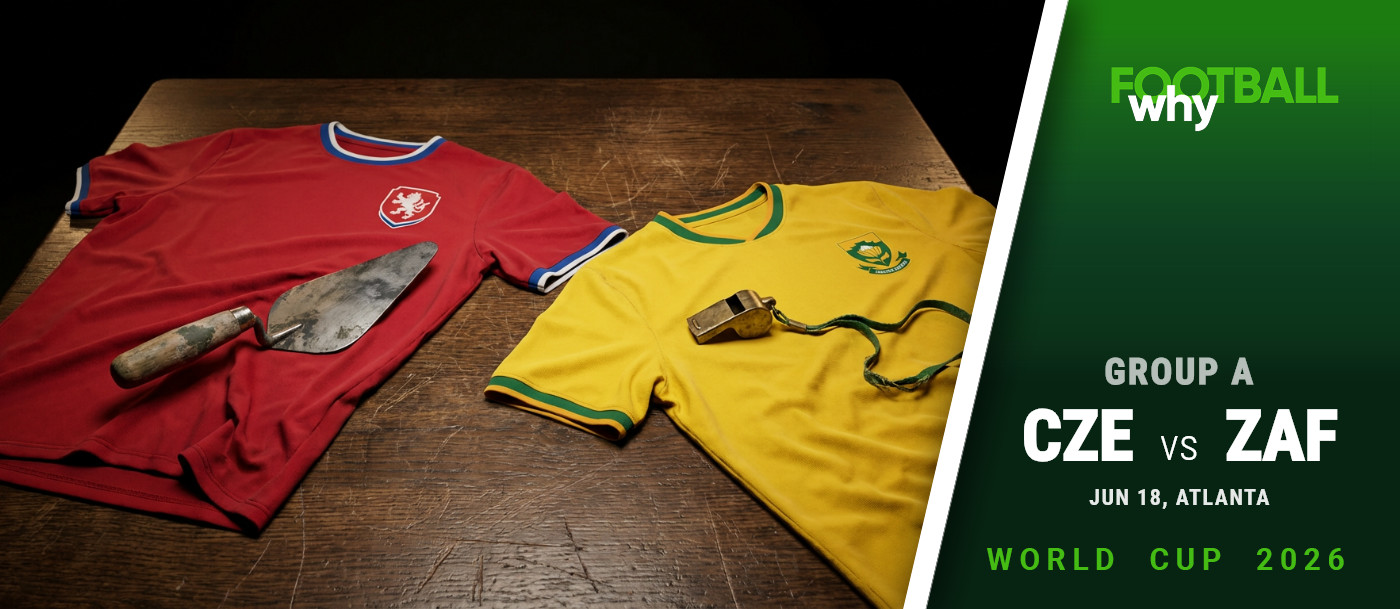
The World Cup Qualification Decider
Thursday, 18 June

Mercedes-Benz Stadium, Atlanta

Czech Republic vs South Africa FIFA World Cup 2026 Group Stage Match A Premature Retreat Punished by VAR Forecast generated:

Czechia treated their sixth-minute lead like an excuse for a long tactical nap, inviting a relentless 17-shot South African siege. Discover how a premature retreat was ultimately punished by a panicked VAR penalty.
Czech Republic vs South Africa Structural Collision

What was it?

A six-minute opener often acts like a heavy velvet curtain drawn across a sunlit room. Michal Sadílek finished a short central feed from Alexandr Sojka to establish a 1-0 advantage. The Europeans immediately retreated into the shadows. Their possession share plummeted to 38 percent.

The coaching staff began assembling a five-man defensive line after just 55 minutes. They battened down the hatches and waited for the clock to run out. South Africa initially struggled to navigate this crowded, draughty corridor. Relebohile Mofokeng arrived at halftime to stretch the pitch wider.

Evidence Makgopa stepped on after 66 minutes to provide a genuine physical focal point. The Africans eventually racked up 17 shots. They pushed forward continually, pressing as though water was seeking a crack in a rusting hull. Ladislav Krejčí picked up a yellow card as the stress mounted around his penalty area.

Inviting that much traffic into your own box inevitably courts disaster. A frantic scramble produced a clear handball. The VAR review paused the evening at 83 minutes. Teboho Mokoena stepped up and dispatched the penalty with utter conviction.

Those final fifteen minutes surged with raw, desperate energy. South Africa ran as if the turf was dissolving beneath their boots. Czechia paid the ultimate price for treating a narrow lead as a finished job.

Why stopped just short of victory?

Czech Republic

The Czech coaching staff reacted to a sixth-minute lead not as a platform to build upon, but as a fragile heirloom to be locked in a vault. Dropping into a rigid defensive shell with over a third of the match remaining effectively surrendered the midfield entirely.

This immediate retreat exposes a glaring lack of genuine wide threat or one-on-one invention within the current squad. Once the primary creators are substituted or contained, the team loses the capacity to relieve pressure through possession. They cannot carry the ball upfield, so they simply invite the opposition forward.

It highlights a deeper, systemic anxiety embedded within Czech football culture. There is a profound institutional distrust of expansive, front-foot posturing. Success is historically framed through the lens of workmanlike grit, aerial dominance, and pragmatic survival against bigger nations.

Domestic academies drill positional responsibility and set-piece mechanics while actively discouraging the kind of arrogant improvisation needed to kill off a wounded opponent. Players are taught to endure pressure rather than dismantle it.

Consequently, they end up meticulously constructing their own defensive prison, tightening the bolts until the structure inevitably collapses inward.

Why stopped just short of victory?

South Africa

South Africa’s eventual equaliser stemmed directly from a mid-game structural overhaul. Shifting to a wider shape at the interval and introducing a traditional target man later on stretched a previously claustrophobic pitch, forcing the opposition to defend uncomfortable areas.

This adaptation was strictly necessary because the current squad frequently lacks a natural penalty-box killer when key personnel are absent. They rely heavily on structured buildup and deep-lying orchestration, which can look sterile against a set block until sheer territorial volume forces a physical error.

The performance mirrors a broader tension within the South African game. There is a constant push-and-pull between European-style positional discipline mandated by the coaching staff and the public demand for indigenous, expressive flair.

Decades of isolation and fragmented development pathways created a reliance on domestic super-clubs to teach structural cohesion. Yet, when the rigid system stalls, the deeply ingrained cultural instinct to improvise a sudden, pragmatic fix kicks in under extreme pressure.

They initially respected the polite tactical script, but ultimately salvaged the evening by throwing collective, physical weight against a cracking door.

Match hero...

Michal Sadílek
Michal Sadílek operated like a diligent railway clerk managing the morning rush. He stamped the ticket at six minutes and spent the next hour ensuring nobody bypassed the midfield turnstiles. His engine relies entirely on procedural discipline; he closes angles and tracks runners without requiring the spotlight or demanding applause. When the manager withdrew him on 67 minutes, it felt like a scheduled shift rotation. Yet, removing that reliable, uncomplaining physical presence effectively severed the power line to the entire Czech structure.

...and one more

Teboho Mokoena
Teboho Mokoena functioned as the designated elder at a highly stressful community gathering. He absorbed the chaos of a 33rd-minute booking and proceeded to distribute possession as carefully as a treasurer allocating shared funds. His influence stems from an innate understanding of spatial equity; he ensures every teammate touches the ball to build collective rhythm. When the penalty arrived, handing him the ball was not a tactical decision but a communal mandate. He simply balanced the ledger.