
Czech Republic (The National Team) - National flag

Czech Republic National Football Team

The National Team

What to look for?

Police sirens and the ghosts of golden generations echo through cold Prague nights. Suffocated by boardroom scandals and a furious public, they must build a fortress from the administrative debris. They fight the urge to panic, choosing mechanical precision over reckless fireworks. Watch them absorb punishment with stoic grit before unleashing brutally choreographed aerial assaults. The machine is wounded, but its gears still grind perfectly.

Team at a Glance

What do they want?

To survive boardroom scandals and prove that a perfectly executed corner kick is a valid form of national redemption.

What are they strong at?

Extreme risk-aversion, paired with an industrial ability to turn absolutely any dead ball into a terrifying aerial bombardment.

What will they show?

A suffocating, mechanical defensive block that drags the tempo to a crawl before unleashing meticulously choreographed set-piece routines.

Why are they as they are?

Decades of political turbulence taught them that reckless improvisation is dangerous, but predictable, iterative processes ensure survival.

Chance of winning the title?

4%. Entirely possible if the tournament decides to settle every single knockout match exclusively through corner kicks and penalties.
CZECH REPUBLIC | Structural Collision

Where it hurts?

Czech Republic: current status and team news Administrative Debris and the Set- Piece Scaffold

The fallout from the Gibraltar debacle left the Czech dressing room staring into a deep leadership void. The captaincy was stripped. The public mood turned deeply combustive, demanding answers rather than federation press releases.

Tasked with navigating this administrative debris is Miroslav Koubek. The oldest-ever national coach faces the immediate, suffocating pressure of two sudden-death home playoff ties. The domestic fanbase guards its pride closely, demanding visible contrition and a genuine hierarchy reset rather than mere political manoeuvring by the federation.

Koubek’s response is a retreat into war-ready pragmatism.

He is forging a domestic-heavy spine designed entirely to compress risk and survive momentum swings. The tactical blueprint relies heavily on early diagonal service from wide areas, driven relentlessly by Vladimír Coufal. Alongside this, Tomáš Souček orchestrates an exhaustive, highly rehearsed set-piece catalogue.

Yet, a razor-thin attacking margin haunts the squad.

The entire nation holds its collective breath over Patrik Schick’s fitness. His mere presence on the pitch calibrates the opponent's defensive depth. To cure this severe over-dependence on a single forward, Koubek is desperately trying to institutionalise second-wave goals and aerial dominance through Ladislav Krejčí.

Should they navigate their March gauntlet and reach the World Cup, expect an unapologetically industrious Czech side. They will offer a compact mid-block and a relentless, set-piece-centric threat, fighting tooth and nail to prove that collective resilience can outlast institutional noise.
Embed from Getty Images

The Headliner

Czech Republic: key player and his impact on the tactical system Attritional Craft in the Penalty Areas

Double-digit goal returns from a defensive midfield position expose a unique, attritional profile. Tomáš Souček operates as a stoic, box-crashing presence, turning routine phases and restarts into imposing tactical advantages. He knits second balls together through long-stride recoveries, offering a constant, physical reference point in both penalty areas. When progression stalls, he frequently self-appoints as the solution, stepping higher to press longer lanes and force turnovers. This relentless workload accumulation occasionally unhinges team spacing, creating structural gaps when he chases the game too aggressively. Yet, without his delayed back-post surges and aerial command, the Czech midfield yields territorial control, forcing the squad into flat, lateral passing. He remains a tireless, industrious standard-bearer whose sheer physical persistence consistently tilts the finest margins of international knockout football.

The Wild Card

Czech Republic: dark horse and player to watch Elastic Glide Amidst the Steel

Early involvement in physical duels dictates the entire operating temperature of this twenty-three-year-old forward. Adam Hložek brings an elastic glide to a traditionally steel-first setup, seamlessly switching between pinning centre-backs and dropping deep to link play. Operating primarily in the left half-space, his dual-threat gravity attracts multiple markers, allowing him to release early final balls without telegraphing his intentions. This self-propelled entry into the penalty area plugs a critical tactical gap, ensuring transitions do not rely solely on static, predictable deliveries. Defences aim to nudge his compact back-lift toward the touchline, overplaying the inside cut and denying the quick wall-pass returns that activate his sudden bursts. If these central touches are denied, he risks drifting wide and conceding prime attacking territory. When fully engaged, his low cut-backs and early finishes provide the exact type of elegant, tempo-flipping impact expected to shatter deadlocks on the grandest stage.
Embed from Getty Images

The Proposition?

Czech Republic : Tactical guide - how to identify their movements and game variations on the pitch Pragmatic Crosses and the Second- Ball Magnet

Following a deeply fractured relationship with their fanbase, the Czech Republic arrives at the World Cup seeking redemption through compact pragmatism and a ruthless set-piece edge. The central conflict defining their tournament is whether their immense aerial superiority can mask severe transitional leaks when facing elite, high-tempo opponents.

Manager Miroslav Koubek demands a hybrid 4-2-3-1 that shifts into a 4-4-2 mid-block out of possession, relying heavily on direct access to striker Patrik Schick.

What to look at: If the back four sets up compactly just inside the middle third during the opening fifteen minutes, with the wingers tucked narrowly inside and the number 10 joining Schick to screen the pivot, they are executing their primary defensive trap. They want to force the opponent into rushed diagonal passes, win the ensuing second balls, and immediately establish territory for early crosses.

When transitioning into attack, the shape morphs aggressively to bypass midfield pressure.

What to look at: If the left-back narrows alongside the centre-backs while right-back Vladimír Coufal sprints high up the pitch, and the number 10 drops between the pivots, the Czechs are forming a 3-2-5 attacking structure. This bypasses man-oriented pressing and ensures a 3v2 rest-defence against immediate counters.

The primary method of progression relies on overwhelming the right flank to feed the penalty box.

What to look at: When Coufal receives the ball beyond the halfway line in the right half-space, watch Schick pin the near post while the number 10 arrives at the edge of the box. Coufal will deliver a first-time flat cross or a low pull-back, aiming to either find Schick directly or harvest the second ball for a late midfield runner.

The entire system is stabilised by the immense presence of Tomáš Souček.

What to look at: When Souček engages in a physical duel or receives the ball centrally, the number 10 will vacate the lane while the near winger tucks inside. This movement pulls the opposing defensive midfielder into the duel zone, freeing up the weak-side half-space for a rapid switch of play.

If the Czechs secure a lead, Koubek will immediately signal for survival mode.

What to look at: If the defensive block drops eight to twelve metres deeper and Schick ceases pressing the goalkeeper, they are trading possession for absolute box density. Counter-attacks will shrink to isolated runs, and the team will rely on tactical fouls and restarts to control the clock.

However, this reliance on advanced full-backs and early crossing creates a significant structural vulnerability.

What to look at: If an opponent clears the ball and immediately switches play behind Coufal while Souček has stepped out to chase a second ball, the far centre-back is dragged wide into a 1v2 situation. The central triangle breaks, leaving the cut-back lane wide open for a high-probability finish.

Despite these transitional flaws, the Czech Republic's sheer physical resilience, unmatched set-piece lethality, and disciplined mid-block make them a deeply uncomfortable, brutally effective opponent capable of grinding down the most sophisticated technical sides.

The DNA

Czech Republic: football's importance and what we will see in their game at the 2026 World Cup Guild Craftsmanship Amidst the Betting Mafia Sirens

Just days before a sudden-death World Cup playoff, police sirens sliced through the cold Prague night. The sázkařská mafie (betting mafia) raids detained referees and officials, instantly incinerating whatever fragile trust the public still held in the national federation.

Yet, amidst this administrative inferno, the national team stepped onto the pitch against Denmark, ground out a gritty 2-2 draw through extra time, and calmly converted their penalties to qualify.

Such stoic resilience stems directly from a deep-seated cultural allergy to chaos.

Living through the political repressions of 1968 and navigating the delicate 1989 Velvet Revolution taught this landlocked nation that reckless disruption is outright dangerous. A predictable, iterative process protects livelihoods.

On the football pitch, this translates into extreme risk-averse game management. When defending a lead, Czech players immediately downshift. They drag the tempo down to a crawl, commit cynical tactical fouls in the centre circle, and retreat into a narrow, suffocating mid-block.

If a centre-back attempts an unscripted, heroic vertical pass and loses possession, the carefully calibrated spacing collapses instantly. The team lacks the raw recovery pace to survive an open footrace. That physical limitation was painfully evident during a humiliating 1-5 chase against Croatia, where broken lines led to a total systemic failure.

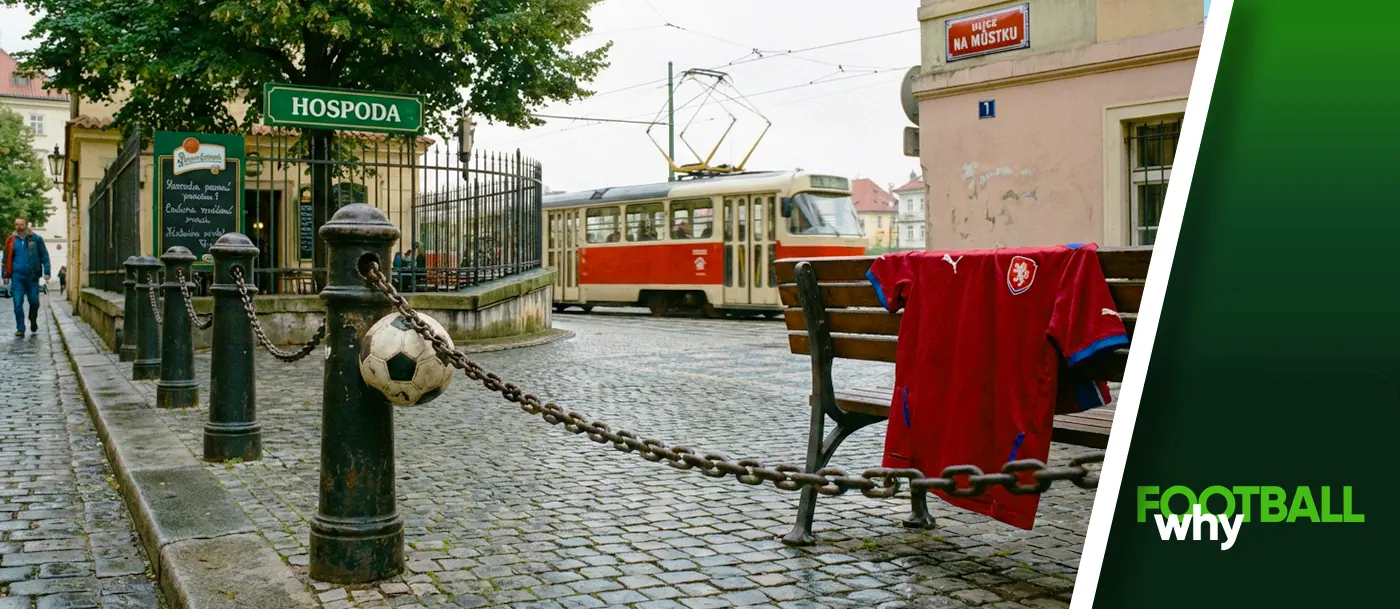
Instead of fluid improvisation, the squad relies heavily on the Austro-Hungarian legacy of bureaucratic order and guild-style craft. It is the exact same logic that keeps the urban tram networks running through Prague with mechanical punctuality. Everything has a strictly assigned slot.

Offensively, this manifests as a heavy, painstakingly choreographed set-piece inventory.

Players like Tomáš Souček orchestrate these dead-ball traps with industrial precision. If a single late runner misses his designated blocking assignment on a corner kick, the team loses its primary attacking weapon and instantly exposes itself to a lethal counter-attack. They are desperately reliant on this mechanical craft because they face a severe bottleneck of elite, one-on-one creators. The system operates as a rigid scaffold, merely waiting for a rare talent like Patrik Schick to provide the final, elegant touch.

Fortunately, the pressing and data-led laboratories of domestic club sides like Slavia Prague are slowly injecting higher-tempo software into this traditional hardware.

Watching this team requires accepting a specific aesthetic. True beauty here is rarely found in wild, unpredictable fireworks. It is found in the quiet, undeniable satisfaction of a perfectly tightened bolt holding a heavy structure together under immense pressure.
Character