

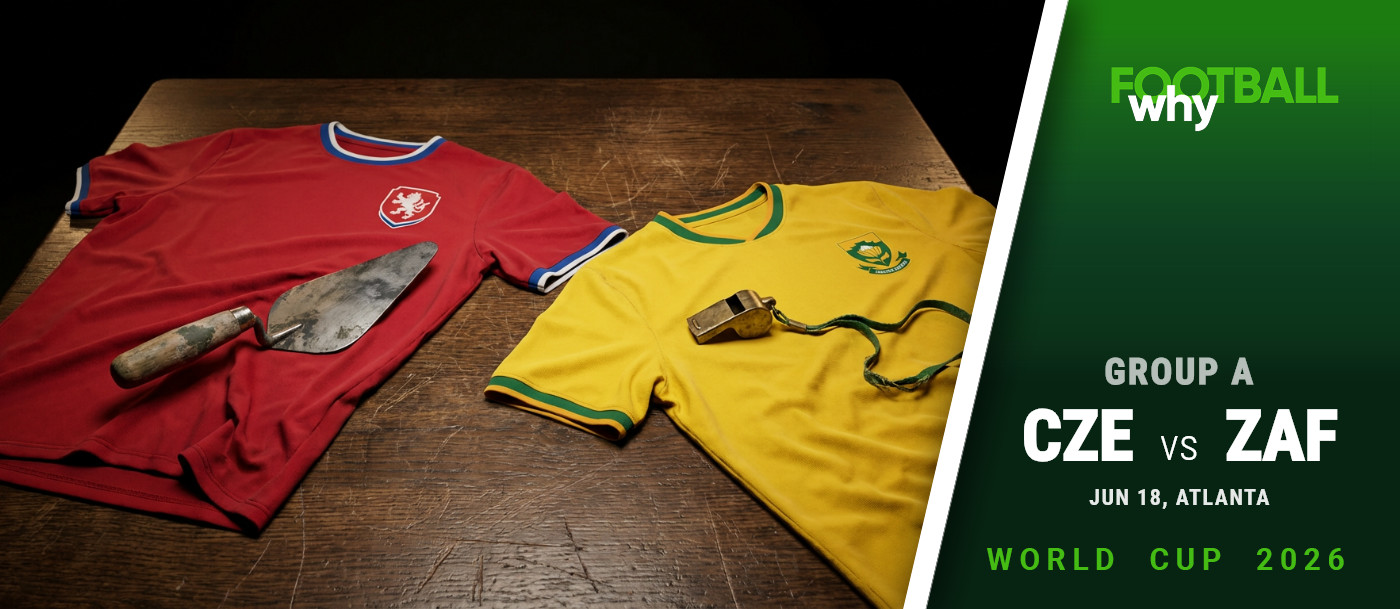
The World Cup Qualification Decider


Mercedes-Benz Stadium, Atlanta
SCORE BY AI PREDICTION: 1:0 SEE SIMULATION

Czech Republic vs South Africa FIFA World Cup 2026 Group Stage Match The Weight of Mortar on the Neighbourhood Barricade Forecast generated:

The austerity of the craftsman’s workshop collides with the warmth of the communal gathering. It is a fundamental clash of worldviews: the unshakeable belief in procedural repetition attempting to dismantle a brotherhood forged in shared, resilient endurance.

Czech Republic: One side's prayer...

The Czech camp is operating with a bunker mentality. Recent police raids on their national federation over alleged corruption have created intense media glare, prompting management to hand the captaincy to Ladislav Krejčí to insulate the dressing room. Expected by the public to secure a workmanlike victory before facing Mexico, the squad remains entirely stoic. With Patrik Schick declared fully fit, their preparation resembles laying thick mortar: methodical, unbothered by outside noise, and entirely focused on grinding down the opposition through set-piece repetition.

South Africa: ...head-on with the other.

South Africa arrive heavily insulated by their elder-led hierarchy. The perennial background noise of SAFA selection politics — where administration blunders often erode public trust — has been deliberately shut out by Hugo Broos, who relies on a settled domestic core. A draw is viewed as a highly acceptable return to keep their qualification hopes alive. With a fully fit squad and Ronwen Williams providing vocal authority, their collective mindset is about closing the shutters early, absorbing the physical pressure, and waiting for the right moment to strike on the counter.
Czech Republic vs South Africa Structural Collision

Czech Republic: How we will host...

Dream
The minimum requirement is a workmanlike victory. A draw is acceptable only if the match descends into late chaos. The public expects three points to secure qualification before facing Mexico, demanding a quiet, efficient job without unnecessary drama.

Strength
This squad operates like a reliable municipal workshop. They rely on a stoic, industrious collective effort, favouring set-piece mastery and percentage football over individual flair. They are comfortable within strict routines, trusting the procedural process over flashes of unpredictable brilliance.

Plans
Koubek intends to aggressively target the right flank, using early crosses to bypass the South African block before it settles. They have also engineered their corner routines to deliver outswingers away from the goalkeeper's catching zone, creating deliberate near-post congestion.

Fears
The underlying anxiety is a sudden collapse of discipline. If they concede early or face frustrating officiating, their stoicism can fracture. This leads to cynical fouls, a retreating defensive line, and a fatal loss of structural integrity.

South Africa: With what we arrive...

Dream
The baseline ambition is to snatch a result without leaving the back door ajar. A stalemate is a perfectly fine evening's work, provided the penalty area remains a fortress. The wider hope is to nick a winner on the break, keeping World Cup qualification ticking over quietly without descending into a chaotic shootout.

Strength
They are bound by a deep, communal resilience, functioning less as a collection of stars and more as a tightly knit neighbourhood watch. Built on a domestic club foundation, their football relies on trusted relationships and collective problem-solving rather than off-the-cuff heroics. When under pressure, they default to shared defensive responsibility.

Plans
Broos has organised a suffocating wide trap to neutralise the European crossing threat. They will double up on the flanks, forcing the opposition backwards to protect their penalty area, while keeping their midfield pivot primed to unleash sudden, long-range strikes the moment the ball is won back.

Fears
The lingering dread hangs in the air above them. They are acutely aware of their physical disadvantage against towering opponents, fearing that one clumsy foul near their own box could invite an aerial bombardment they simply cannot repel.
57%
27%
16%
Not a recommendation for betting
Tap [+] to cast your expert forecast. Can you outperform both the AI and the crowd?

How it will be...

This fixture should resemble a protracted municipal zoning dispute. The Czechs will likely process the match through rigid tram-timetable routines, funnelling play outward to isolate the South African full-backs. South Africa, conversely, will construct a stubborn neighbourhood watch scheme. They prefer closing ranks and suffocating the crossing lanes.

If the African double-teams successfully block the flanks, the focal point pivots centrally. Mokoena will loiter around the box's perimeter, waiting for a misplaced clearance. Souček is tasked with auditing that exact space. Should the Czech midfielder step out prematurely, a sudden, sighted shooting window appears.

The Czech stoicism rarely fractures under standard pressure. Yet, if the referee penalises heavy aerial contact, Krejčí might entangle himself in dissent, compromising their defensive plumb line. Late on, South Africa will likely entrust their revival to Mofokeng’s slinky, stop-start feints. The young winger could briefly unspool the European symmetry, injecting a necessary dose of township unpredictability into an otherwise strictly regulated affair.

Secret mastermind intent

Koubek’s municipal blueprint for a load-bearing right flank

General Strategy
Koubek is treating this fixture like a rigid tram timetable. The primary mandate is a workmanlike victory, prioritising a clean sheet over expansive risks. The squad knows exactly what is expected.

The tactical focal point rests heavily on the right lane. They will look to generate high-volume, early service into the penalty area. It is a strictly procedural approach designed to wear the opposition down through sheer repetition.
Antidote for the Opponent
South Africa’s transition speed is the main threat, requiring meticulous planning to contain. To counter this, Koubek demands a compact mid-block, engaging only when the opponent plays backwards or miscontrols the ball.

Defensively, they will man-mark Mokoena on the edge of the box to deny him long-range shooting windows. There is also a strict embargo on conceding cheap fouls within thirty metres, ensuring the opposition cannot rely on set-piece lifelines.
Internal Task Solving
The media glare from recent federation raids has forced a tightening of internal discipline. Krejčí’s captaincy is designed to project calm authority and prevent emotional flare-ups on the pitch. The dressing room is sealed off from the noise.

There is also a situational wildcard prepared for the referee's temperament. If the official is lenient on physical contact, the Czechs will aggressively escalate their aerial targeting of the South African centre-backs, turning the match into a grueling physical audit.
Crisis Response Plans
If the primary crossing lanes are shut down by double-teams, the Czechs will not panic. The main contingency involves short passing combinations to draw the full-back out of his established position. It is about finding the mortar joints in the defensive wall.

Once the defender commits, play will be swiftly switched diagonally to the weak-side back post. Overall, Koubek is prepared to be flexible, ready to shift to a back three and lock his wingbacks if the penalty area becomes too crowded.
Specific Match Orders
Ladislav Krejčí (Centre-Back): Hold back on any protests and avoid unnecessary yellow cards. Keep the step-out aggression in check until a clear verbal cue comes from the defensive partner. Vladimír Coufal (Right-Back): Whip in early, flat outswingers before the defensive block sets. If forced down the line twice in a row, switch immediately to the underlap-pullback pattern. Tomáš Souček (Defensive Midfielder): Lock onto Mokoena at the top of the box during all defensive set-plays. Never step out alone to press centrally if the ball is turned over in midfield.
/ What if the team concedes an early goal?

The shock-recovery protocol is immediately activated. The team will freeze the game for thirty seconds and drop the defensive line by eight metres. From there, they bypass the midfield entirely, launching direct balls toward Schick and compressing the space to win second balls.

/ What if Coufal’s crossing lanes are completely shut down?

The attacking overload is flipped. The team will use short-short passing routines to pull the opposing right-back out of position. Once the space opens, a diagonal ball is driven to the left-winger at the back post, while the central attacking midfielder underlaps.

Secret mastermind intent

Hugo Broos and the neighbourhood watch defensive blockade

General Strategy
Broos is anchoring his side in a deep, communal trench. The overarching strategy relies on a compact 4-4-2 shape, stationed roughly ten metres inside their own half, deliberately avoiding any sustained high press. It is a pragmatic waiting game.

The primary focus is on preserving tight distances between the lines and striking through calculated transitions. They will act as a unified collective, valuing shared defensive discipline over individual gambles to frustrate the opposition.
Antidote for the Opponent
The central defensive mandate is an anti-crossing operation targeting the European right flank. South Africa will deploy their winger to double up on the overlapping full-back, aiming to block the outswinging delivery at the source.

In the middle, the centre-backs are tasked with forming a front-and-back bracket around the main target man. Crucially, the midfield has been instructed to avoid conceding any free-kicks within thirty metres, removing the threat of dead-ball deliveries entirely.
Internal Task Solving
The squad’s underlying 'make-a-plan' ethos relies heavily on the goalkeeper's vocal authority. Williams is not just a shot-stopper; he acts as the on-pitch municipal planner, dictating the tempo and choosing when to launch rapid, over-the-top distributions to isolated wingers.

Furthermore, their physical engagement will be entirely dictated by the referee's threshold. If the official permits a physical contest, they will aggressively raise their box protection; if the whistle is sharp, they will maintain a strict one-metre stand-off.
Crisis Response Plans
Should the opposition successfully bypass the initial wide trap, the defensive structure will shift conservatively. The winger will drop permanently into the defensive line, forming a back five to plug the gaps and force the ball inside.

If the game state requires chasing a deficit late on, Broos is prepared to abandon caution. He will introduce a second striker, push the full-backs higher on an alternating basis, and instruct his midfield to barrage the box with cut-backs.
Specific Match Orders
Ronwen Williams (Goalkeeper): Vary the speed of distribution, launching quick throws only when the winger has clear isolation. On corners, take a high starting position to punch the ball clear through traffic rather than attempting a contested catch. Teboho Mokoena (Central Midfielder): Track the opposing midfield runner diligently during all defensive set-pieces. Reserve long-range shots for moments when an attacking rebounding structure is fully set, and entirely avoid late tackles in central defensive zones. Khuliso Mudau (Right-Back): Prioritise delaying the opposing winger by showing him down the outside channel and physically blocking the crossing lane. Commit to an attacking overlap only when the holding midfielder is explicitly covering the vacated space.
/ What if the team falls behind to an early goal?

The squad will execute a five-minute freeze protocol. They will drop into a rigid mid-block, significantly slow down the tempo, and milk every restart to drain the momentum. The focus immediately shifts to re-establishing a tight twelve-metre distance between the lines.

/ What if the opposition striker dominates the penalty area aerially?

The defensive shape will immediately transition into a back five out of possession. One centre-back will be assigned solely to contest the first contact, while the holding midfielder drops deeper to sweep up any second balls.

MAIN SIMULATION 0'-25'

The Czechs immediately target the right flank, relying on Coufal’s early, flat deliveries. South Africa’s response is a municipal-level double-team, with the winger dropping to delay the cross and the centre-backs bracketing Schick. It’s a battle of rigid routines. The Czechs keep their crosses low to avoid Williams’ catching zone, while South Africa prioritise suffocating the source. The Czechs’ disciplined 3+2 rest-defence effectively neutralises early South African attempts to switch play to Mokoena.

MAIN SIMULATION 25'-45'

With Coufal’s crossing lanes effectively shut down by South Africa’s double-team, the Czechs pivot to their backup plan: short combinations to draw the full-back, followed by diagonal shifts. However, the breakthrough comes from their set-piece engineering. By delivering outswingers to the 10-12 metre mark, they drag the delivery away from Williams’ vertical leap. A near-post distraction allows Schick to glance a header home. South Africa immediately enact a five-minute freeze protocol, dropping their tempo and resetting their distances.

MAIN SIMULATION 45'-65'

South Africa push Mokoena higher, attempting to pin the Czech right-back with earlier passes to Mofokeng. The Czechs respond with a stubborn, ten-minute embargo on right-back overlaps, dropping their winger deeper to clog the channel. South Africa manage to engineer a long-range effort for Mokoena, but Kovář saves. The Czechs refuse to over-extend, rotating their delivery patterns to low cut-backs and weak-side diagonals while banking territory and managing the game-state.

MAIN SIMULATION 65'-90'

South Africa chase the game with a desperate 4-2-4 formation, pushing their full-backs high. The Czechs immediately drop into a 5-4-1 shell, locking their wingbacks wide and clearing the ball strictly into the channels. South Africa’s volume of attacks increases, but fatigue degrades their quality. The Czechs’ aerial dominance and Souček’s disciplined sweeping of second balls neutralise the chaos. The match ends with the Czechs managing the clock through slow restarts and short corners.

And it will come to...

If the forecast holds, this would be a victory for municipal planning over improvised flair. The Czechs’ meticulous set-piece engineering and disciplined rest-defence would ultimately outlast South Africa’s structured resilience. While the South Africans would demonstrate commendable unity, their lack of central creativity would limit their comeback potential. It would be a match decided by fine margins, validating the Czechs’ incremental approach.
end of Game