
Netherlands (Oranje) - National flag

Netherlands National Football Team

Oranje

What to look for?

Drowning in the ghosts of beautiful, agonizing near-misses, they carry a nation demanding perfection over mere victory. Now, a cold pragmatism wrestles with their inherent urge to paint masterpieces. The old allergy to chaos fights a desperate need to survive knockout football's brutal dying minutes. Watch the orange wave rise — a meticulously engineered flood of geometric precision and sudden force. The dam is built; will it finally hold?

Team at a Glance

What do they want?

To mathematically prove that perfect geometry can conquer the world, finally draining the swamp of penalty shootouts.

What are they strong at?

Arrogant positional intelligence. Plus an academy conveyor belt that produces spatial mathematicians instead of mere footballers.

What will they show?

Hypnotic, asymmetrical passing grids designed to isolate wingers. They will pass you to death, aesthetically and ruthlessly.

Why are they as they are?

Centuries of building dikes against the sea taught them that one rogue ego drowns everyone.

What is a chance of getting title?

12%. Assuming they don't hold a committee meeting to decide who should take the decisive penalty.
NETHERLANDS | Structural Collision

Where it hurts?

Netherlands: current status and team news Reinforcing The Grid Around A Fragile Core

A premature red card against Ecuador saw a player trudge off the pitch with his head bowed, instantly reviving fears of familiar late-game collapses. Ronald Koeman’s squad arrives in North America carrying the weight of a highly demanding public. Currently, fans grumble just as much about the expensive Kansas City base camp logistics as they do about the team's composure in knockout rounds. The expectation across the country is absolute: dominate Group F, advance deep into the latter stages, and finally erase the lingering trauma of past penalty shootouts.

To reinforce the defensive structure, Koeman relies on Virgil van Dijk to marshal a precise high-line geometry, physically pointing and shouting to keep the back four synchronised. Denzel Dumfries provides heavy right-flank momentum, constantly demanding the ball at his feet. His overlapping sprints must be strictly timed, however, to avoid leaving the backline exposed to a quick counter.

The central corridor remains the primary concern.

The entire system hinges on Memphis Depay’s fitness to connect the final third and Frenkie de Jong to calibrate the buildup rhythm from deep. Should this creative axis fracture under tournament pressure, the squad risks defaulting to endless, harmless passing loops around the penalty area. Koeman addresses this with a ruthless physical standard in training sessions and a heavy lean on set-piece routines, aiming to manufacture goals without structural exposure. Expect a side that prioritises positional integrity and calculated efficiency over romantic chaos, ready to systematically dismantle opponents provided they keep their nerve intact.

The Headliner

Netherlands: key player and his impact on the tactical system Surveyor of the High Line

The modern high-line defence requires less tackling and more spatial mathematics. Virgil van Dijk operates as the chief surveyor of this perilous territory. When the pressure mounts, his response is invariably an open-palmed gesture of glacial deceleration. He does not chase the ball; he reorganises the geometry around it, physically pointing to shift a midfielder into a passing lane. As the stabiliser of the Dutch rest-defence, his imperturbable scanning dictates the line height and syncs the pressing triggers. Age dictates its own terms, however. A fractional loss of sprint speed turns the vast green expanse behind the backline into a glaring target for quick forwards. Still, his capacity to drop a raking diagonal pass onto a winger’s boot remains surgically precise, instantly transitioning the side from containment to attack. He stands as the immovable dike holding back tactical chaos, a modern colossus who redefined the parameters of his position.

The Wild Card

Netherlands: dark horse and player to watch Voltage in the Rigid Grid

Dutch football traditionally worships straight lines and positional geometry. Xavi Simons shatters this rigid framework with thrilling disruption. He operates with a mercurial, coiled, ambidextrous energy, fusing the raw swagger of street football with the strict obedience required by a high-pressing system. He moves with a low centre of gravity, executing sudden shoulder-feints that instantly break defensive structures and leave seasoned centre-backs tangled in their own footwork. This 23-year-old injects a vital dose of unpredictability into the squad, offering the crucial acceleration needed between midfield and the striker. Opponents regularly attempt to suffocate his rhythm early, applying immediate physical contact and forcing him toward the touchline to deny his preferred inside lanes. Should he maintain his composure through these physical abrasions, his capacity to flip a tight group-stage match with a single, disguised pass promises to be a defining spectacle of the tournament.

The Proposition?

Netherlands : Tactical guide - how to identify their movements and game variations on the pitch The Geometric Elegance of Asymmetrical Risk

A principle-first Oranje arrives seeking global validation, aiming to weaponise left-sided isolations and right-wing depth. Their central conflict remains brutally clear: a proactive, high-pressing ambition constantly wrestles with recurring spacing lapses, an unresolved back-five puzzle, and the volatile fitness of Frenkie de Jong.

Ronald Koeman’s side operates on a fluid 4-3-3 that seamlessly morphs into a 3-2-5 in possession. A double-pivot — typically Jerdy Schouten alongside Tijjani Reijnders or a fit De Jong — sets the central tempo, while the attacking geometry skews heavily to the flanks.

What to look at: If Denzel Dumfries pushes touchline-high and Nathan Aké or Micky van de Ven tucks inside near the halfway line, then the Dutch are imposing a flank stretch to pin the backline. This funnels play into a left-sided 1v1 for Cody Gakpo while maintaining a secure 3+2 rest-defence.

Building from the back relies on calculated baiting.

What to look at: If Aké steps up as an auxiliary left-back and the goalkeeper fakes a short pass, watch for them to bait the press to the right. They will then release a trademark Virgil van Dijk diagonal pass to Gakpo, or execute a rapid ground switch into zone 14.

In the final third, the system warps to maximise the 'goudhaantje' — Xavi Simons — operating as a left-sided ten.

What to look at: If Simons receives the ball between the lines, the right-sided number eight vacates the lane, and Gakpo holds the width. Expect the opponent's centre-back to be dragged out, opening a weak-side lane for Dumfries or a diagonal cut inside for Gakpo.

What to look at: If Reijnders or De Jong crosses the halfway line with their head up, and Wout Weghorst pins the centre-backs, anticipate a cutback to the D-lane or a flat cross to the back post for a quick finish.

This heavy tilt to the flanks leaves structural gaps.

What to look at: If the opposition wins a second ball after a Dutch wide delivery and switches fast behind Dumfries, Schouten is left isolated. The right centre-back lane becomes exposed, setting up a high-xG cutback before the Dutch rest-defence can reset.

When under siege, Koeman issues risk-floor hand signals from the touchline, dropping the team into a 4-4-2 survival block.

What to look at: If leading, the block drops 8-12 metres, pressing cues are muted, and the fullbacks narrow. They concede territory to ensure second-ball control, comfortably accepting low-quality wide crosses.

Despite the inherent vulnerabilities of their high-wire asymmetry, the sheer geometric elegance of their build-up and the explosive potential of their wide overloads make the Dutch a mesmerising, proactive force capable of dismantling any elite defensive structure.

The DNA

Netherlands: football's importance and what we will see in their game at the 2026 World Cup Geometry, Water, and the Weight of Consensus

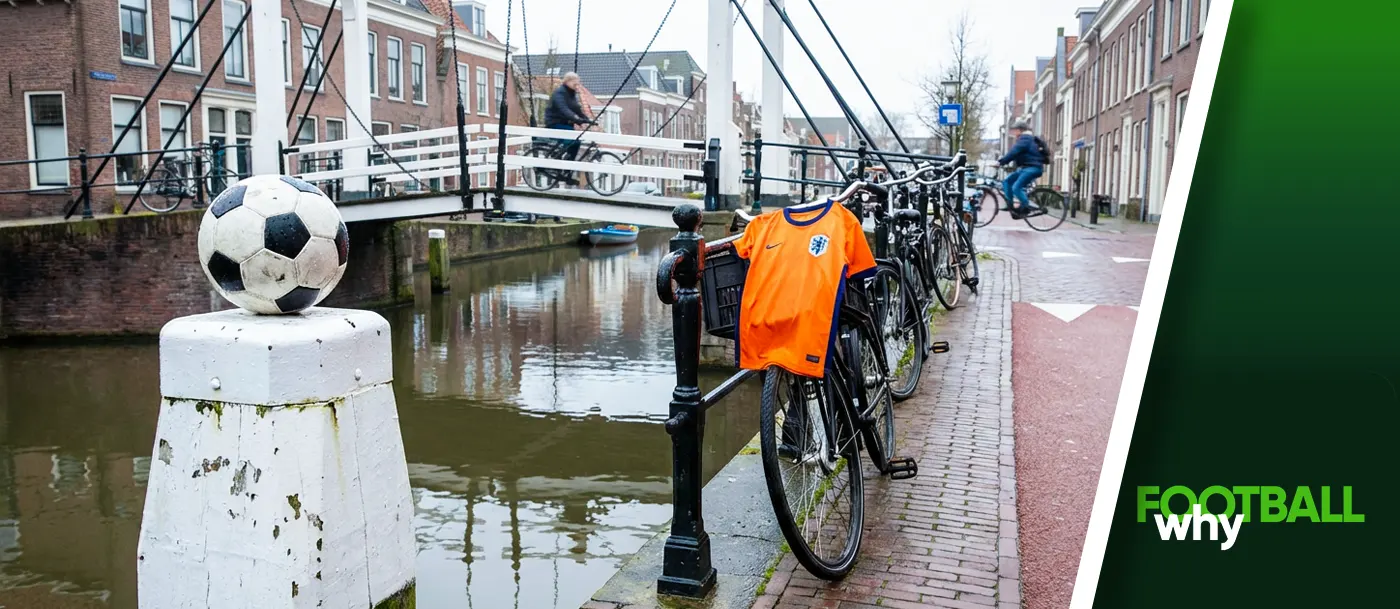
The rhythmic clatter of bicycle chains echoes outside the Johan Cruijff Arena, a deceptively serene soundtrack before the blazing orange spectacle inside. The casual global spectator usually tunes in expecting to watch bohemian artists painting free-form, attacking masterpieces on the grass. The on-pitch reality relies on industrial precision and rigid negotiation.

Picture a local water board committee — the waterschappen — debating canal maintenance in a provincial lowland town. A farmer, a banker, and a teacher sit around a scratched wooden table, armed with blueprints, knowing that one weak dike drowns them all. They argue bluntly, strip away personal ego, and eventually agree on a mathematically precise maintenance grid.

This communal survival mechanism directly shapes their famous high-line positional play.

The pitch operates as a dry polder to be managed. Every player must occupy a specific geometric zone, a habit famously drilled into them via elite academy curricula from childhood. When Virgil van Dijk barks at a fullback to step up two yards and close a passing lane, it is not merely a tactical suggestion; it is active flood prevention.

Consider a traditional birthday gathering in an Amsterdam living room. Guests sit facing each other in a ring, drinking coffee, ensuring nobody speaks too loudly or claims too much attention. Anyone attempting to stand on a table and declare themselves the hero is immediately mocked back into their chair. Conformity to the group provides the ultimate safety net.

A deep-seated preference for collective order makes unscripted moments on the pitch highly uncomfortable. When an opponent breaks the tactical blueprint, visible hesitation sets in. During the 2025 Nations League quarter-final against Spain, as the match dragged into a penalty shootout, players stood with hands on hips, retreating into cautious over-deliberation before ultimately missing their kicks. The trauma of the 1974 and 2010 finals creates a self-fulfilling prophecy where late-game chaos feels fundamentally illegitimate.

The procedural academy system yields a polyethnic pipeline of highly technical, versatile players. It also leaves the backline vulnerable to blunt, direct physicality. When an opponent bypasses the press with a crude long ball — as Ecuador did in a 2026 friendly, forcing a defender into a panicked, red-card challenge — the meticulously planned structure short-circuits.

A pragmatic shift is quietly occurring behind the scenes. The national federation recently began importing club-level set-piece scientists to cure these knockout wobbles, embracing cold tournament survival over traditional aesthetic purity. The choice to base the 2026 camp in Kansas City — a ruthless, performance-first logistical decision that alienated traveling fans — proves the point.

A beautiful blueprint means nothing if the basement floods. Sometimes, you just have to fix the leak and cycle home in the rain.
Character