
Bowing to giants they intend to dismantle, they carry a historical glass ceiling. It has cracked repeatedly, yet never shattered. Bureaucratic caution begs for safe respectability. Meanwhile, fierce ambition wages war against their lack of physical mass. Watch the pitch shrink into a flawlessly synchronised, suffocating trap. Then, witness it explode into lightning-fast strikes. The perfect machine is ready to rewrite its code.
Team at a Glance
What do they want?
To finally smash through the Round of 16, preferably without violating any corporate budgetary guidelines.
What are they strong at?
Terrifyingly flawless synchronisation. They will trap you, launch a lethal counter-attack, and then politely tidy the dressing room.
What will they show?
A suffocating defensive hive-mind that instantly transforms into a blur of razor-sharp, wide-to-central attacking geometry.
Why are they as they are?
Surviving suffocating urban density teaches you that one unpredictable ego can derail the entire morning commute.
What is a chance of getting title?
8%. Highly probable, assuming their brilliant tacticians can finally figure out how to engineer pure physical mass.
Where it hurts?
Japan: current status and team news
Flawless Engineering on Razor-
Thin Margins
A historic 1-0 victory at Wembley recalibrated expectations across Tokyo, only for the national federation to immediately print a financial budget planning for a standard second-round exit.
This bureaucratic caution infuriates a public desperate for a global breakthrough.
Fans want to see Hajime Moriyasuβs squad finally dismantle their historical knockout barriers. On the pitch, the manager stands on the touchline demanding a highly compressed defensive block, instructing players to absorb pressure before unleashing rapid, wide-to-central counter-surges. The entire attacking system relies heavily on Takefusa Kubo and Kaoru Mitoma. Kubo constantly scans the half-spaces to thread precise final passes, while Mitoma drops his shoulder to isolate and beat defenders on the left flank.
If opponents successfully double-team these wide conduits, the forward momentum stalls.
The team often resorts to floating predictable crosses into a crowded penalty area. Furthermore, aerial vulnerability and depth concerns behind young goalkeeper Zion Suzuki leave the six-yard box operating on razor-thin margins against taller, heavier forwards.
To reinforce the ranks, Moriyasu has codified strict defensive lanes and prioritised aggressive set-piece survival drills in training. He plans roster rotations specifically to keep his wide attackers fresh for late-game sprints. Anticipate a side that defends with meticulous collective synchrony and attacks with sudden, surgical width. The upcoming campaign serves as a fascinating test of whether flawless tactical engineering and tireless running can compensate for a sheer lack of physical mass.
The Headliner
Japan: key player and his impact on the tactical system
Frictionless Geometry in the Half-
Space
A collective intake of breath ripples through the stadium the moment the ball arrives at the right half-space and a diminutive figure drops his shoulder. Takefusa Kubo thrives in these claustrophobic margins. He dismantles defensive structures with sudden, surgical hip feints, slipping through gaps before the centre-back can even plant their feet. When a heavy centre-half clips his ankles, he does not retaliate. He simply adjusts his socks, and his irritation distils into colder, more deceptive reverse passes. The national setup relies on him as the primary cognitive processor for their wide-to-central surges. Without his disguised timing and quick glances over the shoulder, the attacking machinery often stalls, defaulting to predictable, looping crosses. The looming danger is cumulative fatigue. If his processing speed drops under heavy tournament minutes, the entire attacking circuitry loses its cutting edge. Watching him thread a slide-ball through an invisible gap remains a masterclass in disciplined audacity. He is a technician turning immense pressure into pure, unhurried inevitability.
The Wild Card
Japan: dark horse and player to watch
Friction in the
Polished Machine
A cheeky grin flashes just before the winger drops his shoulder and accelerates into the defender's chest. Koki Saito introduces a subversive, staccato rhythm to a national squad typically defined by seamless, industrial precision. He thrives on jittery step-feints, actively inviting heavy physical contact near the touchline rather than shying away from it.
He brings the chaos the blueprint occasionally needs.
The 24-year-old offers a direct, foul-drawing alternative that prevents the attacking patterns from becoming entirely predictable. As opponents compress the central lanes, his explosive first step allows him to pry open vital cut-back opportunities, dragging fullbacks out of position. The primary risk lies in his decision-making speed under heavy fatigue. Rival defenders will attempt to double-team him early, baiting him into rushed, early crosses or forcing him to over-dribble straight into a wall of shins. Watching him attempt to dismantle elite defensive structures with relentless, battle-tested pacing promises to be a fascinating subplot of the upcoming campaign.
The Proposition?
Japan : Tactical guide - how to identify their movements and game variations on the pitch
Shape-Shifting Precision and the Half-
Space Trap
Hajime Moriyasuβs shape-shifting Samurai Blue arrive with an explicit mandate: to reach a first-ever World Cup semifinal. A fierce tension defines their approach: an elite, proactive ambition constantly wrestles with a structural reliance on Wataru Endoβs anchoring, severe wingback height exposure, and the struggle to maintain possession coherence under top-tier pressing.
Operating from a fluid 3-4-2-1 that expands into a 3-2-5 in possession, the squad uses wingbacks to hold maximum width, allowing twin tens to occupy the half-spaces. A single pivot dictates the tempo, rolling his studs over the ball to deliberately recycle possession and pry open outside-in passing lanes.
What to look at: If within the first ten minutes the defensive line settles near the halfway mark, the wingbacks push level with the tens, and an outside centre-back like Ko Itakura boldly steps beyond the first line, then the team is imposing 3-2-5 territorial control. This deliberate stance lures the press to free the right half-space for Takefusa Kubo.
Bypassing pressure requires swift, hybrid morphing in the build-up phase.
What to look at: If the goalkeeper plays a short pass under heavy man-marking and Endo drops between the centre-backs while pointing for the wingbacks to delay their forward runs, they are manufacturing a 3v2 advantage on the first line. This frees an outside centre-back to carry the ball forward and hit the tens between the lines.
The primary attacking vector relies heavily on right-sided passing chains to orchestrate surgical strikes.
What to look at: If the ball crosses the halfway line through Kuboβs lane, the right wingback sprints outside the opposing fullback, and Ayase Ueda checks to the near post with a raised arm, anticipate a low cut-back to the edge of the box or a disguised reverse pass for an across-goal finish.
What to look at: If Kubo takes a touch and Ueda darts violently across the front centre-back while Kaoru Mitoma holds his boots on the weak-side touchline, watch the defensive block drag to the right. This movement unlocks a far-side 1v1 for Mitoma or a delayed cut-back window.
This aggressive width demands a heavy structural toll.
What to look at: If opponents aggressively man-mark Endo, force a wide touch, and quickly launch a long diagonal into the right wingback's blind spot after a turnover, the outside centre-back is dragged wide. Rest-defence gaps immediately open in the half-space, leading to a highly dangerous cross to the penalty spot.
To survive these frantic moments, Moriyasu preaches 'Bonji tettei' β doing the basics perfectly β signalling from the technical area to drop the side into a resilient 5-4-1 mid-block.
What to look at: If protecting a narrow lead, the block retreats 12 to 18 metres, the first line stops at the penalty arc, and pressing intensity drops to a simmer. The side trades possession for sheer box density, relying on goalkeeper Zion Suzuki to manage the tempo by holding the ball just a second longer.
Watching this blueprint unfold provides a masterclass in synchronised precision. The ability to seamlessly toggle between suffocating containment and lightning-fast, wide-to-central strikes makes them an incredibly thrilling transition force.
The DNA
Japan: football's importance and what we will see in their game at the 2026 World Cup
Precision Engineering in a
Compressed Island Workshop
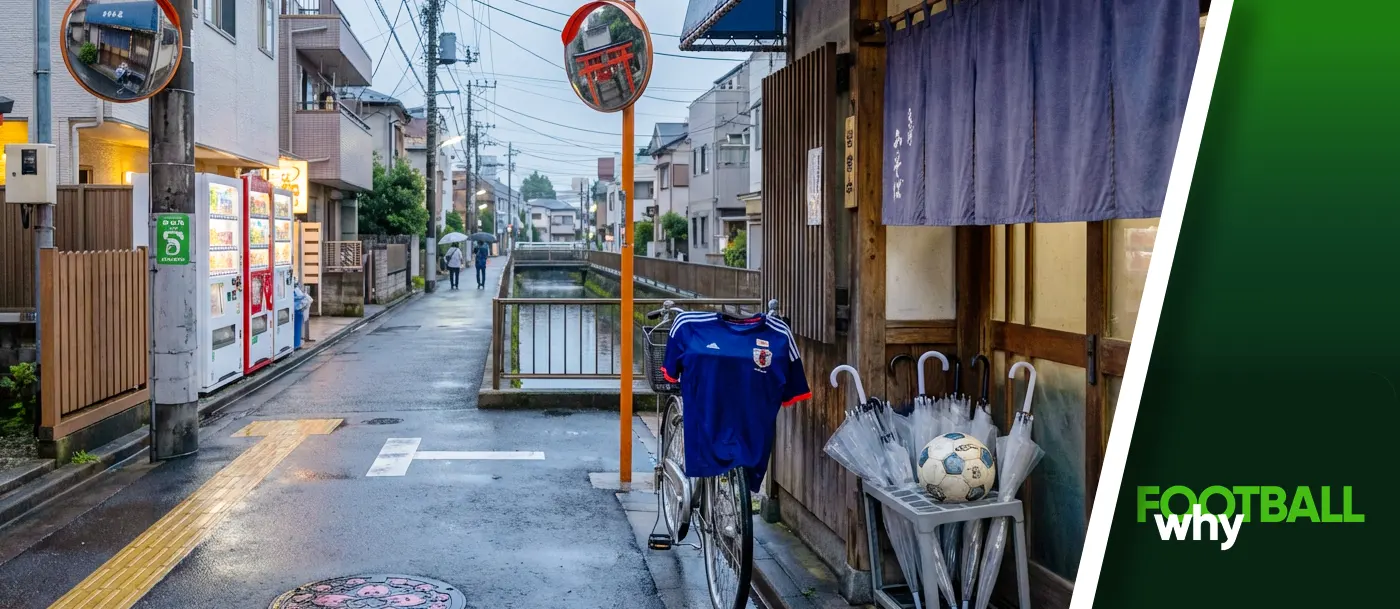
Stand on the platform at Shinjuku station during the morning rush. Thousands of commuters navigate a suffocatingly dense space without a single collision, raised voice, or broken stride. They follow painted lines, anticipate the movements of strangers, and subordinate their personal momentum to the flawless flow of the crowd.
Translated to a rain-slicked football pitch, this island-density survival tactic becomes a terrifyingly synchronised compact block.
Beneath the polite, tireless running lies a lethal, meticulously rehearsed trap. The players absorb pressure collectively, shifting side to side in perfect unison, before triggering rapid, wide-to-central transitions.
Consider the process of changing a supplier in a mid-sized Tokyo logistics firm. A junior clerk drafts a proposal, which must then receive physical ink stamps β the hanko β from six ascending layers of management before a single yen is spent. If an unexpected variable arises during a meeting, the entire room freezes, deferring to the manual rather than improvising a quick fix.
This liability-sharing reflex dictates the national team's severe intolerance for unstructured play.
When matches devolve into unpredictable scrambles, their decision-making latency spikes. During the late stages of their 2024 Asian Cup exit against Iran, towering forwards bypassed the Japanese tactical script with relentless aerial bombardments. Instead of autonomous problem-solving, the squad defaulted to safe, risk-averse clearances, desperately trying to restore order.
They rely on technical precision and low-centre-of-gravity agility to navigate compressed spaces. Yet, the lack of sheer physical mass remains a glaring vulnerability, turning defensive corners into terrifying hazards against heavier opponents.
To counter this physical deficit, a new generation hardened in the bruising transitions of European leagues is subtly altering the national blueprint. They blend traditional harmonious spacing with a colder, more ruthless edge, backed by dedicated dead-ball analytics to survive the physical onslaught of knockout football.
The perfect machine will occasionally falter against a blunt hammer. When it does, the players simply sweep up the broken gears, bow to the travelling support, and return to the workshop to meticulously redesign the circuitry for tomorrow.