

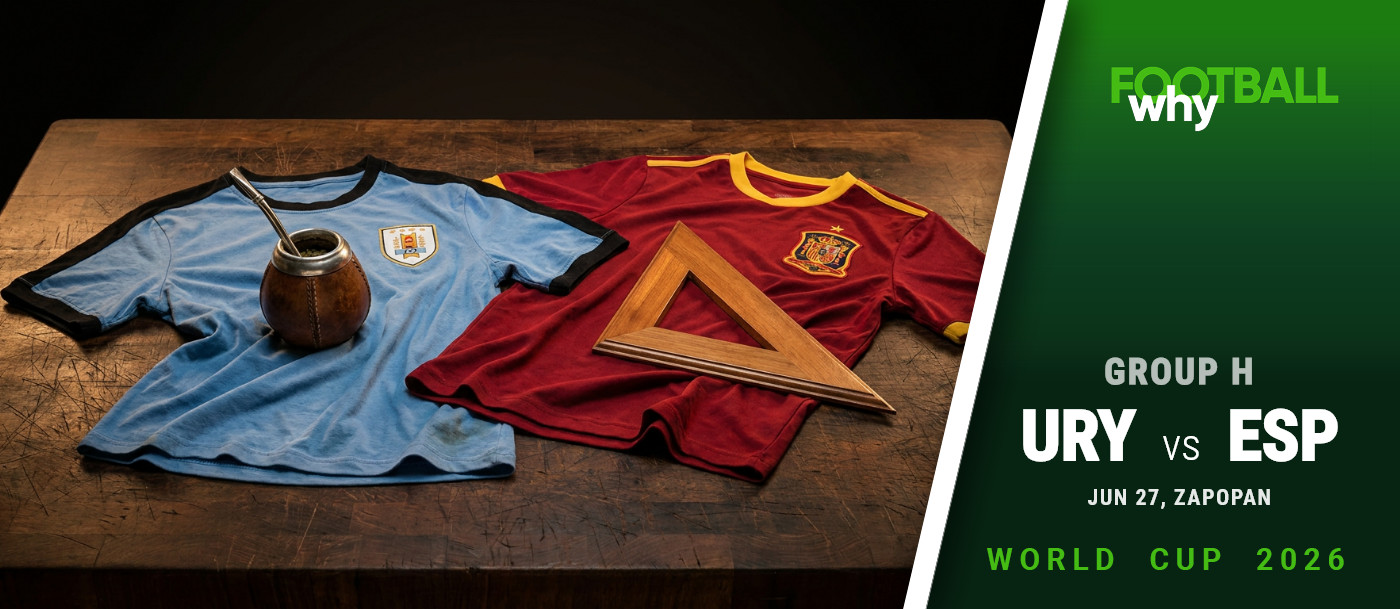
The World Cup Qualification Decider
Saturday, 27 June

Estadio Akron, Zapopan

Uruguay vs Spain FIFA World Cup 2026 Group Stage Match A faulty shaver, a fumbled cross, a bitter exit Forecast generated:

Spain passed the ball like bored civil servants, but a freakish slip from Fernando Muslera handed them a 1-0 win. Discover how a single handling error settled an afternoon of suffocating friction and sterile circulation.
Uruguay vs Spain Structural Collision

What was it?

The afternoon air felt entirely vacuum-sealed, choked by endless, lateral shuffling. Eleven red shirts swept across the grass like a malfunctioning electric shaver — buzzing furiously, shifting weight, but never actually cutting the skin.

Spain managed a mere six shots in ninety minutes. Only one of those hit the target. Uruguay produced even less, scraping together a dismal 0.20 expected goals from five attempts.

The decisive moment arrived not through attacking brilliance, but a sudden, calamitous human glitch. Marcos Llorente drove a low cross from the right wing, and Fernando Muslera simply fumbled it into his own net. The goalkeeper, visibly shattered, asked to be substituted at half-time.

Marcelo Bielsa attempted to inject chaos, throwing Federico Viñas forward to form a desperate front two. The South Americans ran themselves ragged, crashing into red shirts as if trying to shoulder-charge a moving train. Yet, the tactical shift only hollowed out their own midfield.

Agustín Canobbio’s stoppage-time red card provided a fittingly bitter punctuation mark. The Europeans progress having barely broken a sweat, while their opponents depart with the agonising realisation that raw effort means nothing without a sharp edge.

Why not go for the win?

Uruguay

Uruguay ran headfirst into the limits of their own creative ceiling. The desperate need to find an equaliser pushed the team up the pitch, but that visceral intensity quickly drowned in a tactical bottleneck where effort far outstripped invention.

When the coaching staff dismantled the midfield to add a second striker, the side gained physical presence but completely abandoned the flanks. They sprinted faster and tackled harder, but attacked with less coherence, leaving vast, empty channels that allowed their opponents to breathe easily.

This final-third bluntness highlights an awkward structural flaw in the current generation. The modern Uruguayan player excels at high-intensity pressing and attritional duels, but fundamentally lacks a natural connector to pause the play and thread a pass when the opposition retreats into a low block.

If an opponent neutralises direct counter-attacks and smothers set-piece opportunities, the tactical playbook effectively runs dry. The team knows exactly how to suffer, but struggles immensely to manufacture openings from static possession.

Compounding this is the historical fragility between the posts, a recurring anxiety that manifested once again with an unforced error at the worst possible moment.

Raw grit serves to absorb punishment, but it ultimately shatters when the collective imagination fails to provide a way out.

How did they clinch it?

Spain

Spain secured their victory by managing the tempo with a cold, almost bureaucratic detachment. Having edged ahead, the European side simply anaesthetised any attempt at a fightback, burying the contest beneath a blanket of short, risk-averse passes.

The substitutions in the second half reflected a distinctly conservative bias. The changes were not designed to stretch the lead or quicken the transitions, but rather to reinforce the central structure and manage the physical load on the midfielders.

The Spanish defensive shape held firm thanks to a meticulous, preventative retreat. By always keeping a safety net behind the ball, anchored by disciplined holding midfielders, they snuffed out the roots of any potential Uruguayan counter-attack.

This logic of extreme control stems directly from their foundational coaching philosophy. The players are drilled from childhood to prioritise ball retention, constantly form triangles, and absolutely refuse to gamble on low-percentage passes.

Yet, that very technical schooling frequently condemns them to a flat, toothless circulation. The team hoards territory and dictates the pauses, but becomes highly predictable, lacking genuine aggression when approaching the penalty area.

The win was built on a cautious monopoly: they passed the ball until the clock simply ran out, refusing to engage in a contest that might force them to sweat.

Match hero...

Mathías Olivera
Mathías Olivera stood like the last sturdy post of a decaying fence. As the midfield stretched itself ragged chasing the game, the defender tackled, blocked, and absorbed the pressure out wide in near-total isolation. His endurance does not stem from elegant technique, but from a deeply ingrained, pragmatic survival instinct: when the system leaves you exposed, you simply dig your heels in and bite back. He held his ground, delivering the exact quota of bodily sacrifice demanded by the shirt.

...and one more

Marcos Llorente
Marcos Llorente acted as the sudden jolt that briefly woke everyone from a heavy, post-lunch stupor. Slotted in at right-back, he paired positional discipline with sharp, diagonal sprints that the opposing defence failed to track. He exploited the sluggishness of the passing circuit to break lines from deep. His immense physical engine allowed him to surge forward without compromising the defensive structure behind him, proving that even sterile possession requires occasional, violent acceleration to yield anything meaningful.