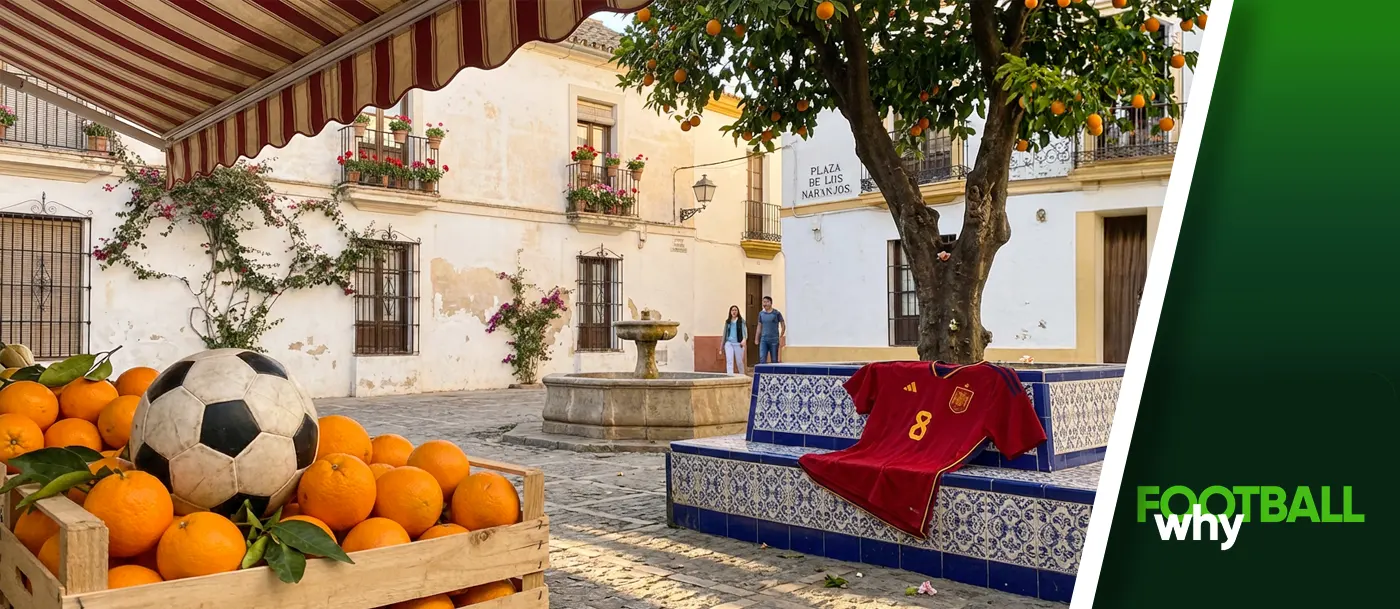
Shadows of a golden era still dictate every pass. They carry the heavy silver of recent triumphs, yet the echo of old stalemates haunts them. Now, they battle boardroom chaos and the terrifying temptation to pass the ball into infinity. Watch a mesmerising, hypnotic rhythm suddenly detonate into a ruthless, wide-flanked strike. It is the beautiful, fragile art of absolute control.
Team at a Glance
What do they want?
To conquer the world, naturally, but only if they can do it while maintaining 75% possession and impeccable manners.
What are they strong at?
Geometric obsession. Backed by an endless conveyor belt of midfielders who simply refuse to surrender the ball.
What will they show?
A hypnotic, thousand-pass lullaby that suddenly erupts into an electrifying sprint down the wing.
Why are they as they are?
Centuries of negotiating shared plaza spaces taught them that patience and consensus always beat chaotic risk.
What is a chance of getting the title?
18%. Highly probable, provided they remember that passing the ball into the net actually counts as a goal.
Where it hurts?
Spain: current status and team news
Tailoring A Suit
Without Madrid Threads
Spain set up camp near Atlanta carrying a peculiar domestic neurosis, attempting to tailor a tournament suit while deliberately leaving out the heavy white fabric of the capital. The reigning European champions intend to prove their collective pattern outlasts any single club crest.
Luis de la Fuente’s squad selection turned a routine announcement into a bustling provincial broadcast of grievances. The complete absence of Real Madrid personnel dominates the airwaves. Meanwhile, the medical staff hover anxiously over Lamine Yamal and Nico Williams, treating their hamstrings like rusted clock-tower escapements.
Those two wide players hold the keys to Spain's verticality. Without them fully fit, the recent scoreless draw against Egypt revived old nightmares of endless, harmless passing loops around the penalty area. The team simply circulates the ball in polite triangles until the final whistle mercifully blows.
Rivals have already identified the loose threads on the right flank. They will dump traffic into that channel, testing a makeshift rotation of Pedro Porro, Marcos Llorente, or Marc Pubill. If Eric García steps in, opponents will deliberately target the back post with heavy aerial traffic.
The opening exchanges will reveal whether this bold experiment in squad building holds its shape under pressure. Viewers can expect a side desperate to dictate the tempo, waiting to see if those explosive wide forwards can stitch the final, decisive seams before the whole ensemble frays.
The Headliner
Spain: key player and his impact on the tactical system
Cold Geometry Of The Anchor
The palms push downward in a glacial, calibrated gesture. Rodrigo Hernández does not demand the ball; he simply arrives where the system requires him.
In an era obsessed with frantic transitions, he remains upright, scanning the pitch to execute a half-turn reception before slipping a disguised diagonal pass to the weak side. He acts as the structural anchor of the 3+2 build-up. Without his positioning, the interiors push too high, the defensive shape fractures, and the wingers starve in isolated pockets.
He maps the pitch with cold precision.
However, his instinct to plug every defensive gap can occasionally drag him out of the crucial central areas just outside the penalty box. A scorer of European finals and a perennial tournament MVP, he has refined the holding midfield role into an act of supreme, quiet governance.
The Wild Card
Spain: dark horse and player to watch
A Brazen Spark In The Grid
Spain constructs neat, methodical passing triangles. This eighteen-year-old shatters that predictability with a simple drop of the shoulder.
Lamine Yamal stands upright on the right flank, scanning the defensive line with a brazen calm before executing a whip-feint that instantly unlocks the half-space. He provides the non-negotiable one-on-one separation that a possession-heavy system desperately requires to avoid stagnation.
Opponents will try to jam his first touch on the touchline and force him onto his weaker foot, hoping to frustrate him into rushed decisions against entrenched low blocks.
Yet, his ability to bend the defensive shape and deliver outswinging crosses to the back post shifts the entire match layout. He transforms harmless passing loops into lethal scoring sequences. Watching him manipulate seasoned full-backs will be one of the most compelling spectacles of the tournament.
The Proposition?
Spain : Tactical guide - how to identify their movements and game variations on the pitch
Geometry, Gravity,
and the Sudden Vertical Cut
Spain arrive in North America tasked with proving their Euro 2024 triumph was not a fleeting peak, but the dawn of a consolidated era. The mission is clear: weaponize their traditional possession model with ruthless, wing-driven verticality, anchored around a singular midfield metronome.
However, this high-control architecture is constantly shadowed by a severe flaw. If their counter-press fails, the spaces behind their advancing full-backs become gaping wounds.
Under Luis de la Fuente, the team operates from a 4-3-3 baseline that fluidly reshapes into a 3-2-5 when they hold the ball. The system is designed to impose an immediate field tilt.
What to look at: If you see the defensive line pushed near the halfway mark, with Rodrigo Hernández stationed just ahead of the centre-backs, watch the number 10 (likely Dani Olmo) step up alongside the striker. This is the trigger to force the opponent into hopeful long balls, allowing Spain to harvest the second balls and immediately isolate their wingers out wide.
The progression is highly deliberate. Spain overloads the left channel — often using Marc Cucurella and Nico Williams — to draw the opponent's defensive focus. This territorial gain acts as a decoy.
What to look at: When Lamine Yamal receives the ball on the right touchline, notice how the right-back anchors deep while the striker pins the near-post defender. Yamal will either drift inside to slip a pass to Olmo, or whip an outswinging cross to the weak-side winger arriving late at the far post.
Everything revolves around Rodri. The entire team warps its shape to ensure he has a clear passing lane, serving as both the control axis and the primary defensive screen.
What to look at: When Rodri receives the ball facing forward, the left interior pushes high and the number 10 occupies the right half-space. This baits the first pressing defender, opening a pristine diagonal passing lane directly to the far winger.
Yet, this extreme width and aggressive posture carries a heavy price tag.
What to look at: If an opponent manages to evade Spain’s initial counter-press and launches a fast diagonal ball behind the right-back, the centre-back chain stretches to breaking point. Rodri is forced to over-extend, vacating the crucial central zone, leaving the far full-back isolated against a high-probability tap-in at the back post.
If disaster strikes late in the game, the blueprint changes.
What to look at: After the 75th minute, if trailing, a more attacking right-back like Pedro Porro enters, the pivot becomes solitary, and an extra runner floods the box. Spain abandons pure control for crossing volume, accepting massive defensive risks to hunt second balls.
Despite the inherent vulnerabilities of their high line, Spain remains a mesmerizing spectacle. The sheer intelligence of their spacing, combined with the sudden, breathtaking electricity of their young wingers, ensures that when the team clicks into gear, they are capable of passing any opponent into total submission before delivering a lethal, vertical blow.
The DNA
Spain: football's importance and what we will see in their game at the 2026 World Cup
Negotiating Space
In The Sunlit Plaza
Step into any shaded plaza in Seville during the midday heat. A person does not simply walk straight across the square. They navigate a dense, overlapping lattice of cafe tables, neighbourhood elders arguing over coffee, and children chasing stray dogs.
If someone bumps a chair, they do not shout. They nod, murmur a quick apology, and adjust their path.
This is the art of shared space. It is a daily negotiation, a survival tactic in a country historically scarred by heavy-handed central authority and defined by fiercely guarded regional autonomy.
Watch the national team circulate the ball against a deep defence, and that exact plaza etiquette appears weaponised on the grass. The players form tight, overlapping triangles, recycling the ball in endless, unhurried arcs. They are not merely passing; they are establishing a shared rhythm.
The ball acts as the great mediator between Basque grit, Catalan geometry, and Andalusian flair.
Casual spectators often yawn at this. They dismiss the overwhelming possession statistics and agonising stalemates — like the 0-0 draw against Egypt in March 2026 — as arrogant, harmless passing loops. They miss the hidden, simmering tension entirely.
Imagine haggling for tomatoes in a bustling Valencia market. A buyer does not demand the lowest price immediately. They ask about the vendor's family, complain about the humid weather, and let the conversation simmer until the exact right moment to strike a deal presents itself.
This is the slow, deliberate extraction of an advantage without rupturing the relationship.
On the pitch, this mindset translates to a profound aversion to sudden, chaotic risk. The team governs the tempo, methodically waiting for the opponent to lose focus. Yet, their recent European Championship victory revealed a sudden, violent evolution.
When the endless passing loops finally disorganise the defence, a winger suddenly detonates down the flank. It converts polite control into a lethal, vertical cutback.
However, this delicate architecture remains highly fragile. When faced with brutal aerial bombardments or institutional noise — like the recent disciplinary scandals casting a dark shadow over the federation's boardroom — the team's instinct is to retreat into even safer, narrower passing networks.
To counter this reflex, the coaching staff is frantically grafting raw athleticism and dead-ball routines onto the squad. They are attempting an urgent renovation of a historic playing style before their 2030 co-hosting duties begin.
The atmosphere surrounding this squad is a complex cocktail of soaring pride and nervous dread. It is a beautiful, fragile mosaic that threatens to shatter if the rhythm drops for even a single second. One simply has to accept that brilliance and frustration naturally coexist within this meticulous system.