

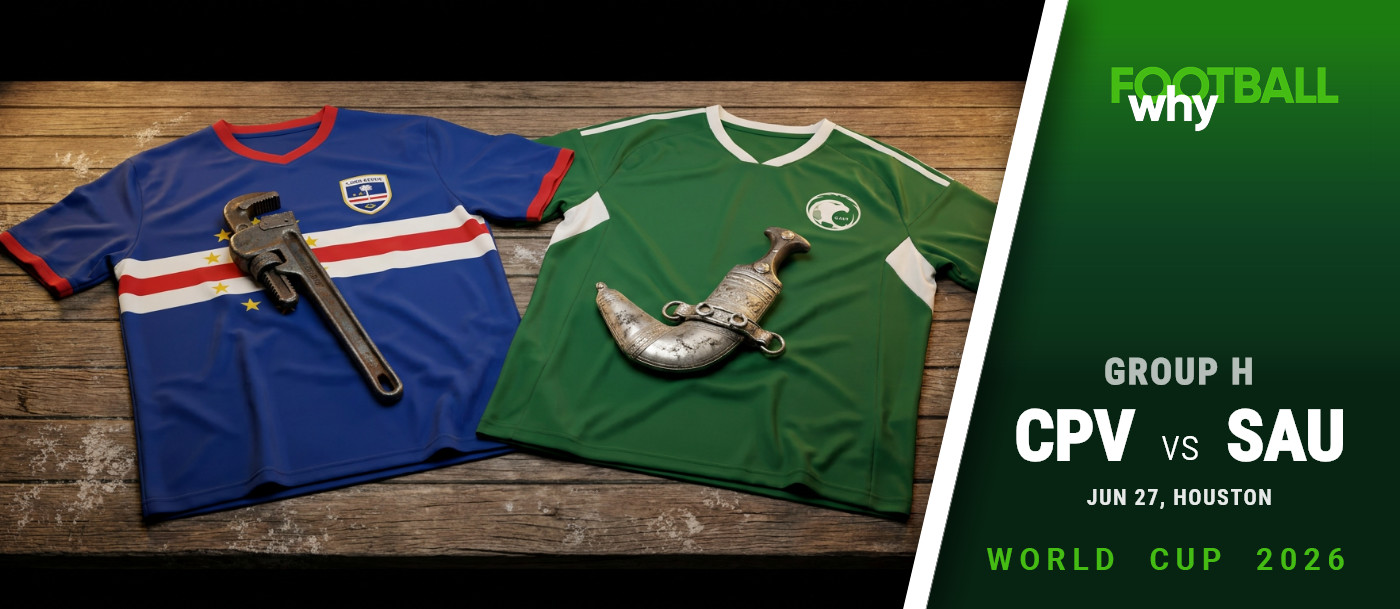
The World Cup Qualification Decider
Saturday, 27 June

NRG Stadium, Houston

Cabo Verde vs Saudi Arabia FIFA World Cup 2026 Group Stage Match Rhythmic seawalls and the hollowed engine room Forecast generated:

Saudi Arabia hammered fruitlessly against Cape Verde’s rhythmic defensive block, generating a miserable 0.40 expected goals in a suffocating 0-0 draw. Discover why a bizarre midfield tactical shift condemned the Asian powerhouse to an evening of aimless crosses.
Cabo Verde vs Saudi Arabia Structural Collision

What was it?

The stifling Texas heat baked the pitch into a claustrophobic grid. Cape Verde swayed across the grass like a synchronized Atlantic swell, absorbing pressure without fracturing. They set up in a deep 4-1-4-1 block. Saudi Arabia managed a paltry 0.40 expected goals across ninety minutes.

The structural failure was entirely self-inflicted. By pushing Mohamed Kanno up as a second striker, Saudi Arabia hollowed out their own midfield. They bypassed the centre entirely, resorting to hurling long throw-ins and early crosses into the penalty area as if blindly shovelling coal into a broken furnace. It produced zero clean shots. The early injury to centre-back Hassan Tambakti only worsened their disjointed build-up.

If you tuned out early, you missed the venom of the closing stages. Substitutes Hélio Varela and Nuno da Costa arrived on the hour mark to stretch the exhausted defensive lines. They triggered two massive one-on-one chances. Yet, Vozinha planted his boots on the goal-line like an immovable lighthouse keeper. He swatted away the late chaos, leaving us with the quiet romance of pure, unyielding human survival.

Why stopped just short of victory?

Cabo Verde

Cape Verde failed to secure three points because their entire operational model actively resists textbook attacking possession. When asked to force the issue with the ball, their forward patterns become hesitant and disjointed.

They only truly threatened the Saudi Arabia goal when the game fractured late on. The introduction of transition-focused substitutes allowed them to bypass slow build-up and attack the spaces left behind.

Yet, their default state remains the 4-1-4-1 mid-block. This structure functions through a quiet, egalitarian discipline, where players step up and drop back together to protect the central lanes.

Their single pivot, Kevin Lenini, managed 61 passes to anchor the rest-defense, but this control was designed for safety rather than final-third penetration.

This cautious approach is born of necessity. The national squad is heavily reliant on a scattered diaspora, pulling together individuals schooled in completely different European tactical environments.

Given the severe lack of preparation time during international windows, the coaching staff cannot engineer intricate, possession-based chemistry. They must prioritize resilience and rigid role adherence over flair.

Consequently, the team instinct is to suppress late-game volatility rather than chase a winner. They manage restarts and commit tactical fouls to ensure structural survival.

They navigate the tournament as if rationing fresh water on a long voyage, perfectly content to drift safely rather than capsize in pursuit of a prize.

Why stopped just short of victory?

Saudi Arabia

Saudi Arabia engineered their own stalemate by systematically dismantling their central progression. By deploying Mohamed Kanno as an advanced second striker, they entirely severed the link between defense and attack.

This structural void forced the team away from interior combinations. Instead, they defaulted to a highly predictable pattern of early, looping crosses and long throw-ins against a firmly entrenched Cape Verdean defense.

The situation worsened when an early injury forced a reshuffle at centre-back. Stripped of their rehearsed defensive chemistry, the team's willingness to build patiently from the back evaporated under pressure.

This tactical paralysis highlights a deeper systemic vulnerability. The squad is shaped by a heavily funded domestic league where elite imported talent usually assumes the creative burden.

When those foreign playmakers are absent, and the tactical script begins to fail, the national side struggles to improvise. They exhibit a deep-seated deference to the initial game plan.

Rather than a player taking individual responsibility to drop deep and forcibly alter the tempo, the collective instinct is to repeat the failing wide patterns. They wait for a structural mandate from the manager.

They pushed against a solid wall with absolute obedience, as if expecting a bureaucratic decree to eventually make the stone crumble.

Match hero...

Vozinha
Vozinha anchored the penalty area as if he were lashing down a storm-battered deck. His capacity to preserve the clean sheet did not stem from acrobatic vanity, but from a profound, drought-honed thrift. The goalkeeper applied a strict scarcity calculus to his movements. He conserved his reflexes for the absolute limits of the match, choosing heavy-handed interventions precisely when the defensive structure threatened to evaporate under late pressure.

...and one more

Abdulelah Al-Amri
Abdulelah Al-Amri stepped into the breached defensive line as though honoring an ancient, unspoken covenant to guard the gates. When the early injury fractured the backline's chemistry, he did not attempt to rewrite the tactical script. Instead, he acted as the ultimate guarantor of collective dignity. He absorbed the physical burden of clearing the box with a patient, uncomplaining endurance that kept the structure intact through sheer obedience to his role.