

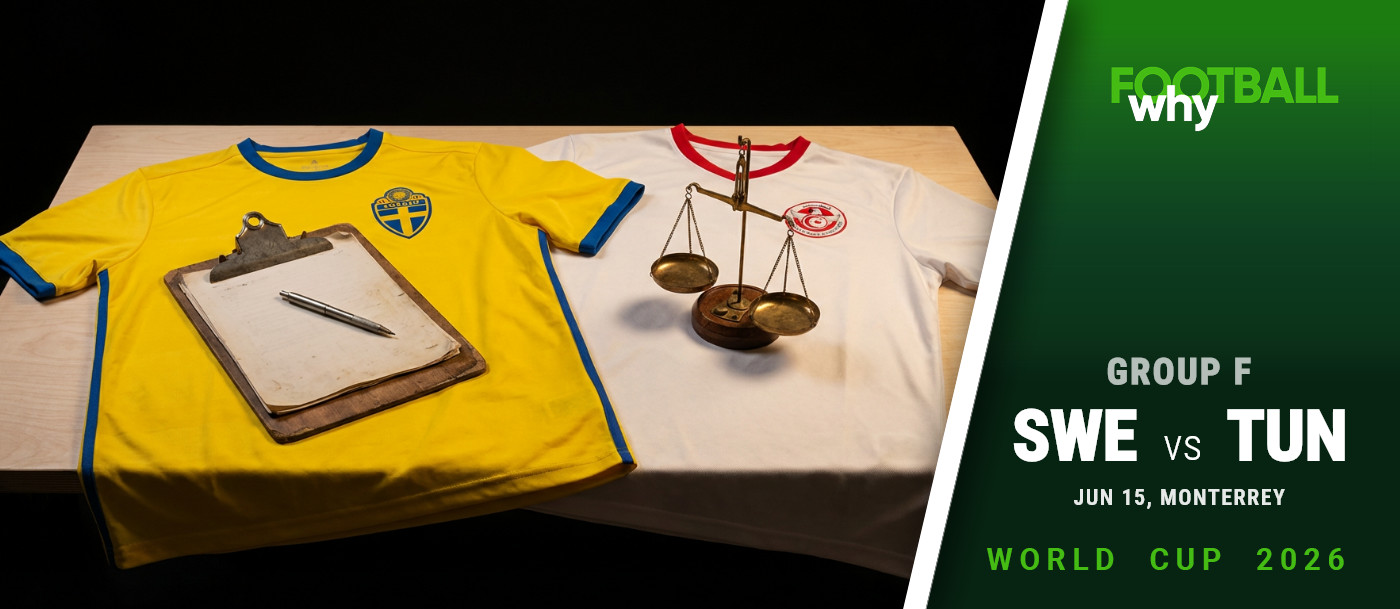
The World Cup Qualification Decider


Estadio BBVA, Monterrey
SCORE BY AI PREDICTION: 1:0 SEE SIMULATION

Sweden vs Tunisia FIFA World Cup 2026 Group Stage Match Applying the Winter Protocol to a Boiling Kettle Forecast generated:

It is the ultimate collision between winter-tested institutional engineering and the unyielding resilience of communal fate. When a society built on meticulous, transparent processes meets a brotherhood bonded by survival and destiny, every single inch of turf becomes a profound ideological battleground.

Sweden: One side's prayer...

Sweden arrive at this Group F opener wrapped in cautious optimism, demanding defensive reliability over spectacle. The squad resembles a heavy winter coat being buttoned up tight against the elements. Injuries restrict them: Dejan Kulusevski and Isak Hien are sidelined, while Alexander Isak’s ankle limits him to a brief cameo. Off the pitch, Graham Potter’s staff have quietly smothered a minor tabloid fuss regarding nightclub photos of Gyökeres and Isak, reinforcing the collective focus. The public expects nothing less than a meticulously organised, drama-free victory.

Tunisia: ...head-on with the other.

Tunisia approach the match with guarded optimism, though public patience remains wafer-thin following their recent AFCON scars. Their setup is purely pragmatic, stacking defensive sandbags against a rising tide. They face significant hurdles: energetic midfielder Hannibal Mejbri is ruled out with a hamstring strain, and talisman Youssef Msakni’s involvement is uncertain following the recent passing of his father. Furthermore, the squad must continually insulate themselves from the background noise of perpetual federation governance disputes. A resilient, low-event draw is the absolute minimum acceptable outcome.
Sweden vs Tunisia Structural Collision

Sweden: How we will host...

Dream
Secure three points without turning the match into a circus. A clean sheet and absolute territorial control are the baseline requirements; a draw is acceptable, but a win fundamentally alters the group arithmetic. There is absolutely no public appetite for chaotic, end-to-end entertainment.

Strength
This is a team built like a winter redundancy protocol: robust, disciplined, and suspicious of individual flair that doesn't serve the collective. Their power lies in a stoic, two-line defensive block and an unshakeable belief in procedural order. They do not panic; they simply consult the manual.

Plans
Graham Potter intends to methodically dismantle the Tunisian left flank. He wants his team to hit early diagonal passes behind the advancing full-back, exploiting the space before the opposition can reset. It is a calculated, repetitive drilling into a known structural weakness.

Fears
The nightmare scenario is a match that descends into a star-led shootout. If the team loses its shape and individuals start trying to win the game single-handedly, the entire Swedish structural facade crumbles, leaving them terribly exposed to counter-attacks.

Tunisia: With what we arrive...

Dream
Survive the ordeal and frustrate the hosts. A barren, low-event draw is viewed as a triumph, while nicking a goal from a chaotic set-piece is the ultimate fantasy. They want to drag Sweden into the tactical mud and keep the scoreboard entirely quiet.

Strength
A deep-rooted, communal resilience that borders on the heroic. Tunisia operates like a tight-knit market syndicate, bargaining for every yard and refusing to break rank under duress. They absorb relentless pressure through collective suffering, relying on a deeply ingrained defensive cohesion.

Plans
Funnel the ambition down the left flank. The strategy is to unleash Elias Achouri into the space left by Sweden's marauding right-back, creating sharp, isolated counter-punches. Set-pieces will be crowded, physical affairs designed to completely overwhelm the Swedish goalkeeper with sheer numbers at the near post.

Fears
The dread of being caught in two minds. If they push too hard for a winner, they risk naive exposure; if they sit too deep, they invite a slow, suffocating defeat. The balance between necessary caution and desperate ambition is a terrifying tightrope to walk.
46%
31%
23%
Not a recommendation for betting
Tap [+] to cast your expert forecast. Can you outperform both the AI and the crowd?

How it will be...

The match will likely resemble a council planning meeting: slow, procedural, and entirely devoid of spontaneous joy. Sweden are expected to establish a rigid mid-block structure. They will tap away at the right corridor, relying on timed overlaps and cutbacks. It is an exercise in industrial patience, waiting for the opposition to lose focus and vacate the crucial half-spaces.

Tunisia, conversely, will bargain for every inch of turf with the stubborn resilience of a market vendor refusing to lower his price. They will absorb the pressure in a compact defensive shell. If the game remains tight, Youssef Msakni will be introduced late on. The veteran playmaker is entirely exempt from defensive duties, existing solely to unpick the Swedish lock with a single, disguised pass.

The final quarter will likely resemble a clogged U-bend under sudden, frantic wrenching. Tunisia will abandon their cautious script and throw crosses into the box. Sweden will respond by flattening their midfield and introducing a third centre-back. Do not expect either side to suffer a mental collapse; the Swedes will simply rely on their winter preparedness to see out the storm.

Secret mastermind intent

Graham Potter's Winter Protocol and Structural Ironwork

General Strategy
The primary objective is to suffocate the game rather than stretch it. Potter is deploying a standard 4-4-2 mid-block, engaging the opposition near the halfway line. The focus is entirely on maintaining a solid rest-defence, keeping two centre-backs and a holding midfielder anchored at all times.

In possession, the strategy is highly directional. Sweden will funnel their attacks down the right corridor, relying on timed overlaps and underlaps to eventually drag the ball back towards the penalty spot. It is a slow, methodical accumulation of pressure.
Antidote for the Opponent
The tactical crosshairs are fixed firmly on the space behind Ali Abdi. Knowing the Tunisian left-back's tendency to push high, Potter has instructed his team to hit early, flat diagonals into that vacated channel the moment possession is won.

Defensively, the plan is to build a wall against Elias Achouri's inside runs. The Swedish right-back and right-midfielder will double up to force him towards the touchline, whilst the defensive midfielder sits deep to seal off the edge of the penalty area.
Internal Task Solving
Perhaps the most culturally resonant tactic is the scheduled 'Fika truce'. During the designated cooling break, the captain is tasked with formally resetting the team's emotional temperature, reiterating defensive distances, and clamping down on unnecessary fouls.

Furthermore, the management of physical exertion is strictly regimented. The coaching staff have programmed specific 'tempo troughs' into each half. By deliberately slowing down throw-ins and goal kicks, they ensure the players do not burn out under the stadium heat.
Crisis Response Plans
If the primary right-sided attacks stall and the full-back finds himself isolated and exhausted, the system shifts gears. The immediate adjustment is to drop the right-back deeper and tuck the right-midfielder inside, effectively clogging the half-space and forming a tighter 4-2-3-1.

Potter has contingencies for most scenarios. Whether it involves dropping a second striker deep to act as a bounce-wall against a stubborn midfield screen, or throwing on an auxiliary centre-back if Tunisia resort to a late aerial bombardment, the manager's playbook is thick with pre-planned responses.
Specific Match Orders
Alexander Isak: You have a strict 30 to 35-minute window. Operate as a nine-and-a-half in the right channel. Do not waste energy joining the first line of the press; save those high-intensity sprints for arriving in the box. Under no circumstances should you drop back into the midfield pivot line. Emil Holm: Throttle your overlaps to one surge every five minutes. If they block three of your crosses in a row, switch tactics immediately: underlap and look only for the low cutback. The second we lose the ball, you drop. No counter-pressing beyond your initial reaction.
/ What if Skhiri successfully screens the midfield and stops the buildup?

If the Tunisian pivot shuts down the central passing lanes, Sweden will immediately create a three-versus-two overload. The second striker drops between the lines to act as a wall-pass option. This movement triggers a third-man run, allowing the centre-back to bypass the press with a flat diagonal pass to the opposite winger.

/ What if the team concedes an early goal and the structure wobbles?

A strict 90-second freeze protocol is activated. The team immediately retreats into a compact shape. The restart is taken as slowly as legally possible, and the ball must be played through the defensive midfielder twice to kill the momentum. The next two attacks must be kept on the ground.

Secret mastermind intent

Sami Trabelsi's Market Haggle and Defensive Trenches

General Strategy
The tactical blueprint is an exercise in profound stubbornness. Tunisia will deploy a compact 4-1-4-1 shape, dropping their engagement line to a cautious 38 metres. The entire premise relies on denying central progression and frustrating the opposition into sterile wide possession.

Upon regaining the ball, the instinct is fiercely vertical. Attacks are channelled almost exclusively down the left side, seeking rapid transitions before the opponent can reset. It is a pragmatic, unglamorous pursuit of territorial margins.
Antidote for the Opponent
To neutralise Viktor Gyökeres, the centre-backs will aggressively front-screen him while the defensive midfielder sweeps up the pieces. They will physically bully him towards the touchline, isolating him from his supporting runners.

On the counter, the trigger is the space vacated by Emil Holm. The Tunisian midfield is instructed to launch early, flat diagonals aimed squarely at Achouri's boots the second possession changes hands.
Internal Task Solving
The squad employs a fascinating bilingual gearshift to manage the emotional temperature on the pitch. Arabic is shouted to restore calm and reinforce the defensive block, whereas French is barked to snap the team into precise, choreographed pressing triggers.

Furthermore, a strict 'heat protocol' will see the team compress into a 30-metre block during lulls. They will use long throws and dead balls as active rest periods to conserve vital energy.
Crisis Response Plans
Should the Swedish right-flank overload become unbearable, the full-back will be ordered to sit deep while the winger pins his man wide. The tactical safety valve is a swift, sweeping diagonal from the left centre-back to bypass the congested zone.

Trabelsi is perfectly willing to sacrifice midfield control for territorial survival if the pressure mounts. If the full-backs start blowing heavily, he will execute an immediate like-for-like substitution and completely ban any further overlapping runs.
Specific Match Orders
Youssef Msakni: You have a controlled 20-minute cameo as a free number ten. Only receive the ball to your feet and constantly look for reverse passes into Achouri's path. You are completely exempt from any defensive pressing duties beyond basic positional blocking. Ali Abdi: For the first half-hour, drop your starting position five metres deeper than usual. Only commit to an overlap if there is a glaringly obvious call for it. Your absolute priority is the recovery sprint, not lingering for second-phase crosses. Aymen Dahmen: Refuse the temptation of risky short passes when the Swedish press arrives. If you feel the squeeze, clip the ball into the left-back channel. After the hour mark, default to long, driven clearances towards the far-side winger.
/ What if the team falls behind and panic sets in?

The side instantly drops into a 5-4-1 bunker for five minutes to stop the bleeding. The tempo is deliberately suffocated through tactical fouls and painfully slow throw-ins. The subsequent possession must feature a wide cycle of passes to drag Sweden out of their counter-pressing shape.

/ What if Skhiri is trapped by the press when dropping deep?

The build-up bypasses him entirely. The centre-back will launch a diagonal directly to the left-back, instantly triggering a third-man combination inside. The holding midfielder must remain high as a decoy screen until the opposition's pressing intensity fades.

MAIN SIMULATION 0'-25'

Sweden establish a mid-block and begin methodically tapping at the right corridor. It feels like a provincial building inspector checking for damp. Holm makes cautious overlaps while Gyökeres works the inside channel. Tunisia counter this by dropping Abdi deeper and using Skhiri to plug the central area. The resulting play forces long restarts and sterile wide circulation.

MAIN SIMULATION 25'-45'

Sweden alter the pattern to unblock the drain. Their second striker drops deep to create an overload, allowing Holm to dart inside. Tunisia's shape holds well centrally but gets twisted by diagonal passes. Around the 38th minute, Holm cuts the ball back for Gyökeres to finish. This precise routine finally breaks the deadlock.

MAIN SIMULATION 45'-65'

Tunisia begin to apply pressure to the seam. They raise their defensive line and fire quicker diagonal passes towards Abdi. Sweden respond by deliberately slowing their metabolism. Full-back overlaps are restricted, and passes are hit early into the channels. When Msakni enters, Sweden assign a midfielder specifically to shadow his turns.

MAIN SIMULATION 65'-90'

Tunisia throw the kitchen sink at the problem. They switch to a hybrid shape, throw crosses into the box, and finally release their full-backs. Sweden simply pull down the heavy iron shutters. They flatten into a five-man midfield, restrict all full-back movement, and eventually introduce a third centre-back. The game devolves into a scrap for second balls.

And it will come to...

If the simulation holds true, structural order should quietly smother desperate guile. Sweden would likely secure the victory by maintaining their compact shape and ruthlessly exploiting the right-hand corridor. Tunisia might attempt to steal a draw through late set-pieces, but they would ultimately crash against a thoroughly prepared defensive wall. It would be a match decided by strict adherence to the script, where the team that blinks and abandons their shape first gets punished.
end of Game