

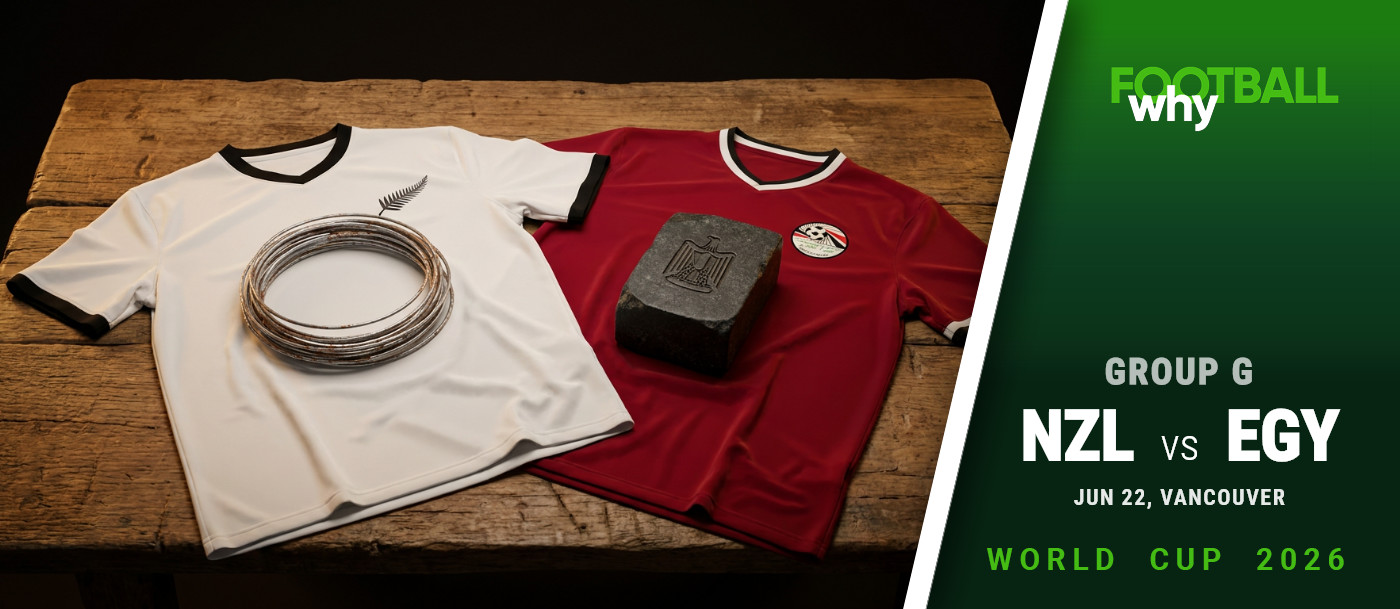
Group G, Matchday 2, Match #40
UTC

BC Place, Vancouver

Prediction by whyFootball readers

Forecast: coming soon
SCORE BY AI PREDICTION: 0:2 SEE SIMULATION

New Zealand vs Egypt FIFA World Cup 2026 Group Stage Match Scrimmage, Set-Pieces, and the Sudden Diagonal Strike Forecast generated:

The pragmatism of the sheep station meets the fatalism of the bazaar. It is industrial toil attempting to cage a dynasty that waits, with Pharaonic patience, for the single moment to strike. Honest sweat defying inherited royalty.

New Zealand: One side's prayer...

New Zealand approach this fixture staring down the barrel of group-stage elimination. Following their opening defeat to Iran, the domestic media has firmly demanded a return to industrial, sleeve-rolling grit rather than tactical posturing. The dressing room remains remarkably stoic, anchored by senior figures doubling down on set-piece details. Their primary concern is managing the physical load of talisman Chris Wood, whose minutes are being strictly rationed. They know a draw only delays the inevitable unless accompanied by a flawless clean sheet.

Egypt: ...head-on with the other.

Egypt arrive burdened by the crushing weight of history. With Iran and Belgium setting a relentless pace in the group, anything less than three points renders their progression mathematically fragile. The Cairo press is a pressure cooker, demanding the nation’s first World Cup match victory since 1934, yet simultaneously bristling at Hossam Hassan’s deeply conservative, tournament-first football. The squad has circled the wagons, deliberately parking the external noise to focus entirely on feeding their star forwards. They are ready to suffocate the game to win it.
New Zealand vs Egypt Structural Collision

New Zealand: How we will host...

Dream
The primary objective is sheer survival. Darren Bazeley’s side simply must avoid elimination, meaning a win is the target, but a gritty, scoreless draw is acceptable. The media expects them to roll up their sleeves and show genuine fight after a previous stumble.

Strength
Their core asset is a rugged, collective work ethic drawn from a culture that values honest graft over individual showboating. They excel at turning the match into a physical contest, relying heavily on aerial dominance and the bruising presence of target man Chris Wood. It is football built on a foundation of set-piece proficiency and sheer endurance.

Plans
The tactical blueprint involves dropping into a stubborn, compact shape to frustrate the opposition. They have designed a specific defensive cage on the left side to deny the opponent's star player his favourite inside runs. Going forward, the plan is to bypass the midfield entirely, opting for early, flat crosses and exploiting dead-ball situations to maximum effect.

Fears
The glaring vulnerability is a lack of central creativity. If they concede early and are forced to chase the game, their structured approach often fractures. The fear is that in throwing bodies forward to salvage a result, they will abandon their defensive discipline and leave vast, unprotected spaces at the back.

Egypt: With what we arrive...

Dream
The absolute minimum requirement is securing three points to stay viable in the group. A draw is effectively useless given the current standings. The weight of an entire nation's expectations rests on their shoulders, demanding a victory that validates their continental pedigree on the global stage.

Strength
Their foundation is built on disciplined defensive solidity combined with lethal, vertical transitions. They are comfortable absorbing pressure without panicking, relying on a deeply ingrained hierarchical structure. When the moment arrives, they possess elite individual quality on the right flank capable of instantly turning a solid defensive stand into a devastating attack.

Plans
The strategy revolves around neutralising the opponent's physical advantages. They have prepared a highly specific marking system to smother the opposition's target man during set-pieces. Offensively, they intend to lure the opposition's midfield out of position with central decoys, thereby creating isolated, one-on-one scenarios for their star winger to exploit.

Fears
The overarching anxiety is their chronic over-reliance on a single talisman to create chances. If the opposition successfully isolates him, the team often lacks the central creativity required to break down a low block. Furthermore, an early concession could force them out of their comfortable defensive shell, exposing them to the chaotic, open game they desperately wish to avoid.

How it will be...

The contest will likely unfold as a test of bureaucratic endurance. New Zealand will offer their customary industrial graft, constructing a deliberate roadblock down the left channel with Liberato Cacace and Joe Bell to deny Mohamed Salah his preferred inward slaloms.

Yet, beneath the polite obstruction, Egypt’s patience conceals a sudden sharpness. The turning point should arrive when their central midfielders deploy a decoy rotation, momentarily unpicking the Kiwi padlock and allowing their right-sided deity the fraction of space required to alter the ledger.

Should the scoreboard turn against the home side, the script dictates a barrage of crosses directed at the totemic Chris Wood. Here, the physical collisions with Mostafa Mohamed — acting as a dedicated bouncer on set-pieces — will provide the visceral thud of a pub carpark disagreement.

The final unravelling would likely occur if desperation prompts the New Zealand full-backs to abandon their structural caution. Advancing in tandem leaves their rest-defence hollowed out, gifting the precise acreage Omar Marmoush requires to casually stroke the ball into the net on the counter.

New Zealand: Just short of victory

The collapse stemmed from a late lapse in structural discipline: both full-backs advancing simultaneously shattered their rest-defence, gifting the decisive counter-attack. That specific naivety exposed a deeper systemic flaw; lacking central ingenuity, they default to predictable wide deliveries when trailing, rendering them vulnerable to clinical transitions.

Egypt: Just short of victory

Victory was secured through the precise exploitation of structural errors and supreme penalty-box management; Mostafa Mohamed completely nullified the opponent's aerial focal point. This rigorous defensive application provided the platform for their elite forwards, proving that a conservative baseline thrives when individual quality deciphers the opponent's desperation.

Secret mastermind intent

Bazeley's No.8 Wire: Rigging the Left-Side Cage

General Strategy
Darren Bazeley’s fundamental approach centres on a compact 4-4-2 mid-block. The primary tactical focus is to deny the opposition any space in the central channels, forcing the game into wide, less dangerous areas.

The team will look to slow the tempo whenever possible. Rather than attempting to dominate possession, they will prioritise territory, using direct, long passes toward their target man to establish a foothold high up the pitch. It is a strategy built on attrition rather than invention.
Antidote for the Opponent
The most crucial opponent-specific preparation involves a defensive trap designed exclusively for Mohamed Salah. Bazeley has instructed his left-back and nearest central midfielder to form a two-versus-one cage, strictly forcing the winger down the touchline to prevent him cutting inside onto his stronger foot.

In attack, the plan targets the space behind Egypt’s left wing-back. New Zealand will look to deploy early diagonal switches of play, aiming to overload the far post by pairing their central striker with the arriving weak-side winger.
Internal Task Solving
A unique element of the setup relies heavily on the captain’s vocal leadership. Michael Boxall has been tasked with physically setting the defensive line height and audibly calling the defensive triggers whenever the opposition's star winger receives the ball wide.

Additionally, there is a highly specific routine planned for attacking corners. The team will utilise short-corner sequences to draw the opposition's five-man defence out of the penalty area, before whipping late, inswinging deliveries into the newly created space.
Crisis Response Plans
The primary backup plan is triggered if Salah consistently breaches the defensive cage early in the match. Should this happen, Bazeley will instruct the left-back to hold a static defensive position, drop the left winger deeper, and aggressively pivot the team’s entire attacking build-up to the opposite flank.

Beyond this specific adjustment, the overall approach to in-game adversity is to simplify the structure. If the team struggles to progress the ball, they will abandon short passing entirely in favour of earlier, more direct diagonals to bypass the congested midfield.
Specific Match Orders
Liberato Cacace: Hold your position and do not advance unless there is a pre-agreed rotation with the midfielder covering behind you. Your body shape must always force the winger down the outside; under no circumstances should you dive in or allow him to cut inside on his left foot. Joe Bell: You are to permanently shade towards the right side of the pitch during our defensive phases. If their star forward manages to turn inside, your job is to take the tactical foul early, high up the pitch, before he can accelerate.
/ What if the team is trailing late in the game?

The structure will radically shift into a 4-2-4 formation. A second striker will be introduced, and both full-backs will be pushed high up the pitch to double the attacking width. The instruction will be to spam early crosses to the back post and actively invite fouls in wide areas to maximize set-piece opportunities.

/ What if the team concedes an early goal?

The immediate protocol is to kill the game's momentum for ninety seconds. The team will manage the touchlines, force a stoppage, and reset their defensive block. The very next restart will be played long to the target man to re-establish territory and calm the nerves.

Secret mastermind intent

Hassan's Pharaonic Shield: Patience and the Sudden Strike

General Strategy
Hossam Hassan’s strategy is rooted in risk-aversion, deploying a resolute 5-4-1 mid-block. The emphasis is on maintaining a compact shape and denying central penetration, rather than chasing possession.

The team is instructed to absorb territorial pressure and wait for the precise moment to spring forward. Upon regaining the ball, the objective is immediate, vertical transition, funnelling the play rapidly into the right half-space to exploit their primary attacking asset.
Antidote for the Opponent
Defensively, Hassan has implemented a strict anti-aerial protocol. The central defenders are tasked with fronting the opposition's target man to disrupt his initial contact, while the holding midfielder is specifically assigned to sweep up any second balls on the edge of the penalty area.

In possession, the attacking pattern is designed to punish the space left by the opposition's advancing right-back. The plan involves drawing the defensive cover inside using a central decoy, before slipping the ball into the isolated star winger for a trademark left-footed finish.
Internal Task Solving
A distinctive aspect of the plan involves deliberate tempo management following any setback. If a goal is conceded, the players are instructed to immediately slow the game down for several minutes, using the touchlines to kill momentum and re-establish their defensive shape before attempting to counter.

Furthermore, the bench holds a specific signal regarding set-pieces. If the opposition's corner count becomes alarming, the team will instantly switch to a mixed marking system, sacrificing a forward to act as a dedicated blocker against the primary aerial threat.
Crisis Response Plans
If the opposition successfully generates a high volume of corners and long throws early in the match, the primary contingency is activated. The wing-backs will be ordered to drop five yards deeper out of possession, and clearances must be directed strictly towards the touchlines, rather than conceding further corners.

Should the match remain deadlocked approaching the hour mark, the manager is prepared to subtly shift the shape. An extra attacker will be introduced to roam as a number ten, aiming to increase penalty-box presence without sacrificing the team's underlying defensive stability.
Specific Match Orders
Mostafa Mohamed: Your primary duty is to act as the dedicated blocker on their target man during all defensive set-pieces. You must obstruct his run path and attack the first contact aggressively. You are to completely sacrifice your role as an outlet for counter-attacks during these situations. Omar Marmoush: When we regain possession, your initial movement must be a sharp, diagonal underlap towards the penalty spot. Look to exploit the space left behind their advancing right-back, anticipating the switch of play from the opposite flank.
/ What if the team is losing in the final fifteen minutes?

The system will transition into a hybrid 4-2-4 shape. A second striker will be added to pin both opposition centre-backs, and both wing-backs will be pushed extremely high. The team will abandon patient build-up in favour of early crosses and aggressively hunting second balls in the penalty area.

/ What if the star winger is successfully double-marked?

The solution is to execute a rapid central wall-pass involving the central midfielders. This is designed to draw the opposition's covering defender inside, instantly followed by a quick return pass to the winger, reopening his preferred attacking lane.

MAIN SIMULATION 0'-25'

New Zealand will likely set up a low-to-mid block, creating a deliberate tactical bottleneck on the left flank. They aim to trap Mohamed Salah with a two-versus-one cage using Liberato Cacace and Joe Bell, forcing him wide rather than allowing his trademark inside cuts. Egypt will patiently circulate possession in a 5-4-1 shape. Meanwhile, New Zealand will bypass central midfield entirely, playing for territory and set-pieces. It is a stubborn waiting game.

MAIN SIMULATION 25'-45'

Expect Egypt to pick the lock by drawing Bell inside with a central wall-pass, instantly reopening Salah's preferred attacking lane. Should this yield an opening goal, New Zealand will activate a blunt-force response. They will increase their direct diagonals and crowd the box, leaning heavily on Chris Wood. Egypt will counter this aerial bombardment by deploying striker Mostafa Mohamed as a dedicated defensive blocker on set-pieces.

MAIN SIMULATION 45'-65'

Egypt will likely drop ten yards deeper into a robust defensive shell, protecting the central zones and using Salah as their sole outlet valve. New Zealand will tilt the pitch, turning every throw-in in the final third into a disguised corner. It becomes a battle of attrition. The home side will generate immense physical pressure, but Egypt will ration their energy, preferring to absorb the blows rather than commit bodies forward for counter-attacks.

MAIN SIMULATION 65'-90'

Chasing the game, New Zealand will likely abandon caution for a frantic 4-2-4, throwing a second striker into the fray and spamming crosses toward the back post. Egypt will respond with mixed marking, keeping one runner high to stretch the pitch. The tactical breaking point arrives if New Zealand's full-backs both advance, destroying their foundational rest-defence. This structural suicide would allow Salah to effortlessly release Omar Marmoush into the resulting acres of space.

And it will come to...

Should the match unfold as predicted, Egypt's conservative structure and star-centric transitions would ultimately outmanoeuvre New Zealand's physical grit. The visitors would rely on a dedicated anti-aerial plan to neutralise Chris Wood, waiting patiently to exploit structural errors. New Zealand would compete fiercely through set-pieces and sheer industry, but their lack of central creative invention would prove fatal. If the hosts abandon their defensive discipline to chase the game, Egypt would ruthlessly punish the resulting spaces.
end of Game