

Round of 32 (A), Match #75
UTC

Estadio BBVA, Guadalupe

Prediction by whyFootball readers

NLD
DRAW
MAR
57%
0%
43%
Not a recommendation for betting
Tap [+] to cast your expert forecast.
SCORE BY AI PREDICTION: 2:0 SEE SIMULATION

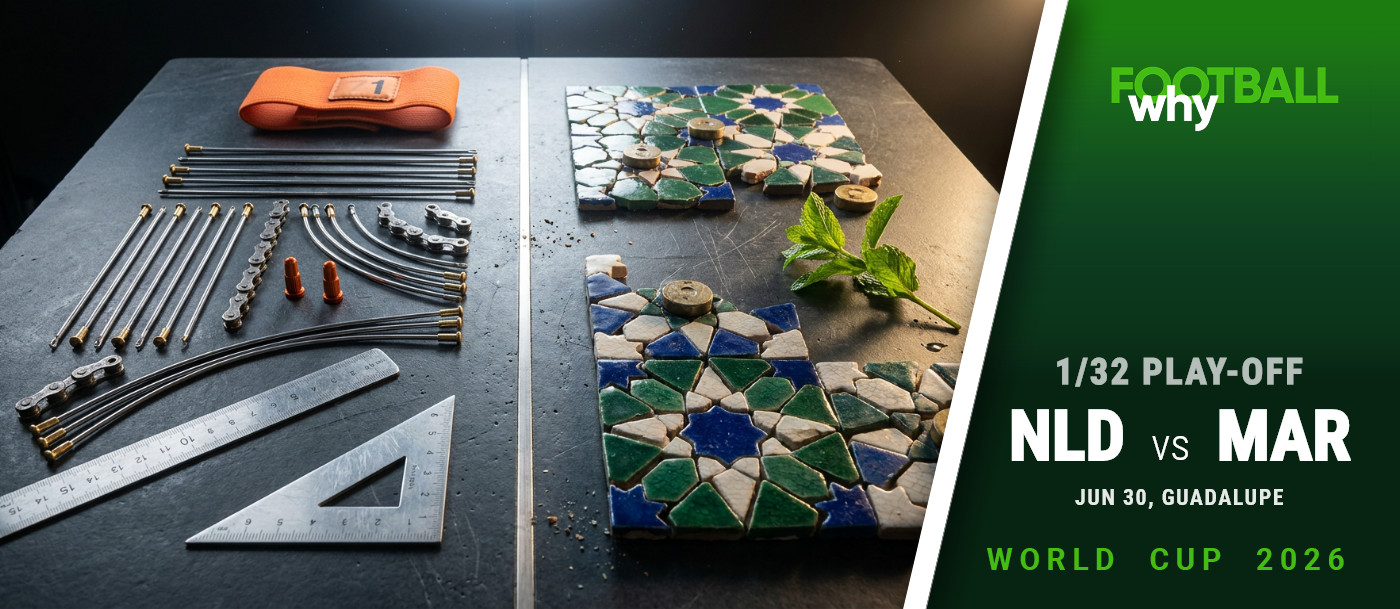
Netherlands vs Morocco FIFA World Cup 2026 Group Stage Match Laying Plumb Lines Through a Crowded Medina Forecast generated:

The relentless logic of the polder meets the communal patience of the medina. One side seeks to channel the match through rigid, controlled canals; the other waits to weave a sudden, devastating pattern from the threads of their opponent's overconfidence.

Netherlands: One side's prayer...

The Netherlands enter the knockout stages carrying the familiar, heavy expectation of total control. The public mood demands clinical efficiency; anything resembling late-game panic will be seen as a cultural betrayal. Jurriën Timber’s absence through injury forces a slight defensive reshuffle, but Bart Verbruggen’s confirmed fitness provides relief in goal. The squad’s mentality is focused on methodical progression, treating possession like laying a plumb line to ensure structural stability before committing bodies forward. They know they must break the deadlock early to avoid the creeping anxiety of a prolonged stalemate.

Morocco: ...head-on with the other.

Morocco arrive in the knockouts wrapped in a quiet confidence, fully aware of their status as continental standard-bearers. Losing Nayef Aguerd and Abde Ezzalzouli to injury is a severe blow, depriving them of their primary aerial anchor and a vital wide outlet. The burden falls heavily on the veteran spine of Yassine Bounou and Sofyan Amrabat to maintain order. Their collective mindset is one of disciplined suffering, absorbing pressure like a tightly bound parcel in a sorting office, waiting for the exact moment to spring a rapid counter.
Netherlands vs Morocco Structural Collision

Netherlands: How we will host...

Dream
The absolute priority is to wrap this up within regulation time, avoiding the lottery of extra time at all costs. There is a palpable public demand for authoritative, clinical control; anything resembling a chaotic, scrambled finish will be viewed as a failure of basic competence.

Strength
This squad is built on a foundation of elite, tactical schooling. They possess an ingrained understanding of positional play, capable of fluidly rotating to create overloads, particularly through the half-spaces. It is a collective intelligence anchored by seasoned, top-tier European experience.

Plans
Koeman is preparing to heavily exploit the flanks, pushing the right-back exceptionally high from the first whistle to stretch the opposition. Crucially, they are banking heavily on set-pieces, looking to capitalise on their towering central defenders against a potentially weakened Moroccan aerial defence.

Fears
The recurring nightmare is a late-game collapse in structure. When control slips, the team has a habit of overthinking rather than embracing pragmatic, ugly defending. This egalitarian desire to debate every action on the pitch can lead to fatal hesitation and exposure to quick transitions down the flanks.

Morocco: With what we arrive...

Dream
The primary objective is to advance by suffocating the central spaces and drastically limiting the opponent's set-piece opportunities. There is a quiet confidence within the squad, a readiness to accept less possession if it means preserving their defensive solidity and striking with precision when the moment arrives.

Strength
This is a remarkably cohesive unit, built on a foundation of disciplined suffering. They operate a highly organised mid-to-low block, excelling at denying passing lanes and crowding the penalty area. Their threat lies in their ability to transition rapidly, using pace out wide to exploit gaps left by the opposition.

Plans
Mohamed Ouahbi has tailored the setup to combat the Dutch aerial threat, implementing double-marking in the first-contact zones on set-pieces. Offensively, the focus is entirely on rapid surges down the right channel, looking to slip runners behind the advancing Dutch full-back and deliver early cut-backs.

Fears
The underlying anxiety stems from a tendency to become overly conservative under pressure. When the stress mounts, their attacking ambition can shrink, leading to a reliance on early clearances and a rising foul count near their own box. This deep retreat can invite the very pressure they seek to avoid.

How it will be...

The spectacle should resemble a prolonged structural stress-test. The Netherlands will likely monopolise the ball, laying down passing sequences like courses of brickwork to examine the mortar of the Moroccan mid-block. Do not expect a chaotic shoot-out. The Dutch prefer to build their advantages slowly, relying on their ingrained spatial awareness to stretch the pitch.

Morocco’s response will be rooted in communal resilience. They will absorb the pressure, waiting to exploit the space behind the advancing Dutch right-back with sudden, vertical surges. However, the true fracture point is likely to emerge from dead-ball situations. Without their premier aerial defender, the North Africans face a severe height mismatch in the penalty area.

If the Dutch capitalise on a rehearsed corner routine, the entire complexion of the tie alters. Morocco will be forced to abandon their cautious framework, introducing fresh runners to salvage the result. This late surge of collective urgency will be admirable, but it leaves them exposed. The Netherlands are well-versed in closing out ties, shutting the door on the counter-attack to secure their passage.

Netherlands: How did they clinch it?

They triumphed because their set-piece engineering exploited a specific structural weakness. A rehearsed corner routine unpicked a Moroccan defence missing its primary aerial anchor. Once ahead, the Dutch abandoned their expansive principles for pragmatic game management, using timely substitutions to seal the result on the counter-attack.

Morocco: Why not go for the win?

Their exit stemmed from a vulnerability in the air and an overly cautious creative setup. Missing their premier centre-back, they conceded the decisive goal from a set-piece mismatch. Their subsequent chase generated late pressure, but a reliance on flank attacks and second balls lacked the central penetration needed to equalise.

Secret mastermind intent

Koeman's Blueprint for Opening the Floodgates

General Strategy
The overarching strategy is to establish immediate positional control, dictating the tempo through methodical circulation. The team will look to build play patiently through the midfield, using Frenkie de Jong as the primary metronome to unlock the half-spaces.

The focus is on creating overloads, particularly on the left side, before switching play quickly to exploit isolated defenders. They want to avoid a frantic, end-to-end contest, preferring to wear the opponent down with sustained, structured possession.
Antidote for the Opponent
A major focal point is exploiting Morocco's potential vulnerability in the air. The Netherlands will heavily prioritise set-pieces, utilising the delivery quality of Tijjani Reijnders to target the imposing figures of Virgil van Dijk and Jan Paul van Hecke at the back post.

Defensively, the plan is to aggressively screen the central channel to deny Morocco's playmakers time on the ball. They will also look to overload the zone just outside the penalty area on the right to prevent dangerous cut-backs from the opposition's wing-backs.
Internal Task Solving
A distinctive feature of this setup is the asymmetrical full-back rule. While Denzel Dumfries is given license to raid high up the right flank, the left-sided defender is instructed to hold a much deeper, more conservative line to maintain a solid rest-defence structure.

Furthermore, attacking throw-ins on the right side are treated almost as formal set-pieces. The team has rehearsed specific routines involving near-post darts and edge-of-the-box volleys, turning a mundane restart into a genuine scoring opportunity.
Crisis Response Plans
If the team finds themselves trailing heading into the final half-hour, the shape shifts drastically. The compact mid-block will be discarded in favour of an aggressive high press, transitioning into a 'siege mode' that saturates the opposition penalty box with bodies.

Should the opponent find early success progressing down the flanks, the immediate response is to lower the starting position of the attacking full-back. The team will then look to hit early, diagonal passes to pin the opposition deep and halt their momentum.
Specific Match Orders
Micky van de Ven (Defender): Keep your overlaps to an absolute minimum, no more than thirty per cent, until we pass the hour mark or unless we are chasing the game. Your primary job is to control the depth and stop their right-back getting in behind. Denzel Dumfries (Defender): Start as high up the pitch as possible to pin them back. If you pick up an early booking, you have to drop the intensity in the physical duels and start looking for underlaps instead. Remember, only one full-back goes forward at a time. Tijjani Reijnders (Midfielder): On the dead balls, you need to mix it up. Alternate between a flat, hard whip to the near post and hanging it deep to the back post. Don't use the same delivery more than twice in a row; keep them guessing.
/ What if the Moroccan goalkeeper dominates the penalty area?

If their keeper is coming out and claiming every high ball, we immediately switch the corner routine. Stop hanging it up; start driving flat, near-post flicks to the runners on the ground to take him out of the equation.

/ What if the team suffers a sudden shock or loss of momentum?

We trigger a two-minute freeze on all risky passes. Recycle the ball safely through the midfield and the centre-backs. Draw them out of their shape, and the next forward action must be either a controlled switch of play or hunting for a set-piece.

Secret mastermind intent

Ouahbi's Mortar and Plumb Line Defensive Structure

General Strategy
The core strategy is built around a resilient, compact mid-block. Morocco are perfectly willing to concede possession, focusing entirely on controlling the territory that matters. The priority is to maintain a rigid shape, deny access through the centre, and protect the cut-back lanes at all costs.

When the ball is recovered, there is no rush to force the play. They will look to exit calmly through the full-backs or the midfield pivots, waiting for the right moment to trigger a vertical surge rather than risking a turnover in a vulnerable area.
Antidote for the Opponent
A massive part of the preparation has been dedicated to surviving the Dutch set-piece barrage. The plan involves heavily overprotecting the near post and assigning a specific, zonal blocker to disrupt the run-up of their most dangerous aerial threat.

In possession, the target is the space left vacant by the Dutch right-back. The Moroccan playmakers will look to drag the opposition's holding midfielder out of position, creating the room to slip quick passes into the channels for their wide men to chase.
Internal Task Solving
A strict rule applies to the full-backs: they must stagger their forward runs. They are never permitted to invert or overlap simultaneously. If one pushes high, the other must immediately drop back to form a makeshift back three, ensuring the team is never caught short on the counter.

Furthermore, the goalkeeper has specific instructions regarding his distribution. Under heavy pressing, he is to prioritise safe, angled throws to the full-backs or the holding midfielder, completely avoiding risky kicks down the congested central channel.
Crisis Response Plans
If they find themselves behind with twenty minutes to go, the conservative shell is immediately discarded. A triple substitution will inject fresh pace, and the team will shift into an aggressive high press, pushing bodies forward and bombarding the box with early, low crosses.

Should the Netherlands start racking up dangerous free-kicks and corners early on, the defensive scheme alters. The marking system will switch to a mixed zonal and man-to-man setup, keeping two players stationed on the edge of the box to sweep up the second balls.
Specific Match Orders
Achraf Hakimi (Defender): You must coordinate your runs with the left-back; never push inside at the same time. If their left-back is pinning you deep in our half, don't try to beat him on the outside — just hit the early delivery from the middle third. Noussair Mazraoui (Defender): Only tuck inside when our defensive block is fully set. The second we lose the ball, your first three steps have to be backwards to form the back three. Make sure you aren't overlapping at the exact same time as the right-back. Sofyan Amrabat (Midfielder): You are responsible for taking the first tactical foul on their winger if he turns in the half-space, but do it at least thirty-five yards out. Absolutely no diving in or rash tackles inside the 'D'.
/ What if the team gets pinned deep in their own penalty area?

If we are forced back, we accept the loss of territory but absolutely refuse to give up the cut-back lane. We hold our shape, and any substitutions will focus on adding pace out wide to provide an outlet, rather than throwing more bodies into the central midfield.

/ What if the opposition successfully breaks the initial press?

The immediate reaction within the first three seconds is to collapse the central lanes entirely. The threshold for committing a foul is raised significantly, aiming to stop the play between thirty-five and fifty metres from our goal to allow the defence to reset.

MAIN SIMULATION 0'-25'

The Netherlands will likely monopolise the ball early on, treating possession like a load-bearing wall to build their attacks. They will push their right-back high up the flank to test the waters. Morocco, however, are perfectly comfortable sitting in a compact mid-block. They will absorb this early pressure, focusing heavily on sweeping up second balls and denying space for cut-backs. The main tactical friction will spark down that right channel, pitting Dutch advances against surging Moroccan counter-runs.

MAIN SIMULATION 25'-45'

Following a mid-half pause, the tempo will likely drop to a cautious crawl. Morocco might attempt a brief, probing press, sending their advanced midfielder to harry the Dutch base. However, the Netherlands will quickly restore order by recycling the ball safely across their backline. Neither side wants to make a fatal error before the interval. The game settles into a holding pattern. The Dutch will continue to probe for set-piece opportunities, while Morocco keeps their shape intact.

MAIN SIMULATION 45'-65'

The tactical stalemate will eventually crack under the weight of rehearsed set-pieces. The Netherlands will repeatedly target the space behind the Moroccan defence, forcing clearances and winning corners. Around the hour mark, a well-drilled near-post flick and back-post header combination will likely break the deadlock. Morocco will briefly pause to steady themselves, like sorting letters after a spilled mailbag. They will then shift gears, pushing their lines higher and trading their defensive shell for an urgent chase.

MAIN SIMULATION 65'-90'

Morocco will throw caution to the wind, introducing fresh legs and committing five men forward in a desperate wave. The Netherlands will respond by pulling down the shutters, shifting into a compact defensive shape to conserve energy. They will rely on fresh attacking substitutes to hold the ball up and relieve pressure. Morocco will win corners and create scrambles on the edge of the box. Ultimately, the Dutch will absorb the blows and strike on the counter in stoppage time.

And it will come to...

If this forecast holds, the match will be decided by the triumph of structural engineering over disciplined resilience. The Netherlands would likely leverage their superior positional play and elite set-piece routines to bypass Morocco's compact block. Should the North Africans fall behind, their lack of central creative spontaneity might leave them overly reliant on hopeful crosses. Ultimately, the Dutch ability to execute rehearsed dead-ball patterns, combined with their pragmatic game management late on, would prove decisive.
end of Game