

Round of 32 (A), Match #74
UTC

Gillette Stadium, Foxborough

Prediction by whyFootball readers

DEU
DRAW
PRY
72%
0%
28%
Not a recommendation for betting
Tap [+] to cast your expert forecast.
SCORE BY AI PREDICTION: 1:0 SEE SIMULATION

Germany vs Paraguay FIFA World Cup 2026 Group Stage Match A pristine blueprint tangled in rusted wire Forecast generated:

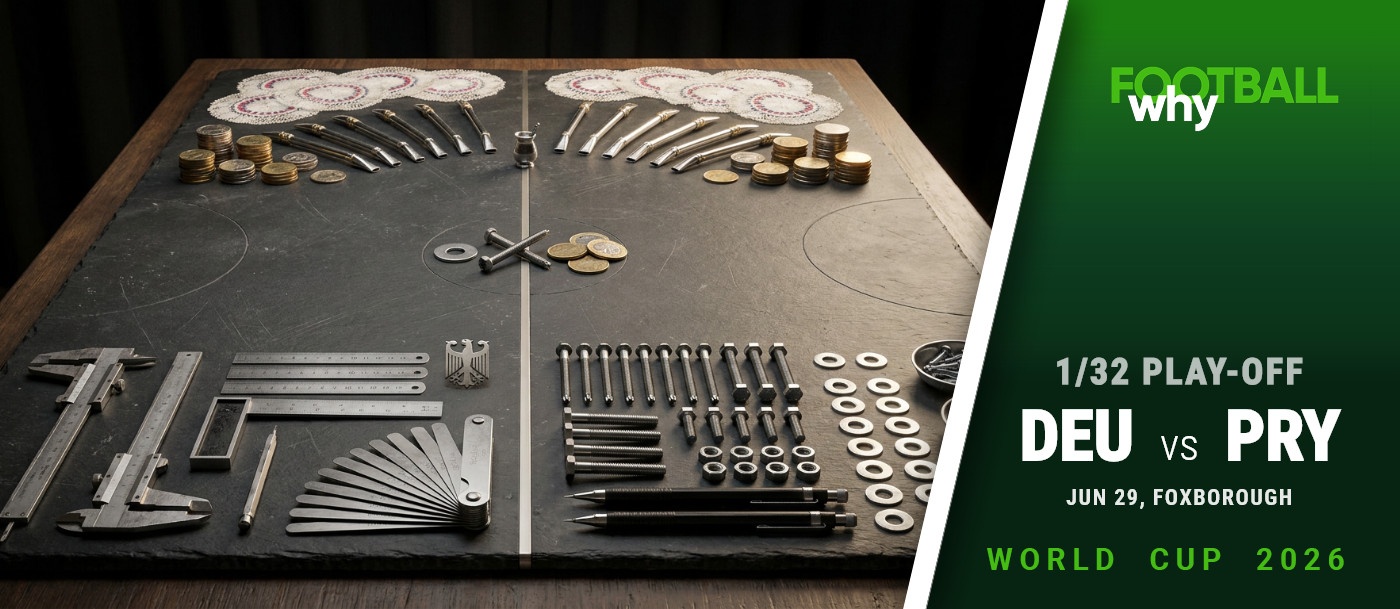
The certified blueprint of industrial order confronts a nation forged in the memory of absolute survival. It is a collision between the belief that systems solve everything, and the rugged pride of enduring the unbearable. The eagle’s precision meets the barbed wire.

Germany: One side's prayer...

Germany enter the knockout stages carrying the heavy expectation of a nation desperate for a drama-free progression. The loss of Nico Schlotterbeck to an ankle injury forces a slight reshuffle, placing immense pressure on Antonio Rüdiger to marshal a makeshift high line. The public mood is cautiously optimistic but severely intolerant of any return to sterile, sideways passing. They demand a surgical dismantling of the opposition, terrified that systemic rigidity might jam the gears of their tournament machine.

Paraguay: ...head-on with the other.

Paraguay arrive at this sudden-death fixture entirely comfortable in their role as the tournament’s premier spoilers. The return of Miguel Almirón from his bizarre suspension — earned for covering his mouth under the new directives — provides a vital counter-attacking lung. Back home, there is zero expectation of expansive, free-flowing football; the public merely demands absolute, unvarnished suffering. They are mentally prepared to drag the contest into the deep water, treating every blocked cross and won header as a quiet victory for the collective spirit.
Germany vs Paraguay Structural Collision

Germany: How we will host...

Dream
Advance within the regulation ninety minutes, avoiding the lottery of extra time. The public expectation is a clean, assertive victory that suppresses the opponent's counter-attacks and dead-ball threats without descending into a chaotic scrap.

Strength
The team’s rhythm flows from a deeply educated central midfield platform. They rely on positional discipline and an immediate, collective counter-press to win the ball back quickly. This structural order acts as a launchpad for sudden, vertical surges into the final third.

Plans
The strategy involves pinning the opposition deep and relentlessly probing the left half-space to feed their central attackers. They intend to isolate the opponent's wide defenders and use quick, rehearsed passing patterns to bypass the inevitable low block.

Fears
Their primary anxiety is that a preference for order might harden into a slow, sterile rigidity. If the ball circulation drops, they can become vulnerable to cheap fouls and fast transitions, exposing a defence missing a key left-sided centre-back.

Paraguay: With what we arrive...

Dream
Drag the contest into the deep, murky waters of the second half with the scoreboard entirely untouched. The ambition is a stoic, low-event grind, frustrating the hosts and snatching a smash-and-grab victory from a late, chaotic set-piece.

Strength
They possess a remarkably blue-collar appetite for suffering. Their footballing DNA is built upon collective endurance, aggressive aerial dominance, and a backline marshalled by veteran guardians who treat defending the penalty area as a matter of solemn civic duty.

Plans
The tactical blueprint relies on a combative, heavily fortified defensive shell, denying the central lanes entirely. Upon recovering the ball, they will immediately launch direct diagonal passes into the channels, explicitly targeting the empty grass vacated by the opposition's advancing full-backs.

Fears
Their chronic anxiety is sinking so deep that their forwards become entirely detached from the rest of the side. If they accept too much sterile pressure, they risk accumulating yellow cards and inviting an unsustainable, exhausting siege.

How it will be...

The fixture should unfold as a prolonged, asymmetrical territorial dispute. Spectators will likely witness a repetitive loop: pale shirts circulating the perimeter of a congested penalty area, probing for a structural seam. This mirrors Germany’s academy-drilled positional compliance colliding with Paraguay’s historical appetite for stoic, collective endurance.

Amidst the procedural passing, Jamal Musiala’s elastic hips should provide the necessary unpredictability. He glides through tight avenues where others merely bounce off. Conversely, Gustavo Gómez will anchor the South American rearguard, treating every near-post clearance as a solemn civic duty. If Manuel Neuer misjudges the flight of a late, cross-wind corner, the script could tear entirely.

Do not expect a psychological unravelling from the underdogs. Even when starved of possession, Paraguay’s communal discipline acts as a coolant against panic. They will likely push this to the final whistle, launching a crude aerial bombardment that forces Germany to temporarily abandon their high-minded ideals for sheer, unvarnished survival.

Germany: How did they clinch it?

They triumphed by actively altering the geometry of the pitch. Julian Nagelsmann’s hour-mark pivot to a back three uncorked the wide channels, bypassing the central logjam. Retaining their elite playmakers ensured the final pass remained incisive. Ultimately, their deeply ingrained, academy-drilled flexibility allowed them to solve a stubborn puzzle without panicking.

Paraguay: Why not go for the win?

They succumbed because their commendable defensive suffering lacked a viable attacking outlet. By sinking so deeply to deny space, their forwards were marooned. When they finally launched their late aerial bombardment, the hosts simply fortified the penalty box. Their systemic inability to manufacture open-play chances ultimately sealed their fate.

Secret mastermind intent

Nagelsmann’s stress-tested blueprint for positional compliance

General Strategy
The overarching strategy is to establish complete midfield control and pin the opposition into a stable defensive shape. Possession is not merely for show; it is the designated launchpad for vertical surges.

When possession is lost, the team is instructed to execute an immediate five-second counter-press. If the opponent breaks this initial shield, the directive is to commit a tactical foul early in the middle third to prevent a footrace.
Antidote for the Opponent
To dismantle the anticipated deep block, the plan targets the gaps just outside the opposition's right-sided centre-back. Wirtz will drift inside, allowing Raum to overlap, while Havertz makes late runs to the back post to isolate his marker.

Defensively, the focus is on denying direct diagonal passes to the opponent's wide outlets. The full-backs are tasked with squeezing the passing lanes, forcing the play towards the touchline where the midfield can double up on the ball carrier.
Internal Task Solving
A non-negotiable rule within the setup is the preservation of creative balance under pressure. At no point will both primary playmakers be withdrawn simultaneously, ensuring the team retains its ability to pick a final pass.

There is also a highly specific protocol for defending corner kicks in heavy traffic. The goalkeeper is explicitly instructed to punch the ball clear rather than attempting a clean catch, minimizing the risk of a fumble under physical pressure.
Crisis Response Plans
If the opposition manages to launch multiple successful counter-attacks early on, the manager will trigger a more conservative shape. The left-back's attacking height will be capped, and the right-back will tuck in to form a back three during possession.

Should the match remain deadlocked approaching the hour mark, a structural shift to a 3-4-2-1 is pre-planned. This involves introducing aggressive wing-backs to saturate the penalty area, while strictly ensuring at least one elite central creator remains on the pitch.
Specific Match Orders
Joshua Kimmich: Only step inside into midfield when the opposition's holding player is pinned back. If their attacking midfielders manage to receive the ball centrally twice within five minutes, hold your position out wide and form a back three during possession until we reset. Manuel Neuer: When dealing with corners in a crowded penalty area, your default action is to punch the ball clear. Only attempt to catch it if you have a completely unobstructed path to the ball. Do not look for quick throws against a set defence; let the team regain its shape first. David Raum: For the first twenty minutes, focus on delivering low crosses early before reaching the byline. If we are protecting a lead in the final twenty minutes, do not push higher up the pitch than the ball, and avoid making blind overlapping runs.
/ What if the team is caught by a sudden counter-attack or set-piece scare?

The immediate response to a defensive shock is a mandated two-minute period of possession retention. Pascal Groß will drop deeper to dictate a slower tempo, full-back attacking runs will be temporarily halted, and the backline will explicitly communicate a structural reset before the team attempts to accelerate the play again.

/ What if the opposition adds a second striker to chase the game?

If the opponent shifts to a more direct, aerial approach late in the match, an extra centre-back will be introduced. The formation will drop into a rigid 5-4-1, and the team will be instructed to route any clearances directly into the channels to win cheap fouls and waste time.

Secret mastermind intent

Alfaro’s rusted barbed wire and siege mentality

General Strategy
The foundational strategy relies on dropping into a stubborn, energy-conserving defensive shell. They will happily surrender the ball, focusing entirely on maintaining a narrow shape that forces the play strictly towards the touchlines.

Upon regaining possession, the transition must be instant and direct. If the initial counter-attack is stalled, the midfield is instructed to commit a cynical foul to halt the game, ensuring clearances are always hooked into the wide channels.
Antidote for the Opponent
To stifle the opposition's creative hubs, the nearest midfielder will aggressively lock bodies upfield whenever the playmakers attempt to receive the ball. They will explicitly deny the opposing right-back the chance to drift inside by anchoring a forward in his lane.

In attack, the transition trigger is a quick diagonal ball to the wingers. They will look to isolate the opposition's recovering defenders, aiming to win cheap free-kicks to stack the penalty box with their towering centre-backs.
Internal Task Solving
A fascinating cultural quirk is their mandated 'cooling-off' protocol after bookings. To avoid emotional spirals, the goalkeeper is authorised to hold the ball longer on restarts to kill the tempo, allowing the team to breathe and bleed the emotion out of the stadium.

Furthermore, a strict zero-protest directive is in place. Only the captain is permitted to speak with the referee, shielding the rest of the combative squad from accumulating unnecessary dissent cards.
Crisis Response Plans
If the defensive line is breached too frequently in the opening half-hour, the shape will flatten into a deeply conservative 5-4-1. The wingers will be pulled back to form a double-layered barricade, leaving a lone striker to chase lost causes.

Should they find themselves chasing the game in the final ten minutes, the handbrake will be fully released. A second target man will be thrown on to create a 3-2-5 shape, turning the match into a crude bombardment of long throws and hopeful crosses.
Specific Match Orders
Andrés Cubas: Bite into loose balls immediately as the first presser. If you find yourself isolated against two men in the middle third, take the tactical foul early, but absolutely no sliding tackles from behind near our own penalty area. Julio Enciso: Constantly hunt the empty grass behind their advancing right-back when we win possession. If they double up on you, do not force the dribble; recycle it backwards to our full-back and immediately dart inside on the underlap. Gustavo Gómez: Take absolute command of the near-post zone on every single defensive corner. Set the defensive line exactly one metre away from the edge of the six-yard box, and ensure all clearances are angled out towards the touchline, never back into the central mixer.
/ What if the team concedes or faces an overwhelming barrage?

The squad will execute a ninety-second freeze protocol. They will collapse into two tight banks of four and five, restricting all communication to the captain alone, and aim their clearances high into the stands to compress the pitch and buy precious oxygen.

/ What if the opposition relentlessly spams crosses from the left flank?

If the wide deliveries become unmanageable, the right-sided defensive duties will be inverted. The wing-back will stick tightly to the winger, the central midfielder will shift over to help, and a striker will drop deep to block the crossing lane at the source.

MAIN SIMULATION 0'-25'

Germany will likely open with measured control rather than a frantic blitz. They will establish a permanent camp in the Paraguayan half. Wirtz and Musiala will patiently probe the left channel. Paraguay will sit in a deeply stubborn 5-3-2 shape, treating territorial submission as a practical necessity. Tactical friction remains quite low in this phase. Germany will dominate the ball, but clear shooting opportunities will be scarce.

MAIN SIMULATION 25'-45'

The middle of the half will feel like a crowded waiting room. Following a hydration pause, Germany will note that central combinations are failing to penetrate. They will shift to a more rudimentary approach, instructing David Raum to swing early crosses toward Kai Havertz. Paraguay will happily absorb this straightforward pressure. The game stays entirely manageable, only spiking during occasional dead-ball scrambles before both sides agree to a low-risk truce approaching the interval.

MAIN SIMULATION 45'-65'

The hour mark is Germany's traditional time to rip up the initial blueprint. Expect Julian Nagelsmann to discard the starting formation and pivot to a 3-4-2-1. Maximilian Beier will push high on the right flank. This suddenly intensifies the pitch tilt. The decisive friction occurs right here. A disguised pass from Wirtz into Raum’s underlap should carve open the exhausted Paraguayan shell, setting up Havertz to break the deadlock.

MAIN SIMULATION 65'-90'

Germany will shut up shop, swapping flair for concrete. They will bring on Malick Thiaw to form a rigid 5-4-1 defensive line. Paraguay will abandon their initial caution and push into a 3-2-5 shape. It becomes a frantic clash of hopeful crosses against disciplined headed clearances. Musiala will occasionally threaten on the break, but the match will end as a gruelling exercise in penalty-box survival.

And it will come to...

If this forecast holds true, methodical order should eventually outlast stubborn endurance. Germany would solve the Paraguayan riddle through a timely second-half tactical pivot, using their deep academy-drilled flexibility to sharpen their attack. Paraguay would likely execute their gruelling defensive game plan with immense pride, turning the final minutes into a bruising aerial contest. Ultimately, Germany's retained creative class and strict set-piece protocols should be enough to secure a narrow, hard-fought victory.
end of Game