

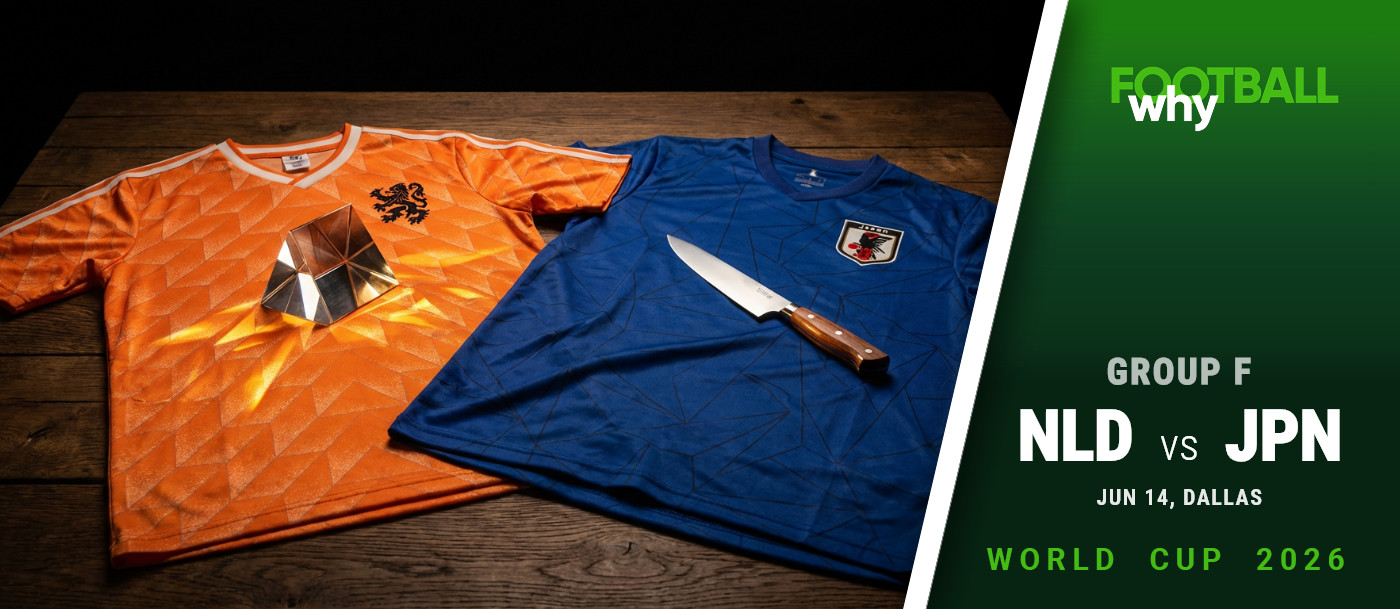
The World Cup Qualification Decider
Sunday, 14 June

AT&T Stadium, Dallas

Netherlands vs Japan FIFA World Cup 2026 Group Stage Match A rigid stalemate unravelled by cowardly late substitutions Forecast generated:

After forty-five minutes of rigidly locked, mechanical football, the second half finally erupted. Ronald Koeman tried to board up his penalty area, but Japan's methodical 88th-minute equaliser proved that tactical cowardice rarely goes unpunished. Read the full breakdown.
Netherlands vs Japan Structural Collision

What was it?

Twenty-two men spent the first forty-five minutes operating like the heavy weights of a neglected clock-tower, locked into rigid, symmetrical grids. The Dutch positional structure shifted side to side with mechanical precision, while the Japanese defensive block retreated exactly in step. Nobody dared to break the sequence. The expected goals tallied a miserable fraction.

The tension finally snapped after the interval. Virgil van Dijk headed a recycled cross into the net at 51 minutes, forcing an immediate response. Keito Nakamura levelled via a deflected cutback, before Crysencio Summerville curled a shot into the far corner to restore the European advantage.

Then, Ronald Koeman chose to fold his own hand. He withdrew his wingers and deployed five defenders across the penalty area as if boarding up a provincial broadcasting station for the night. All ten Dutch shots had come from inside the box, yet they suddenly abandoned any attacking intent.

Japan simply adjusted their dial. Losing Takefusa Kubo to injury, they sent on two centre-forwards and began launching crosses into the heavily populated area. This methodical siege paid off at 88 minutes when Daichi Kamada scrambled a corner over the line. A perfectly deserved punishment for a manager who tried to halt time rather than play through it.

Why stopped just short of victory?

Netherlands

The Netherlands surrendered their advantage because they treated a narrow lead as a ledger to be balanced rather than a momentum to be maintained. When the coaching staff withdrew the attacking wide players to construct a flat back five, they voluntarily severed the team’s only transition routes.

This tactical retreat highlighted a glaring profile deficit within the current squad. Without a traditional target striker to pin the opposition centre-backs and hold up long clearances, the Dutch had no mechanical way to relieve the mounting pressure.

They were forced to absorb repeated waves of attacks, with their midfield dropping deeper until they were practically standing on their own goalkeeper's toes. The team registered a mere three final-third touches in the closing fifteen minutes.

This late-game anxiety stems from a deep-seated cultural imprint. The national footballing identity is built on supreme positional schooling, fluid rotations, and proactive control of the pitch.

Yet, whenever that control frays against resolute opposition, a collective memory of historical near-misses triggers a sudden, pragmatic conservatism. They abandon their expansive principles and attempt to legislate the game's final moments through pure defensive density.

They tried to stitch the match shut with heavy, rigid threads, only to watch the seams burst under the continuous strain.

Why stopped just short of victory?

Japan

Japan salvaged a draw because they process sudden adversity not as a crisis, but as a prompt to switch manuals. When Takefusa Kubo limped off, depriving them of their primary creative conduit, the team did not fracture into desperate individualism.

Instead, Hajime Moriyasu activated a pre-aligned structural shift. He introduced two physical forwards and instructed the wide players to bypass patient circulation entirely. They began delivering the ball into the penalty area with the rhythmic repetition of a printing press.

This seamless pivot reveals the core strength of the current generation. While they possess a rising cohort of Europe-hardened technicians, their true advantage remains their absolute adherence to collective procedure. They generated six distinct set-piece routines in the final quarter-hour alone.

Such disciplined execution is rooted in a long-standing developmental philosophy. Historically, the national team has suffered from a perceived vulnerability in raw physical combat and aerial duels against taller opponents.

To compensate, their academies drill positional timing and collective problem-solving until it becomes instinctive. When trailing late in a match, they do not rely on chaotic passion; they rely on stoic endurance and the mathematical probability of continuous, calibrated pressure.

They dismantled the opposition’s towering blockade by simply turning the screw until the thread finally gave way.

Match hero...

Virgil van Dijk
Virgil van Dijk directed the backline as if calibrating a vast system of drainage locks. He headed the opening goal with geometric precision, but his true value lay in how he channelled the opposition's pressure.

By stepping up to clear every high delivery in his own penalty area, he dictated the defensive flow and filtered out danger before it could accumulate. He simply read the angles of the incoming crosses and positioned his frame to absorb the impact, demanding blunt competence from those alongside him.

...and one more

Daichi Kamada
Daichi Kamada processed the late-game chaos as if adjusting the tolerances on a high-speed loom. He scored the late equaliser from a corner, capping off a period where he quietly aligned the midfield's shifting shape.

When the team lost their primary playmaker, Kamada did not force the issue; instead, he operated within the tight margins of the penalty box, finding the exact seam in the defensive structure. He absorbed the physical friction of the European centre-backs and simply waited for the correct sequence to unfold.