

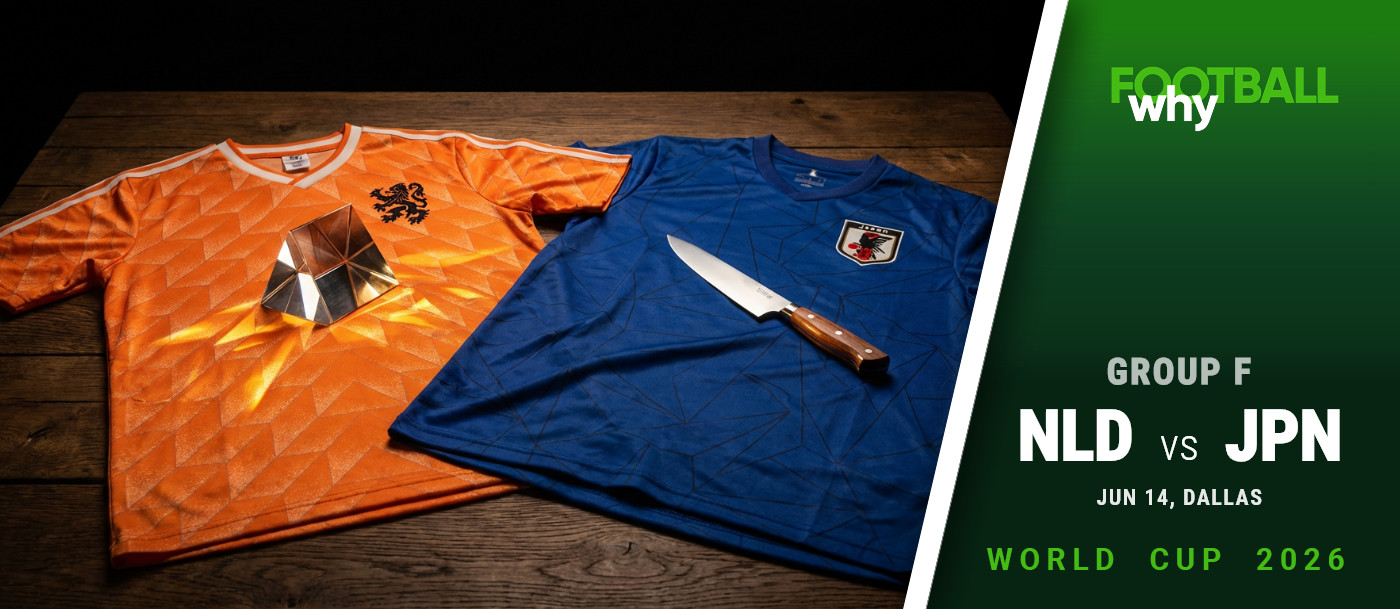
The World Cup Qualification Decider


AT&T Stadium, Dallas
SCORE BY AI PREDICTION: 2:1 SEE SIMULATION

Netherlands vs Japan FIFA World Cup 2026 Group Stage Match Heavy Aerial Geometry Splinters The Delicate Clockwork Forecast generated:

It is the arrogance of structural perfection against the humility of relentless craft. One side seeks to dominate the space through sheer physical authority; the other waits patiently to exploit the tiniest flaw in the design. A fascinating collision of blueprints.

Netherlands: One side's prayer...

The Netherlands arrive demanding absolute group control, though the mood is a tightly wound coil. Despite the neutral venue, the public expects a flawless, drama-free victory to silence simmering grumbles over tournament costs and recent disciplinary lapses. Manager Ronald Koeman is under strict orders to deliver without fuss. Crucially, playmaker Frenkie de Jong is operating on strictly managed minutes following a hamstring injury, while Denzel Dumfries must navigate the lingering shadow of a recent red card. It is a strictly business affair.

Japan: ...head-on with the other.

Japan enter the fixture knowing a draw represents excellent mathematical business, yet the atmosphere remains highly-strung. The lingering scars of their Asian Cup exit mean manager Hajime Moriyasu operates with a target on his back, with fans ready to revolt if the team appears overly timid. Their physical preparations are walking a tightrope: captain Wataru Endo’s minutes are strictly capped following ankle surgery, and Takefusa Kubo is being gently eased back from a hamstring tear. Survival requires absolute collective harmony.
Netherlands vs Japan Structural Collision

Netherlands: How we will host...

The Dream
Secure three points with minimal fuss to establish immediate group dominance. A draw is only acceptable if the match state turns sour. The public demands a professional, drama-free victory that silences the ongoing grumbles about discipline and managerial choices.

The Strength
The squad boasts a formidable blend of elite tactical schooling and towering physical presence. They expect to dictate the tempo through intelligent positional play, leaning on a cerebral midfield and a defensive line that can dominate the aerial battles in both penalty areas.

The Plans
The strategy is to starve the opposition of transition opportunities while aggressively exploiting their lack of height. Expect a controlled first phase, deliberate wide overloads, and a heavy, unapologetic reliance on punishing set-pieces to break the deadlock.

The Fears
Their egalitarian debate culture breeds perfectionism, which can quickly curdle into overthinking. When control slips, the team has a habit of slowing down the play to protest, risking stretched lines, cynical fouls, and a rapid unravelling of their defensive structure.

Japan: With what we arrive...

The Dream
Escape with a point, or snatch all three if the counter-attack bites hard enough. The ultimate goal is pure mathematical survival without surrendering the first goal. A quiet, disciplined evening that keeps the demanding public and the restless media firmly at bay.

The Strength
A relentless, stoic collective that thrives on meticulous preparation and rapid execution. They function like a perfectly calibrated engine, absorbing immense pressure without splintering. Their ability to transition from a deep defensive shell into a surgical, wide-attacking surge is genuinely lethal.

The Plans
The manager has constructed a stifling midfield filter. The intention is to let the opposition pass themselves into a stupor, wait for a loose touch, and immediately spring the trap. They will deliberately target the space left behind adventurous full-backs, using swift, two-pass combinations to isolate their wingers.

The Fears
The sheer terror of a crowded penalty area. A historical vulnerability to high crosses means defending set-pieces often feels like trying to hold back the tide with a bucket. If they are pinned too deep, their rapid counter-attacks will simply dissolve into desperate, hurried clearances.
49%
26%
25%
Not a recommendation for betting
Tap [+] to cast your expert forecast. Can you outperform both the AI and the crowd?

How it will be...

The match should unfold as a grinding industrial stress-test rather than an open shootout. The Netherlands will likely impose their spatial geometry, dominating possession to methodically herd Japan towards the touchlines. Japan, conversely, will accept the territorial suffering, relying on their collective endurance to absorb the pressure before snapping back like a coiled spring. The Dutch will seek to crush the opposition through sheer accumulation of crosses; the Asian side will aim to bypass the midfield entirely with two swift, vertical passes.

The genuine intrigue lies in the wide channels. Keep an eye on Gakpo, whose long-striding inside cuts are designed to unpick the tightest defensive joints. On the opposite flank, if Kubo can exploit the space behind the advancing Dutch full-back, his left foot will spark panic in the Dutch rest-defence.

The breaking point may simply come down to human fatigue. When the oxygen debt hits around the hour mark, the meticulous Japanese structure might finally splinter. If their defensive screen arrives a fraction late, the Dutch will instantly thread the needle.

Do not expect either side to surrender quietly. The Dutch mercantile pride refuses to accept a cheap loss, and the Japanese commitment to the collective prevents a total collapse. It will be a gripping watch, precisely because one momentary lapse in concentration will ruin ninety minutes of perfect planning.

Secret mastermind intent

Koeman’s Mercantile Calculus to Drain the Japanese Break

General Strategy
The approach is grounded in bureaucratic caution, prioritising risk management over expansive thrills. The primary focus is establishing a mid-high press while rigidly maintaining a three-plus-two defensive structure behind the ball.

This ensures the team is never caught short on the counter. The wide defenders are instructed to hold their runs early on, acting as a structural dike against quick transitions.
Antidote for the Opponent
Japan’s glaring lack of height in the penalty area is the primary target. The plan involves bypassing central congestion and peppering the far post with early crosses, explicitly using the towering centre-backs as blunt instruments on set-pieces.

Defensively, the focus narrows onto the left wing. A pre-set two-versus-one trap is designed to force the opposition's star dribbler into heavy traffic, denying his trademark cut inside.
Internal Task Solving
The midfield playmaker's fitness demands strict micromanagement. He is restricted to ten-minute bursts of high-tempo dictation before returning to a slower, energy-saving rhythm to protect his recently healed hamstring.

Meanwhile, the goalkeeper is operating under a heavily restricted risk profile. He is explicitly forbidden from attempting clever central passes under pressure, instructed instead to clear his lines flat and wide.
Crisis Response Plans
If the deep defensive block successfully starves the central attacking zones, the contingency involves a rapid escalation of wide deliveries. The right winger will drift into the half-space to pin the defenders, while the midfield arrives late into the box.

The manager is also prepared to shift into a wider shape if an early goal is conceded. This involves throwing the captain forward and turning the penalty area into a congested bartering floor for second balls.
Specific Match Orders
Denzel Dumfries (Right-Back): Hold position strictly behind the ball for the opening twenty-five minutes. Do not attempt any sliding tackles in the wide channel. Delay the winger on the outside and wait for the central midfielder to complete the trap. Bart Verbruggen (Goalkeeper): Refuse all central square passes when under heavy pressure. Apply the six-second rule to find the left half-space or hit the full-back with flat drives if the short passing lanes are blocked.
/ What if Japan score first?

Immediately shift the shape to a wider setup and drastically increase the volume of crosses. Stagger the runs across the near and far posts, and send the captain up front for two full cycles to force the issue through sheer physical presence.

/ What if discipline wobbles early on?

If the right-back picks up a cheap yellow card, lock him permanently behind the line of the ball. Flip all attacking overloads to the opposite flank and completely suspend any overlapping runs on the right until the interval allows for a proper reset.

Secret mastermind intent

Moriyasu’s Monozukuri Blueprint for Deep Defensive Endurance

General Strategy
The overarching philosophy is rooted in unapologetic pragmatism and collective endurance. Japan will operate like a tightly coiled spring, perfectly content to let the opposition hold the ball in harmless areas. They will deploy a compact defensive block roughly forty yards from their own goal. The trigger to attack relies entirely on pouncing upon blind touches or sloppy backward passes.

Once possession is secured, the transition must be instant. The mandate is to find the wide players within two passes, bypassing the midfield scrap entirely.
Antidote for the Opponent
A dedicated midfield screen is tasked with suffocating the opposition's primary playmakers. By standing directly in the passing lanes, they aim to force the ball into less dangerous wide channels. Set-pieces demand a specific zonal blockade to disrupt the run-up of towering rival defenders.

Offensively, the blueprint targets the space left by the advancing right-sided defender. The plan isolates their star winger on the touchline, using an underlapping run from the centre to create a sudden numerical advantage.
Internal Task Solving
The physical toll on the squad's veteran anchor dictates a strict operational ceiling. He is on a pre-planned minute restriction, meaning his defensive screening duties will be handed over right on the hour mark to preserve stability late in the game.

Furthermore, their creative talisman is being carefully managed following a recent hamstring issue. He will be deployed in specific, high-impact windows rather than asked to grind through the entire ninety minutes.
Crisis Response Plans
Should the initial build-up phase face a relentless high press, the structure will immediately adapt. An attacking midfielder will drop deeper to form a sturdier base, while the goalkeeper is instructed to bypass the centre entirely.

If the primary winger finds himself permanently double-marked, a pre-authorised swap will occur. The wide forwards will trade flanks for a brief spell to alter the angles of attack and unpick the lock.
Specific Match Orders
Zion Suzuki (Goalkeeper): Take an aggressive starting position on defensive corners. Punch the ball clear through the crowded six-yard box rather than attempting to catch it. Favour flat, wide distribution when the opposition press is fully set. Kaoru Mitoma (Winger): Hug the touchline during the first phase of an attack to stretch the defensive line. Release the ball with one touch and dart inside if confronted by two markers. Signal for an immediate switch of flanks if successfully isolated on consecutive possessions.
/ What if they concede early?

Maintain the five-man defensive shell for ten minutes to prevent a total collapse. Deliberately drag the tempo down to a crawl. Only after the panic subsides will fresh attacking legs be introduced to chase the deficit without leaving the back door open.

/ What if sustained aerial pressure hits?

Introduce an additional towering central defender to sweep the penalty area. Automatically clear the ball into the channels rather than trying to play out. Leave two forwards high up the pitch to offer an immediate escape route and relieve the siege.

MAIN SIMULATION 0'-25'

The Netherlands establish a mid-high press, locking Dumfries deeper to act as a parking warden against Mitoma's runs. Japan drop into a compact block, denying the centre and forcing the Dutch wide. The friction settles into a predictable rhythm of Dutch diagonals against Japanese central denial. Eventually, the sheer physics tell. Van Dijk bullies his way to an 18th-minute header from a corner, punishing Japan's lack of height.

MAIN SIMULATION 25'-45'

Japan initiates a diplomatic freeze, killing the tempo for ten minutes to clear their heads. They then nudge Kubo infield to stitch together rare exits. Finding the centre clogged, the Dutch escalate their early crossing frequency, aiming for late midfield arrivals. A clean Japanese transition on 33 minutes briefly threatens the Dutch lines. However, Van Dijk sweeps up the mess at the back post with minimal fuss.

MAIN SIMULATION 45'-65'

Japan slightly raise their pressing line, offering Kubo an inside lane but exposing the seams in their own structure. It is a calculated gamble that backfires during a scheduled substitution. Endo is withdrawn around 59 minutes to manage his fitness. During this brief structural wobble, Aké hits a rapid cross-field switch. Gakpo is isolated, cutting back for the arriving midfielder to make it 2-0.

MAIN SIMULATION 65'-90'

The Dutch retreat into a sensible 4-4-2 mid-block, pinning a full-back and throwing on a target man to hold up clearances. It is bureaucratic caution at its finest. Japan shift to a desperate 4-2-3-1, hurling crosses into the box. Doan's early ball finds Ueda for a 78th-minute goal. The Dutch wobble briefly but lean on deep restarts and throw-in tempo to slowly suffocate the remaining time.

And it will come to...

If the blueprints hold, the Netherlands would suffocate the game through positional control and sheer aerial physics. Japan would mount a stoic, disciplined resistance, seeking surgical transitions, but ultimately fall short against the brute reality of set-piece mismatches. A 2-1 Dutch victory wouldn't be a romantic epic, but rather a successful industrial stress-test. They would absorb Japan's late flurry by relying on rehearsed restarts and the towering presence of their defensive leaders.
end of Game