

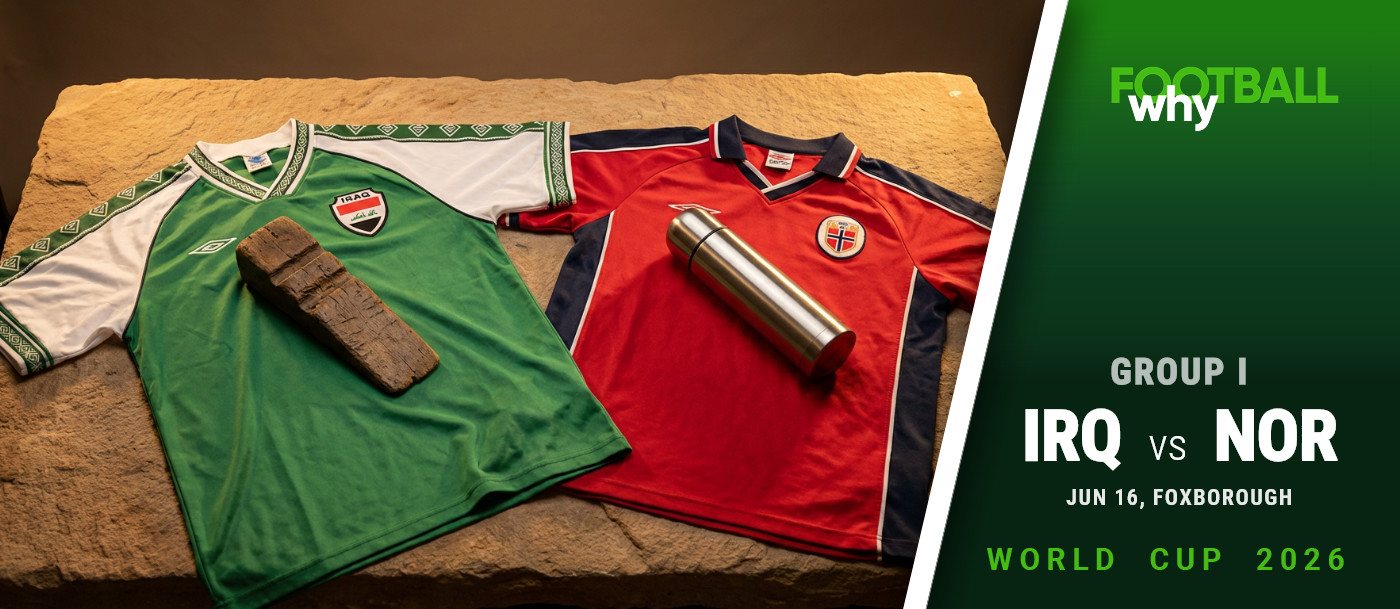
The World Cup Qualification Decider


Gillette Stadium, Foxborough
SCORE BY AI PREDICTION: 0:1 SEE SIMULATION

Iraq vs Norway FIFA World Cup 2026 Group Stage Match Filing Routine Paperwork Behind A Battered Desert Barricade Forecast generated:

The calculated chill of the fjords meets the fierce, honour-bound heat of the desert. It is a clash between meticulous resource stewardship and a defiant, siege-tempered resilience. Structure attempts to suffocate pride.

Iraq: One side's prayer...

Iraq enter this Group I opener enveloped in a self-imposed social media blackout, a deliberate move to shield the squad from external noise and prevent the emotional unravelling of previous campaigns. The weight of a forty-year World Cup absence hangs heavy, demanding cathartic vindication from a desperate public. They must navigate the crucial absence of Zidane Iqbal, whose severe knee injury robs them of vital midfield progression. Consequently, they are preparing to absorb pressure like a deeply entrenched sandbag wall, relying entirely on collective defiance and Aymen Hussein's aerial physicality to survive the ninety minutes.

Norway: ...head-on with the other.

Norway arrive with a clear mandate to validate their egalitarian system and prove their elite talents can deliver under tournament pressure. The public expectation is grounded but firm: secure the points without descending into chaotic, unstructured football. The primary complication is the delicate physical state of Martin Ødegaard. His ongoing knee discomfort requires meticulous minute-management, forcing the technical staff to carefully ration his involvement to avoid early, heavy collisions. To compensate, the team will operate with the ruthless efficiency of a winter snowplough, methodically clearing a path through possession rather than relying on spontaneous individual heroics.
Iraq vs Norway Structural Collision

Iraq: How we will host...

Dream
The bare minimum is to emerge from the opener with something to show for the effort; a draw settles the nerves, but a smash-and-grab victory would be the stuff of immediate folklore. The squad desperately needs to banish the ghosts of past late-game collapses and prove they can handle the pressure without losing their heads.

Strength
This is a team built on defiance and a willingness to suffer for the shirt. Their primary weapon is a rugged collective resilience paired with a formidable aerial threat, largely channeled through the physical presence of Aymen Hussein. They do not mind ceding possession, viewing it merely as a staging ground before launching rapid, direct counter-attacks.

Plans
Arnold has prepared a specific trap to neutralize Ødegaard, closing the door on his favoured left foot with a disciplined double-team. They will also look to exploit the space behind Norway's right-back with early, low crosses, and have a deceptive goal-kick routine designed to bypass the initial press entirely.

Fears
The overriding concern is that their passionate honour culture might betray their tactical structure. If they fall behind or suffer a contentious refereeing decision, the team has a tendency to spiral into dissent and chaotic, rushed clearances. That sort of emotional indiscipline would simply hand the initiative straight back to a methodical opponent.

Norway: With what we arrive...

Dream
The mandate is straightforward: secure three points while dictating the geography of the pitch and minimizing turnovers. A draw is only acceptable as an insurance policy if the fixture descends into an attritional scrap. Norway needs to validate their structured, egalitarian approach and prove that their elite individual talents can operate efficiently within a disciplined collective framework.

Strength
This is a side defined by empirical pragmatism and collective industry. Their main asset is a compact defensive shape coupled with absolute aerial dominance. They operate with the patience of a sorting office, methodically processing possession until a controllable opening appears, relying on their star forwards to provide the ruthless finishing touch.

Plans
Solbakken has devised a specific routine to exploit the opposition's left flank. The aim is to draw out the full-back with short, intricate passing before releasing Ryerson on an underlapping run. Defensively, the instruction is to engage early with the Iraqi striker, ensuring body-to-body contact to neutralize his aerial threat before the cross even arrives.

Fears
The greatest anxiety is that the team might abandon their structural discipline if frustrated, resorting to sterile possession or aimless long balls. If their primary creators are stifled, the side can sometimes look devoid of spontaneous invention. There is also a quiet, underlying concern regarding Ødegaard's physical durability and how his workload must be managed.
19%
24%
57%
Not a recommendation for betting
Tap [+] to cast your expert forecast. Can you outperform both the AI and the crowd?

How it will be...

This fixture promises the peculiar, compelling friction of two opposing survival strategies grinding against each other. Norway will likely operate like a meticulous sorting office, endlessly circulating possession to bait Iraq's defensive shape. Iraq, however, are built for a siege. They will happily surrender the ball, relying on a deeply ingrained cultural resilience to weather the storm.

The aesthetic clash alone is worth the price of admission. You will see Ødegaard attempting to unpick the lock with delicate, reverse passes, directly contrasting with Iraq’s frantic, visceral desire to launch the ball toward Aymen Hussein. It is the clash of the seminar room and the barricades.

The match's internal logic hinges on discipline. If Norway's structural patience holds, their superior chance-creation should eventually tell. Yet, if Iraq can force a chaotic, broken-field game, the raw dribbling energy of Ali Jasim could bypass the Norwegian midfield entirely.

Late on, expect the pattern to fracture. A desperate Iraqi side will likely abandon their mid-block, flooding the penalty area in a frantic search for catharsis. Norway will respond by battening down the hatches, committing cynical fouls far from goal. It will be ugly, desperate, and fundamentally gripping.

Secret mastermind intent

Arnold’s Checkpoint: Securing the Defensive Perimeter

General Strategy
Graham Arnold is setting up for a war of attrition, demanding a disciplined mid-block that prioritizes defensive solidity over possession. The idea is to conserve energy for a gruelling ninety minutes, ensuring the team does not burn out before the final quarter.

When they do win the ball, the transition must be immediate and vertical. Possession is not meant to be pretty; it is simply a vehicle to get the ball into the final third as quickly as possible.
Antidote for the Opponent
The primary defensive assignment is to ring-fence the right half-space to stifle Martin Ødegaard. The central midfielders are instructed to double up and force him toward the touchline, cutting off his preferred passing angles.

Offensively, the plan targets the space left by Julian Ryerson’s forward runs. The instruction is to hit early, low cut-backs rather than floating crosses into a tall Norwegian defence. Aymen Hussein is tasked with pinning Leo Østigård to create disruption in the penalty area.
Internal Task Solving
Arnold has implemented a complete social media blackout for the squad. This is a deliberate move to shield the players from external noise and maintain a siege-mentality unity within the camp.

On the pitch, they have prepared a decoy goal-kick routine. The defensive pivot will show short to draw the press, before the goalkeeper drives a flat pass directly into the left half-space to spark a rapid three-on-three counter-attack.
Crisis Response Plans
Should Norway introduce Alexander Sørloth to form a two-striker partnership, Arnold’s blueprint shifts toward pure containment. The wingers will drop to form a flat five-man midfield, and the full-backs will tuck in closer to the centre-halves.

In this scenario, the defensive pivot must drop deeper to block the cut-back lane. If, however, Iraq find themselves chasing the game late on, they will revert to a 4-4-2, throwing on Ali Al-Hamadi to stretch the Norwegian defence with his pace.
Specific Match Orders
Rebin Sulaka: Stay tight to Haaland but do not get dragged out when he drops deep to lay the ball off. Keep your body open to anticipate the cut-back and block his run to the near post. If you pick up a booking, immediately drop two yards deeper and let the holding midfielder take the first contact. Merchas Doski: For the first twenty minutes, prioritize holding your defensive position over joining the attack. Only push past the winger if their right-back is completely pinned back. When recovering, run diagonally toward the centre of the pitch, not straight down the touchline. Aymen Hussein: Pin Østigård early and initiate your runs to the near post with a quick two-step burst to find space. Keep your arms down when challenging in the air; we cannot afford cheap yellow cards that ruin our advantage at set-pieces.
/ What if a VAR review causes a lengthy delay?

The team must gather in a huddle immediately to prevent any dissent or arguing with the referee. The captain will dictate a breathing count to settle nerves. The coaching staff will instantly relay the specific tactical pattern required for the restart.

/ What if the team concedes an early goal?

The full-backs will immediately freeze their forward runs, and the team will adopt a strict two-touch limit in possession. The priority is to draw a foul and win a set-piece to reset the game's tempo and regain structural composure.

Secret mastermind intent

Solbakken's Audit: Methodical Control and Clinical Strikes

General Strategy
Ståle Solbakken is demanding a performance built on territorial dominance and low-risk circulation. The tactical emphasis is firmly on maintaining structural integrity rather than chasing constant, frantic attacks. It is about patience and precision.

The team will deploy a compact medium block, designed to funnel the opposition into wide areas. Pressing triggers are highly specific, activating only when the opponent plays a backward pass or receives the ball with a closed body shape.
Antidote for the Opponent
To stifle Iraq's primary attacking threat, the wingers are instructed to track their opposing full-backs diligently, aiming to suppress the volume of crosses coming into the box. The right-back must close down early to prevent the winger from cutting inside onto his stronger foot.

Going forward, Norway will target the space behind the Iraqi left-back. The strategy involves baiting the defender high up the pitch with quick, short passes, before whipping a diagonal ball into the vacated space for an underlapping run.
Internal Task Solving
A crucial, unpublicized element of the game plan is the strict management of Martin Ødegaard's physical load. There is an explicit internal cap on his minutes to protect his knee, meaning he must avoid unnecessary early physical confrontations.

Should Ødegaard's influence wane or his minutes run out, the creative burden will seamlessly transition to Aursnes and Bobb. The system is designed to absorb this rotation without requiring any fundamental change to the team's overall block height or defensive posture.
Crisis Response Plans
If the team struggles to create chances or finds themselves trailing around the hour mark, the formation will shift to a more direct 4-4-2. Alexander Sørloth will be introduced to partner Haaland, creating a formidable physical presence in the penalty area.

In this scenario, Aursnes will drop to anchor the midfield alone, while the full-backs adopt staggered positions. The focus will switch to delivering fast, low crosses and fiercely contesting second balls on the edge of the box.
Specific Match Orders
Martin Ødegaard: Manage your physical exertion carefully in the early stages; avoid heavy 50/50 challenges. If you are tightly marked, take a step wider to open up a reverse passing lane, then release the ball quickly. Do not force difficult passes on a damp surface. Julian Ryerson: Prioritize underlapping runs rather than overlapping down the outside until the opposition's left-back is securely pinned back. If possession is lost high up the pitch, your first recovery stride must be inward to block the cut-back lane, not toward the touchline. Erling Haaland: Remain centrally positioned; avoid drifting out to the wings during periods of sterile possession. Anticipate near-post runs when the ball is on the right flank. If service dries up, look to isolate yourself against the full-back at the far post rather than vacating the penalty area entirely.
/ What if Iraq escalate the physical chaos at set-pieces?

The team must immediately reduce the number of fouls committed in wide channels. When defending corners, two players will be stationed on the edge of the penalty area to facilitate an instant, direct exit pass to release Haaland on the counter.

/ What if the team concedes an unexpected goal?

The response must be methodical: execute two slow cycles of possession between the centre-backs and the pivot to take the sting out of the game. Squeeze the distances between the lines, draw a foul to reset, and re-establish overloads out wide before attempting any risky central passes.

MAIN SIMULATION 0'-25'

Norway will set up a methodical medium block, trying to bait Iraq's left side like a patient angler. Iraq, however, refuses the lure, keeping a rigid shape with Doski firmly anchored in rest-defence. The opening exchanges will resemble a delayed commuter train schedule — lots of waiting, very little movement. Both sides will test each other's structural seams without committing bodies forward. Chance creation remains minimal.

MAIN SIMULATION 25'-45'

Norway will refine their trap, with Ødegaard drifting slightly wider to unpick the lock. This subtle shift triggers a diagonal ball from Ajer, allowing Ryerson to underlap and feed Haaland for a likely breakthrough. Iraq will immediately deploy their crisis management protocol. They will freeze their full-backs and stick to a strict two-touch rule to steady the ship. Aymen might briefly threaten from a corner, but the visitors maintain control.

MAIN SIMULATION 45'-65'

Iraq will push their defensive line five yards higher, injecting a dose of desperate energy into the proceedings. Jasim might find a fleeting window, but Norway will respond by battening down the hatches. The game will turn into a slog through heavy tweed. Norway will throttle their full-back overlaps and rely on a fierce three-second counterpress. They accept a lower attacking output simply to protect their lead and manage Ødegaard’s fading legs.

MAIN SIMULATION 65'-90'

Iraq will abandon caution, shifting to a stretched formation and launching long balls toward the mixer. It is the footballing equivalent of throwing the kitchen sink through the front window. Norway will counter this by retreating into a dense defensive shell. They will commit cynical, controlled fouls far from their own penalty area. Despite some late penalty-box chaos and a near-miss from Aymen, the Scandinavian wall holds firm.

And it will come to...

If this forecast holds true, Norway’s structural pragmatism should ultimately outlast Iraq’s emotional resilience. The visitors would likely secure a gritty 1-0 victory by converting a calculated wide trap and then retreating into an impenetrable shell. Iraq would undoubtedly throw everything into a chaotic late bombardment, relying on their siege-tempered spirit. However, the Scandinavian commitment to low-risk game management and aerial superiority should see them absorb the pressure without buckling.
end of Game