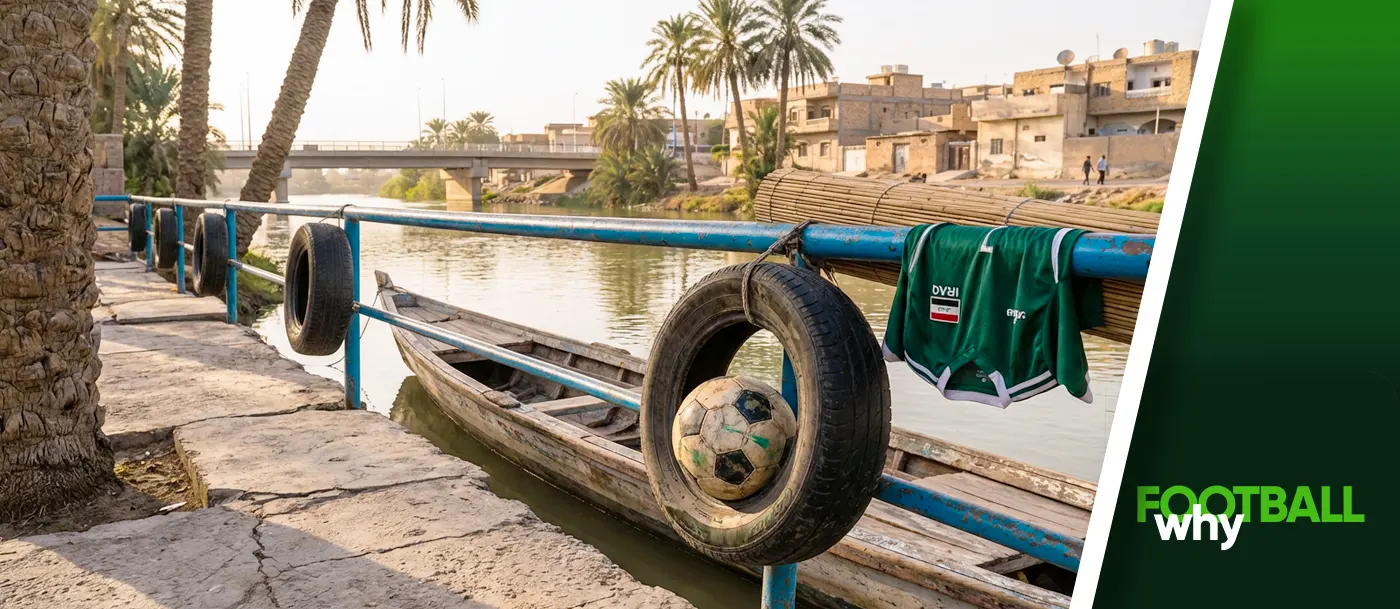
Decades of relentless stadium bans forged a portable fortress built on sheer emotional survival. They carry the desperate joy of millions, turning neutral venues into makeshift homelands. Yet, this raw surge-and-hold grit now collides with a demand for modern sophistication. The old guard's chaotic defiance wrestles fiercely against a rising tide of imported elegance. Watch them absorb suffocating pressure before exploding into a singular, devastating aerial assault, collapsing to the turf in prayer after every massive clearance. Expect a side that treats ninety minutes as an absolute assertion of existence.
Where it hurts?
Iraq: current status and team news
Defiance in the
Departure Lounge
Forty years after their solitary World Cup appearance in Mexico, Iraq’s most formidable opponent in returning there is the departure lounge. Wartime airspace closures and visa bottlenecks have turned the national squad into an ad-hoc diaspora, navigating bureaucratic checkpoints with frantically stamped passports to reach Monterrey for the March intercontinental playoff. Intricate positional play cannot be drilled whilst players are stranded waiting for connecting flights. Recognising this logistical reality, Graham Arnold has stripped the tactical circuitry down to its most shock-proof components, demanding absolute adherence to basic shape.
The blueprint relies on a reinforced double pivot governed by Amir Al-Ammari, designed to eradicate the late-game concentration collapses that routinely fray nerves in Baghdad coffee houses. From this secure base, the ball is funnelled efficiently into the wide channels. Merchas Doski provides a relentless volume of left-sided deliveries, whilst Zidane Iqbal threads immediate vertical passes before opposition structures can settle. Every attacking sequence ultimately converges on the massive frame of Aymen Hussein. Relying so heavily on a single finishing node acts as a ruthless calculation. It maximises limited preparation time, though it leaves the squad exposed should opposing defenders sever the supply line.
Domestically, the atmosphere is a prickly blend of desperate hope and loud cynicism regarding FA selection politics, particularly following abrupt cuts to the veteran core, prompting furious debates on television panels. Arnold’s countermeasure was a strict social-media blackout, confiscating digital distractions to enforce raw, barracks-style discipline. When the squad eventually steps onto the Mexican grass, expect a side devoid of decorative illusions. They will present a fiercely pragmatic, box-first assault, leaning heavily on set-pieces and sheer competitive defiance to pry the doors of the global stage open once more.
The Headliner
Iraq: key player and his impact on the tactical system
The Combustible Penalty-
Box Anchor
The six-yard box is a crowded marketplace, and Aymen Hussein demands the largest stall. Opposing centre-backs know the sequence intimately: an early shift of body weight to seal the marker, a sudden two-step separation towards the near post, and a seismic, downward header that abruptly closes the negotiation. Iraq’s entire crossing economy orbits this specific physical transaction. Wingers do not merely launch the ball into the area; they deliver it to a fixed, unyielding marker. Without his massive frame anchoring the second-ball swarms, the team’s cut-backs often drift into vacant territory. The immense load he carries, however, comes with a combustible thermal threshold. Long spells of isolation cause him to wander into wider channels chasing touches, whilst post-goal adrenaline spikes frequently tempt him into needless friction, pushing chests and exchanging heated words with defenders. His 2023 Asian Cup dismissal remains a stark proverb in Baghdad cafes about how raw physical power can be fatally hijacked by sudden rashness, and opponents actively bait him hoping for a repeat. Despite this volatile temperament, his refined blindside runs and sheer fight-through-contact dominance stand as the inescapable focal point of a nation's attacking intent, transforming chaotic deliveries into undeniable consequence.
The Wild Card
Iraq: dark horse and player to watch
A Negotiation in the Half-
Space
A sudden drop of the shoulder immediately alters the stadium's acoustic cadence. Ali Jasim bypasses straightforward sprinting to conduct a series of rapid, deceptive physical negotiations with the defender. Receiving the ball in the left half-space, he utilises a low centre of mass to sell a wide route before sharply cutting inside to lash a shot across the goalkeeper. This stop-start elasticity is a functional necessity for the squad. It diffuses the heavy reliance on a single target striker, providing a crucial secondary scoring route through perfectly timed weak-side crashes at the back post. Furthermore, he possesses a rare appetite for the immediate counter-press, sprinting back to tackle and ensuring attacking waves recycle instantly rather than fading after one blocked cross. Youth, however, exacts a predictable toll. If an opposing full-back applies early physical contact and traps him against the touchline, his decision-making slows. Denied an early successful duel, he often takes an extra touch, turning a fluid transition into a static, over-complicated haggle by rolling his studs over the ball while the defence resets. Should he learn to reset his tempo under such heavy policing, this whippy, spring-loaded winger possesses the exact profile to dismantle rigid defensive blocks on the world stage.
The Proposition?
Iraq : Tactical guide - how to identify their movements and game variations on the pitch
The Price of Width and
the Weight of Order
Arriving in Monterrey after severe travel disruption, Graham Arnold’s squad faces a stark playoff mission: enforce a control-first 4-2-3-1 and convert their wing-led crossing identity into goals, without succumbing to the late-game defensive fray that has recently haunted them.
To impose order, the system toggles into a 2-3-5 in possession. A double-pivot secures the half-spaces, pushing full-backs like Merchas Doski exceptionally high up the pitch. What to look at: In the opening minutes, watch if the full-backs advance right to the opposition line while wingers hug the touchline. This aggressive tilt forces early aerial duels towards Aymen Hussein and pins opponents deep, smothering potential breaks at their source.
Beating the press requires a fluid baseline. Amir Al-Ammari drops to split the centre-backs, physically pointing to direct his teammates as Frans Putros tucks inside. What to look at: When facing a front press, observe Al-Ammari forming a temporary back three. The number 10 drops to drag the defensive midfielder out of position, bypassing pressure and freeing a clean diagonal passing lane into the left half-space.
From this stable base, short combinations release runners into the final third. What to look at: Crossing the halfway line, look for Zidane Iqbal hitting a sharp, low diagonal pass to Ali Jasim. Doski overlaps instantly, setting up a waist-high cross or a cut-back to the penalty spot.
Everything ultimately converges on Hussein. The squad gladly isolates him against defenders to maintain sheer crossing volume. What to look at: As the ball travels wide, watch the number 10 crowd the six-yard box while the far winger crashes the back post. This decoy movement pulls centre-backs away, freeing the weak-side lane for Jasim.
Once ahead, Arnold initiates strict mid-block pacing, flattening the midfield into a rigid 4-4-2. What to look at: If the block drops ten metres and pressing throttles down, full-backs will hesitate to overlap. The defensive line deliberately concedes territory to prioritise packing the penalty area with bodies, relying on massive centre-back clearances to survive the pressure.
Yet, extreme width carries a structural tax, risking a late-game compactness fade. What to look at: If an opponent absorbs the flank overload and instantly hits a long diagonal pass behind the advanced Doski, the rest-defence becomes a fragile two-versus-three, exposing the central defenders to dangerous cut-backs.
Despite these late-game tightrope walks, the ability to turn chaotic preparations into a heavy, suffocating physical assault makes this side an undeniably compelling force, consistently wrestling sheer competitive willpower out of adversity.
The DNA
Iraq: football's importance and what we will see in their game at the 2026 World Cup
A Portable Fortress Built
on Barracks Discipline
Decades of geopolitical isolation and relentless stadium bans forged a footballing culture that treats every neutral venue as a contested border checkpoint. The national squad rarely relies on the comforting, sustained roar of a familiar home ground. Instead, they pack a fiercely portable identity into their kit bags, building an emotional stronghold wherever the fixture list strands them.
This unyielding resilience traces its lineage directly back to the military and security-affiliated clubs in Baghdad, such as Al-Quwa Al-Jawiya and Al-Shorta. Inside these institutions, coaches demand barracks-style obedience and actively value rugged physical endurance over decorative flair. When a veteran captain barks a frantic command to drop the defensive line in the final ten minutes of a tense qualifier, a young winger does not argue or attempt a reckless dribble. He immediately turns and sprints fifty yards back towards his own penalty area, sacrificing his attacking ambitions to maintain the collective shape. This action represents a deep-seated cultural reflex. Honour is preserved through collective duty, and severe public shame falls on anyone whose selfishness fractures the group.
On the pitch, this mentality translates into a highly reactive, surge-and-hold rhythm. The squad absorbs pressure in a tightly packed mid-block, conserving energy under sweltering heat, before exploding into sudden, vertical counter-punches. They rely heavily on towering target strikers and perfectly rehearsed set-pieces, turning a single corner kick into a chaotic, physical brawl for aerial superiority. It is a style demanding immense emotional bandwidth. When a crucial header crashes into the net, players do not merely jog back to the centre circle; they collapse to the turf in prayer, gripping the crest on their shirts, directly channelling the desperate joy of millions watching on crackling televisions in crowded local cafes.
A modern friction, however, now tests this historic blueprint. A growing influx of European-trained diaspora talent brings refined first touches and a clear desire for cleaner, possession-based build-up play. These newcomers expect structured pressing triggers rather than raw, emotionally fuelled surges. The domestic public watches this integration with a complicated mix of desperate hope and loud suspicion. They crave the technical upgrades necessary to compete on the modern global stage, but they severely distrust any tactical shift that might dilute the combative, giant-killing spirit that famously unified the country during the 2007 Asian Cup triumph.
Navigating this transition requires more than just coaching acumen; it demands delicate cultural diplomacy. The squad must somehow evolve its tactical sophistication without ever washing away the gritty, sweat-soaked defiance that originally made them formidable.