

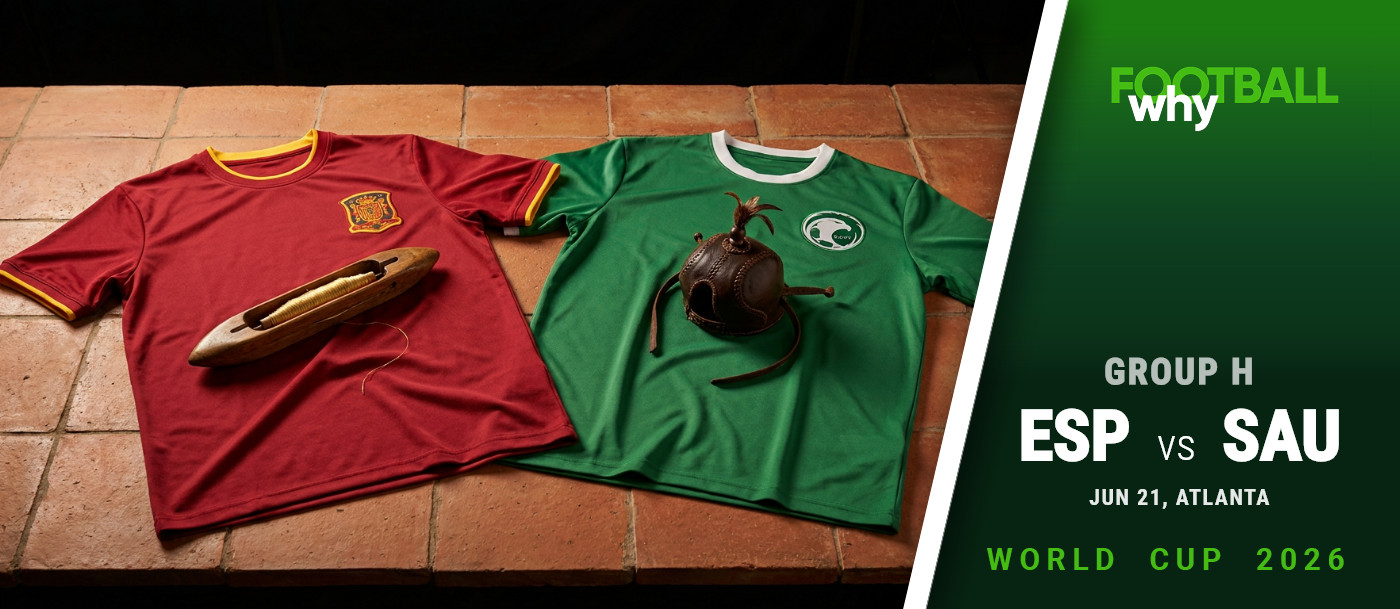
The World Cup Qualification Decider
Sunday, 21 June

Mercedes-Benz Stadium, Atlanta

Spain vs Saudi Arabia FIFA World Cup 2026 Group Stage Match The killer confesses on the third page Forecast generated:

Spain filed away the paperwork with three goals in the opening 24 minutes, turning the rest of the afternoon into a gentle stroll. Discover how diagonal switches killed the contest before the kettle even boiled.
Spain vs Saudi Arabia Structural Collision

What was it?

The supreme injustice of the sport funds the bookmakers. Spain executed the exact same horizontal passing patterns that yielded absolutely nothing against Cape Verde, yet here they dismantled a national structure in twenty-four minutes.

Lamine Yamal and Mikel Oyarzabal arrived at the far post as if stepping off an empty commuter train. The Asian side's deep defence failed to track runners on the blind side, repeatedly caught out by sweeping diagonal switches. By the 24th minute, the scoreboard already read three-nil.

From there, the tension evaporated entirely. The European bench hooked their star attackers at the interval, preferring to save legs. They circulated possession side-to-side, quietly suffocating any faint hope of a revival.

Saudi Arabia failed to register a single shot inside the penalty area all afternoon. Their only meaningful contribution to the second period was a panicked parry from their own goalkeeper that ricocheted off Hassan Tambakti for a comical own goal.

Anyone hoping for a contest missed it while putting the kettle on. It was a clinical execution that left the remaining hour feeling like a detective novel where the culprit simply turns himself in at the prologue.

How did they clinch it?

Spain

Spain’s absolute control stemmed directly from their relentless targeting of the weak side. They shifted play diagonally across the pitch, repeatedly exposing the space behind the opposing full-backs.

This constant switching stretched the Asian side's defensive block until it snapped. The rotation of the starting lineup injected a sudden verticality that bypassed the usual midfield congestion.

Players like Pedro Porro and Dani Olmo accelerated the transitions, opting for incisive thrusts rather than cautious, horizontal circulation. The squad’s depth allowed them to manage physical loads efficiently, maintaining their rigid defensive shape even after withdrawing their primary attackers.

This seamless interchangeability of personnel points to a deeper, institutional reality. The Spanish academy system rigorously drills positional awareness from the earliest age groups.

Young players are taught to scan the pitch, recognise pressing triggers, and form passing triangles long before they encounter senior football. It creates a collective heuristic where every individual instinctively understands where the next pass should go.

The national philosophy remains anchored in the belief that controlling the rhythm of possession neutralises the chaos of the opposition. They trust the collective structure to solve the problem, rather than relying on raw physical dominance.

They dismantle opponents exactly like a mechanic quietly stripping a seized engine down to its barest bolts.

Why not go for the win?

Saudi Arabia

Saudi Arabia’s collapse began the moment they decided to sit deep without applying pressure to the source of the pass. Their five-man defensive line functioned as a static barrier rather than an active shield.

By allowing the European midfielders time to look up, they invited sweeping crosses into the blind spots of their wing-backs. Once the structure was breached, the team never managed to reset its emotional baseline.

Falling behind forced them to chase the game, but they did so through isolated, individual carries. The lone striker was left entirely detached from the midfield, chasing clearances that simply bounced right back.

This inability to adjust on the fly highlighted a severe structural vulnerability. Under sustained pressure, the defensive line retreated unevenly, creating massive gaps in the half-spaces and leaving the goalkeeper exposed to second balls.

The root of this paralysis extends beyond a single tactical misstep. The national team suffers from a lack of regular exposure to the relentless, high-tempo circulation of elite international football.

While domestic investment has raised the athletic standard, it has not cured the ingrained habit of deferring initiative when the system breaks down. Players wait for a structural override rather than solving the immediate crisis themselves.

They sank quietly into the turf, waiting for a rescue mandate that simply never arrived.

Match hero...

Mikel Oyarzabal
Mikel Oyarzabal stitched the game together without needing to dominate the threading himself. He simply arrived at the far post exactly when the pattern demanded it. His effectiveness relies entirely on cognitive geometry — scanning the defenders' blind spots and stepping into the void just as the cross is struck. He understands that in the modern Spanish system, the most dangerous man is not the one holding the ball, but the one slipping quietly through the back door while everyone else argues in the plaza.

...and one more

Mohammed Al-Owais
Mohammed Al-Owais stood stranded in the gateway while the walls collapsed around him. He parried shot after shot, desperately trying to bail water from a sinking vessel, but the rebounds continually fell to unattended attackers. His frantic saves exposed a deep structural flaw: his defenders were retreating unevenly, deferring responsibility rather than clearing the danger. He threw himself at every loose ball as if trying to single-handedly hold back the tide, the isolated guardian of a system that had already surrendered its courtyard.