

The World Cup Qualification Decider
Sunday, 21 June

Hard Rock Stadium, Miami-gardens

Uruguay vs Cabo Verde FIFA World Cup 2026 Group Stage Match Industrial pressure fractured by brittle human errors Forecast generated:

Uruguay operated like a relentless industrial press, forcing eleven corners, but shattered their own blueprint with a thirty-yard free-kick concession and a comical back-pass. Discover how structural dominance was undone by brittle human errors.
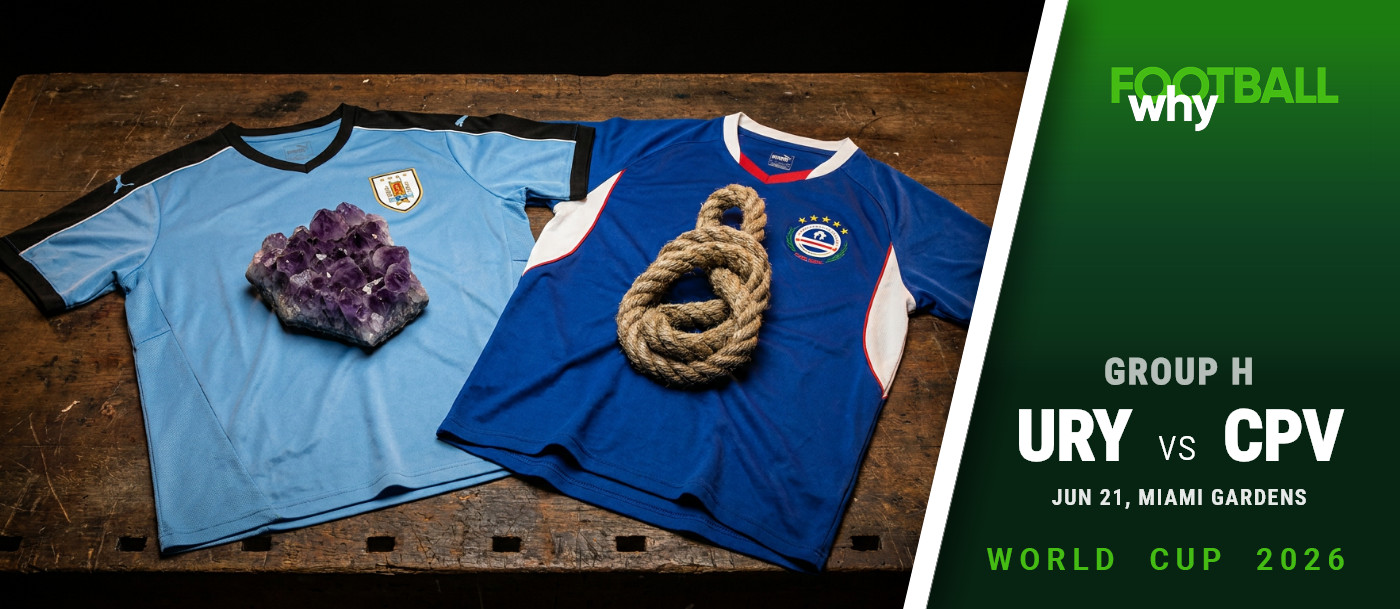
Uruguay vs Cape Verde Structural Collision

What was it?

The afternoon felt like watching heavy oak planks being forced into a space too small for them. Uruguay applied relentless, groaning pressure down the flanks. They suffocated the territory, hoarding sixty-six percent of possession and forcing eleven corners.

Yet, structural integrity relies on the smallest joints. The South Americans conceded a historic opener when a thirty-yard free-kick simply strolled through a fractured two-man wall. The goalkeeper reacted a fraction too late. A basic lapse in concentration shattered the entire tactical blueprint.

Bielsa’s men rebuilt the lead through sheer mechanical output. Wide deliveries operated like a relentless conveyor belt, resulting in two close-range finishes. You missed a masterclass in suffocating width, but also a masterclass in how to immediately throw it away.

Cape Verde refused to panic. They passed out of tight corners with surprising elegance. Their reward arrived via an absurdly under-hit back-pass and a frantic goalkeeper exit, gifting an equaliser to a newly introduced substitute.

A fractional offside call erased a late Uruguayan winner. It leaves us with a strangely beautiful truth: you can engineer the perfect pressing machine, but you cannot legislate for the sudden, tragicomic frailties of the human mind.

Why stopped just short of victory?

Uruguay

Uruguay’s inability to secure the victory stems directly from a sudden loss of structural automatism at the back. When injuries forced unfamiliar faces into the defensive line, the usual unspoken rhythm of their retreat stuttered.

This stutter became a critical fault line due to an aggressive, high-pressing mandate. Pushing wide runners high up the pitch demands a goalkeeper who sweeps the space behind the line. Relying instead on a traditional, static shot-stopper stretches the defensive fabric until it inevitably tears.

Further up the pitch, the initial absence of natural depth-runners meant Uruguay had to grind exclusively through the flanks. They generated immense physical friction out wide, yet struggled to pick the lock centrally when the crosses were repelled.

This reliance on wide attrition highlights a broader, systemic reality. The domestic academy pipeline reliably forges elite, combative midfielders and tenacious forwards. It excels at producing players who thrive in physical duels.

However, it frequently under-produces natural playmakers. When faced with a deeply entrenched opponent like Cape Verde, the team lacks the surgical patience to dismantle a low block, defaulting instead to raw, emotional surges.

They export fiercely resilient competitors for the world's most demanding leagues, but occasionally forget how to manufacture a simple, unlocking central pass.

The furnace burns hot enough to melt heavy iron, but struggles to cast a delicate mold.

Why stopped just short of victory?

Cape Verde

Cape Verde secured this result through a masterful calibration of their limited resources. Facing an opponent determined to suffocate the flanks, they simply dropped their defensive anchor and absorbed the friction.

Rather than contesting the midfield possession, they maintained a remarkably narrow block. They allowed Uruguay to circulate the ball out wide, banking on their own ability to clear the inevitable crosses.

This patience provided the foundation for a calculated mid-game shift. The introduction of fresh, direct runners just before the hour mark was not a desperate gamble. It was a pre-planned escalation designed to exploit the spaces left by heavy South American legs.

Such precise game management reflects the maturity of a squad heavily reliant on its diaspora. Players forged in structured European leagues bring a tactical stoicism that domestic-only setups often lack. They understand how to suffer without fracturing.

This transnational pipeline creates an unusual but highly effective national team profile. They may lack the depth of global heavyweights, but they possess a high baseline of professional competence.

Because the squad gathers from across the globe with limited preparation time, they naturally gravitate towards simple, robust tactical frameworks. Complex passing networks are discarded in favor of rehearsed set-pieces and sudden vertical transitions.

They survive the drought by hoarding every drop of rain, striking only when the clouds finally break.

Match hero...

Maximiliano Araújo
Maximiliano Araújo operated like a heavy-duty sanding belt along the left flank. He stripped the varnish off Cape Verde’s wide defenders through sheer, repetitive physical friction. His ability to arrive late at the back post stems from a distinctly street-level calculus: let the others cause the central pile-up, then quietly collect the scraps on the edges. He understood exactly when to stoke the furnace and when to pull back, turning chaotic deflections into polished, actionable deliveries.

...and one more

Kevin Pina (Lenini)
Kevin Pina treated possession with the severe thrift of a man rationing fresh water on a long voyage. He anchored the midfield currents, absorbing heavy South American pressure without evaporating under the heat. When the moment presented itself, his thirty-yard free-kick bypassed the wall like a carefully plotted maritime chart avoiding jagged rocks. This sudden lethality is born from diaspora-forged discipline: you calculate the wind, adjust the sails, and never waste a clear sighting of land.