

Round of 32 (B), Match #80
UTC

Mercedes-Benz Stadium, Atlanta

Prediction by whyFootball readers

ENG
DRAW
COD
70%
0%
30%
Not a recommendation for betting
Tap [+] to cast your expert forecast.
MATCH IS FINISHED. SEE REVIEW

England vs DR Congo FIFA World Cup 2026 Group Stage Match A bureaucratic timetable delayed by a sudden ambush Forecast generated:

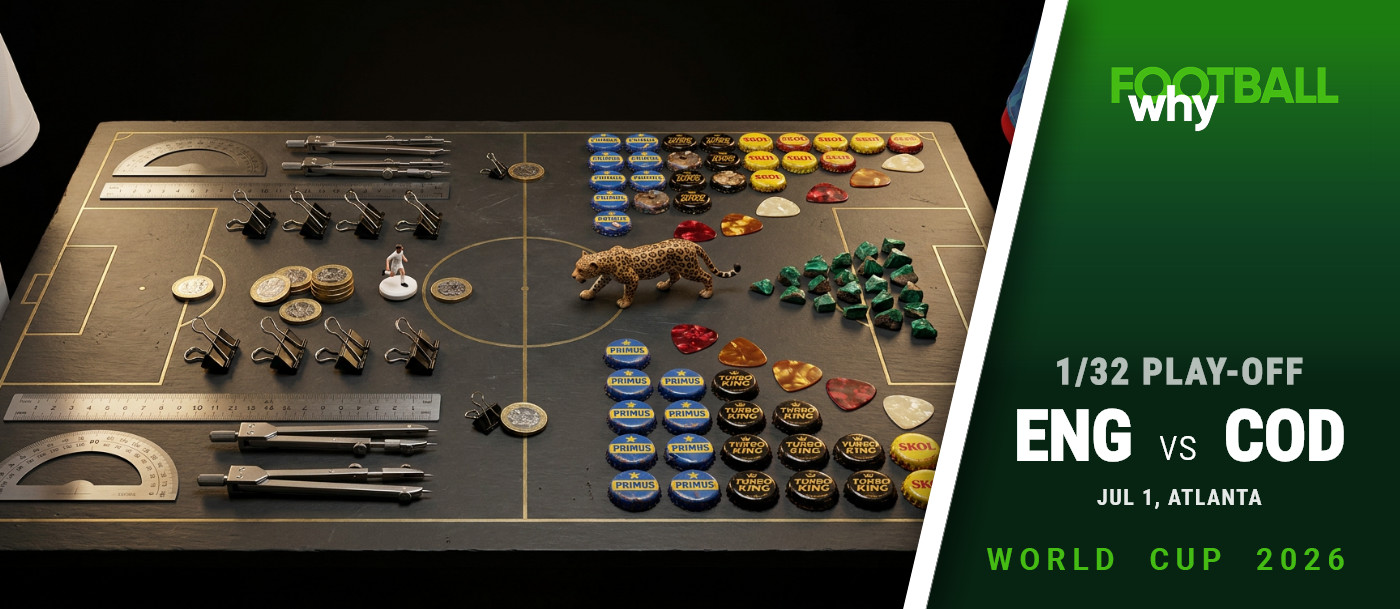
The rigid architecture of established precedent collides with the adaptive hustle of the street market. It is a compelling audit of institutional control against fierce, communal defiance. One side demands orderly turn-taking; the other prepares for a sudden, joyous ambush.

England: One side's prayer...

England enter this knockout tie carrying the usual suffocating weight of domestic expectation. The public demands a serene, drama-free progression, viewing anything less as a national crisis. Thomas Tuchel’s preparations have been slightly disrupted by a right-back injury curse and whispers of 'spygate' paranoia, forcing a defensive reshuffle. The mood in the camp remains procedural and calm, but they know they must lay down a smooth tarmac of early possession to prevent the tabloid anxiety from seeping onto the pitch.

DR Congo: ...head-on with the other.

DR Congo approach this fixture with the fierce, communal pride of a heavy underdog. For them, this knockout stage is a free hit, a chance to unify a passionate diaspora. Their build-up has required smoothing over the usual administrative friction regarding player bonuses, ensuring the camp remains a tightly sealed unit. With defensive rotation severely limited by injuries, their starting centre-backs face a grueling physical toll. They are preparing to weld their defensive hull shut, relying on collective defiance to weather the inevitable English storm.
England vs DR Congo Structural Collision

England: How we will host...

Dream
The absolute requirement is to secure progression within normal time, ideally breaking the deadlock before the hour. The national mood demands a controlled, drama-free victory, leaving no room for late-game panic or the dreaded penalty shootout.

Strength
This squad’s foundation rests on elite, club-hardened discipline and a deep respect for structural order. They excel at maintaining positional control and executing meticulously rehearsed set-pieces, reflecting a cultural preference for doing things by the book and forming an orderly queue.

Plans
Tuchel intends to exploit the flanks by targeting the space behind the opposition's wing-backs with darting runs. The strategy heavily involves crowding the goalkeeper on corners and delivering precise cutbacks, bypassing the need for overly intricate central combinations.

Fears
The overriding anxiety is falling into a pattern of sterile possession against a deep defensive block. If the tempo drops and passing becomes overly cautious, old fears of tournament paralysis will quickly resurface, inviting the crowd's frustration.

DR Congo: With what we arrive...

Dream
The baseline ambition is to drag the contest deep into the second half without conceding a goal. They want to turn the occasion into a gritty, frustrating scrap, relying on collective defiance to weather the inevitable early storm.

Strength
Their primary asset is a fierce, communal resilience built upon a highly compact defensive block. This reflects a wider societal instinct to form tight, trusted circles when facing external pressure, defending the middle of the pitch with absolute conviction and shared physical effort.

Plans
Desabre intends to spring direct counter-attacks specifically into the channels left vacant by the opposition's advancing full-backs. The setup relies heavily on winning the first contact in midfield and immediately releasing early, flat deliveries to bypass the press entirely.

Fears
The lingering dread is that discipline will dissolve into desperate individualism if they fall behind. When their structural integrity rusts under scoreboard pressure, players often revert to isolated, rash duels, which elite opposition will mercilessly punish.

How it will be...

England will likely dictate the afternoon with the procedural detachment of a county court judge. They will circulate the ball around the perimeter of DR Congo’s defensive trench, waiting for a structural lapse. This will be a test of institutional patience against communal defiance. The visitors will not simply absorb pressure; they will protect the central lanes with a fierce, collective pride, looking to spring Yoane Wissa on the counter.

The most compelling individual sub-plot will materialise on the flank. Aaron Wan-Bissaka’s one-on-one containment of Bukayo Saka promises to be a fascinating, isolated duel of timing and leverage. If the winger struggles to find traction, England’s reliance on set-piece engineering will become their primary avenue for a breakthrough.

Watch for the hour mark. Should the scoreline force DR Congo to abandon their rigid shell, the match will abruptly fracture. Their transition from a disciplined rearguard to an expansive, desperate chase will leave vast tracts of turf exposed. England’s structural superiority will then ruthlessly exploit those newly vacated channels, punishing any descent into frantic individualism.

England: How did they clinch it?

England navigated the stalemate by leveraging their set-piece routines, breaking the deadlock when open play stalled. Once ahead, their robust midfield rest-defence stifled any immediate backlash. Ultimately, their elite structural discipline allowed them to absorb late pressure and ruthlessly exploit the spaces left by a chasing opponent.

DR Congo: Why not go for the win?

The visitors surrendered their crucial compact shape following a messy concession from a corner. Forced to chase the game, their shallow defensive rotation and lack of structural patience betrayed them. As collective discipline dissolved into isolated heroics, they left vast channels completely unguarded for the decisive counter-attack.

Secret mastermind intent

Tuchel’s steady navigation through the knockout headwind

General Strategy
Tuchel wants to lay down a steady tarmac of positional control, grinding out territory without rushing. The primary objective is to score within the first hour to avoid a siege mentality later.

The focus is on establishing a heavy attacking presence on the right flank. This right-sided gravity is designed to naturally open up the left half-spaces for late arrivals.
Antidote for the Opponent
To dismantle DR Congo’s compact defensive shape, the plan specifically targets the space behind Arthur Masuaku using out-to-in darts from Anthony Gordon.

Defensively, the midfield is instructed to shut down the inside-left channel completely. Declan Rice will act as a permanent screen, explicitly blocking bounce passes into the striker and ensuring Yoane Wissa cannot transition through the centre.
Internal Task Solving
The ongoing injury issues at right-back force a highly specific contingency plan. With key players missing, the chosen full-back will have a hybrid role, strictly altering how set-pieces are assigned and delivered.

Furthermore, Bukayo Saka’s workload is being heavily managed. The medical staff have placed a hard cap on his sprint volume, meaning his minutes will be strictly limited if England secure a comfortable lead.
Crisis Response Plans
If DR Congo shift to a proactive press and force early turnovers, the immediate response is to drop John Stones deeper. He will form a secure base alongside Rice during the first phase of build-up.

Beyond that specific adjustment, the manager is prepared to be flexible. If the game remains goalless late on, the approach will shift towards flooding the penalty area with extra forwards and relying on raw box-saturation.
Specific Match Orders
Bukayo Saka: Keep to the isolation drills for the first fifteen minutes, then actively dial down the repeat sprints. If they start doubling up, drift inside to the half-space and let the full-back overlap rather than trying to force your way through two men. Harry Kane: Do not drop deeper than the attacking midfielders during open play. Arrive slightly late at the penalty spot to meet the cutbacks, and make sure to physically screen their goalkeeper on every corner. John Stones: Only step forward into the midfield pivot if the holding midfielder is covering and both full-backs are set. If we are forced into a defensive siege, drop back and sit in a rigid two-man shield.
/ What if the possession becomes completely sterile?

If the ball circulation loses its edge, the immediate fix is to pin both wingers as high as possible. The attacking midfielders will push further up to re-stagger the passing lanes, and the team will aggressively increase the volume of set-pieces to force an opening.

/ What if the opponent scores first?

The shock-recovery protocol kicks in immediately. The restart must go directly to the striker's feet at the edge of the box, followed by a rapid wide switch. The team is mandated to force a set-piece within ninety seconds to regain territorial authority and settle the nerves.

Secret mastermind intent

Desabre’s tight defensive circle and the opportunistic hustle

General Strategy
The blueprint revolves around stubborn survival and opportunistic strikes. Desabre wants his side to maintain a dense 5-3-2 formation, entirely denying access through the central corridors. The aim is to reach the hour mark with the scorecard blank.

From this secure foundation, they will look to harvest set-pieces and launch immediate, direct transitions. It is a strategy of patience, waiting for the heavy machinery of the opposition to overextend before hitting the exposed flanks.
Antidote for the Opponent
To nullify the threat of the opposition's central creators, the defensive anchor is tasked with permanently screening the edge of the penalty area. Meanwhile, the right wing-back has a strict mandate to manage his winger in isolated one-on-one situations without committing early.

In attack, the focus shifts to the space behind the English right-back. The moment possession changes hands, the instruction is to bypass the midfield entirely and expose that specific channel with early, flat crosses.
Internal Task Solving
A lack of depth in the defensive ranks means the starting centre-backs will have to endure a massive physical load. To protect their focus, management has worked overtime to silence any off-pitch administrative noise or bonus disputes.

Additionally, the team will use deep throw-ins as a makeshift weapon. Every touchline restart in the attacking third will be treated like a corner, loading the penalty area to disrupt the opposition's defensive organisation.
Crisis Response Plans
Should the opposition successfully overload the right flank and consistently breach the penalty area, the immediate fix is to pin the wing-back deeper. A central midfielder will then slide across to double up in the inside channel, prioritizing delay over aggressive tackling.

If the team falls behind late in the game, Desabre is prepared to abandon the barricades. The shape will morph into a frantic 4-2-3-1, throwing on an extra striker to flood the box and hunt for second balls.
Specific Match Orders
Aaron Wan-Bissaka: Track the winger from the inside out and do not get lured into making rash slide tackles on the edge of the box. Only overlap on the counter-attack; blind overlapping runs are strictly off the table today. Chancel Mbemba: Do not step out of the defensive line unless the holding midfielder explicitly calls that he has your cover. When defending corners, make sure to put a body on their main striker first before attacking the flight of the ball. Lionel Mpasi: Stay away from punching the ball back into the central traffic. Commit to two-handed catches or punch wide, and look to launch quick throws out to the left the second their full-backs are caught up the pitch.
/ What if the team concedes early?

The squad is instructed to form an immediate huddle and deliberately waste thirty to forty seconds before the restart. They must compress the lines tightly for three full minutes to weather the adrenaline spike, before relaunching attacks via diagonal balls to the left channel.

/ What if individual hero-ball takes over?

If players start abandoning the structure to chase the game solo, a strict two-touch limit will be imposed on the midfield. Every single first pass must be routed through the defensive anchor to force the team back into a cohesive, collective rhythm.

MAIN SIMULATION 0'-25'

England will likely establish a steady rhythm of positional control, probing DR Congo's stubborn defensive block. The tactical friction will centre around Bukayo Saka trying to isolate Aaron Wan-Bissaka wide on the right. John Stones will step out from the back to overload the midfield and dictate the tempo. It should be a low-friction start, with England dominating territory while DR Congo comfortably protect the central lanes without panicking.

MAIN SIMULATION 25'-45'

The pressure will gradually mount until England's set-piece engineering breaks the deadlock, likely around the half-hour mark. A far-post overload should yield a rebound for Harry Kane to sweep home. Following the goal, DR Congo will trigger a brief huddle to compress their lines and survive the immediate shock. The half will end with England slowing the tempo to a crawl, managing their lead with risk-averse passing.

MAIN SIMULATION 45'-65'

DR Congo will start to show their teeth. Around the 55-minute mark, sensing the ticking clock, they will likely shift to a more aggressive shape, bringing on a second striker to press higher. This will create noticeably sharper tactical friction. Wissa will find pockets of space, but England’s defensive shell — anchored by Declan Rice — should absorb the surge and snuff out the transitions before they reach Jordan Pickford.

MAIN SIMULATION 65'-90'

The final quarter will resemble a messy pub brawl as DR Congo abandon their shape entirely to chase the game. They will throw bodies forward, looking for second balls. England will pragmatically withdraw Saka to protect his legs, introducing a fresh runner to stretch the play. This substitution will prove fatal for the Africans; the runner will exploit the vast spaces left behind, setting up Jude Bellingham to kill the tie.

And it will come to...

If the match unfolds as expected, the favourite’s methodical approach would eventually outlast the underdog’s grit. England would dictate the tempo, using their elite set-piece routines to crack the initial defensive wall. Once DR Congo were forced to abandon their compact shape to chase an equaliser, the structural gap between the sides would become glaringly obvious. It would be a victory built on cold, pragmatic control, punishing a brave but ultimately disorganised late surge.
end of Game