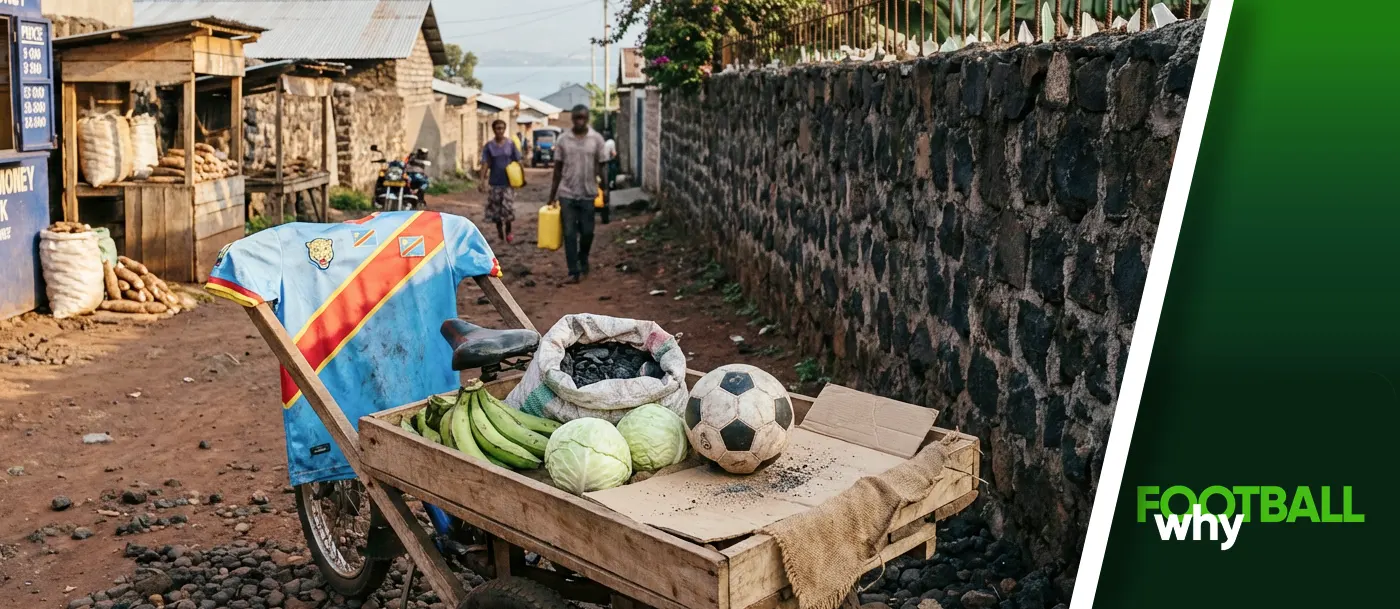
Half a century of exile casts a heavy shadow over a nation vibrating with unspent fury. The ghosts of 1974 demand redemption, yet the sprawling chaos of home constantly threatens to derail the dream. Stripped of their deafening stadium, they must pack their raw, percussive soul into a cold, disciplined suitcase. The urge to conquer through heroic individualism battles the necessity of ruthless organisation. Watch for sudden, rhythmic surges tearing through congested midfields, driven by an unbreakable collective pride. The Leopard is finally ready to hunt.
Where it hurts?
DR Congo: current status and team news
Packing the Roar
into a Suitcase
The vast concrete bowl of the 80,000-seat Stade des Martyrs usually vibrates with a deafening, chaotic energy that melts visiting teams before kick-off. Right now, it sits aggressively empty. CAF decertified the venue following crowd incidents, stripping the Leopards of their most intimidating asset just as they attempt to end a 52-year World Cup exile. Kinshasa’s football public nurses a familiar, bruised pride. They direct their fury at the local federation for the administrative mess, while nervously tracking Nigeria-led FIFA petitions whispering about player eligibility. Domestic fans also scrutinise the squad list, questioning why local Linafoot talents are bypassed for European-based diaspora players. Sébastien Desabre cannot fix the bureaucratic rubble. He is busy building a travel-ready, altitude-proof system for a one-off inter-continental playoff in Guadalajara. Instead of relying on the emotional surges that usually define the national style, his blueprint demands a disciplined mid-block. Chancel Mbemba commands the defensive line, pointing constantly to adjust spacing and settle nerves, while Samuel Moutoussamy stays anchored to keep the midfield shape intact. The attacking threat funnels down the left channel, where Yoane Wissa waits to turn possession into sudden, sharp cuts towards goal. The true test arrives late in the match. Historically, the team’s structure unravels when the scoreboard tightens and players abandon their posts to chase the game. Desabre counters this vulnerability with rigid substitution schedules around the 60-minute mark, swapping tired legs to sustain intensity and prevent familiar late-game collapses. If they reach North America, expect a squad that has learned to pack their fierce, rhythmic intensity into a tightly organised suitcase. They will bring defensive bite and rapid transitions, proving they can finally thrive far away from the deafening noise of home.
The Headliner
DR Congo: key player and his impact on the tactical system
The Broker of the Back Line
A raised palm settles the defensive block. A sudden, anticipatory stride severs the passing lane. Chancel Mbemba operates as the undisputed patron of the Congolese back four, managing space like a seasoned broker calming a frantic Kinshasa market crush. Globally, scouts note a highly effective stopper with refined diagonal distribution. Domestically, fans revere "Demi-Dieu" — an authoritative elder whose physical presence dictates the squad's resting pulse. His mechanics rely on proactive lane-breaking. He reads the opposition's intent, stepping out to execute front-foot interceptions that immediately flip the tempo. When a match devolves into chaos, his reaction becomes seismic. He pushes higher, competing aggressively for every aerial duel in both boxes. Such an imperious urge to personally extinguish every localised fire inevitably leaves space behind his forward surges. Midfielders must scramble to cover the exploitable channels he temporarily abandons. Even with that aggressive exposure, his commanding composure and aerial dominance stand as a monumental, load-bearing pillar of modern African defending.
The Wild Card
DR Congo: dark horse and player to watch
The Architect of the Half-
Turn
Defying his parents' initial hesitations, Noah Junior Sadiki committed to the Leopards, bringing an uncharacteristically quiet geometry to a fiercely emotional midfield. At 21, the domestic public has already crowned him their conductor for his ability to untangle congested build-up play. He operates as a press-resistant pivot, scanning constantly to receive the ball on the half-turn. When opponents collapse inward, Sadiki executes sharp, line-breaking punch passes that instantly bypass the first wave of pressure. His positioning tidies up the team's rest-defence spacing, ensuring the backline isn't exposed during transition bursts. Opposing teams actively try to disrupt this rhythm by crowding his back-to-goal receptions and forcing his hips toward the touchline to shrink his passing options. Pushing him into an early booking or a forced vertical pass into heavy traffic temporarily blunts his intervention rate. Still, once he cleanly breaks an early press, his confidence dictates the entire tempo of the match, making him a vital, stabilising intelligence to watch closely when the tournament begins.
The Proposition?
DR Congo : Tactical guide - how to identify their movements and game variations on the pitch
The Asymmetric Geometry
of the Leopard
The Democratic Republic of Congo arrives at a neutral-site, high-altitude playoff in Guadalajara with a singular mission: to secure their first World Cup appearance since 1974. Navigating institutional chaos, stadium bans, and the thin Mexican air requires a ruthless win-anywhere pragmatism. Under Sébastien Desabre, the Leopards have traded emotional, chaotic football for a disciplined mid-block identity, though they still carry a dangerous, asymmetric risk down their left flank.
A 4-2-3-1 system that frequently toggles into a 4-3-3 anchors this pragmatic approach. The team operates out of a controlled mid-block designed to deny central progression. The shape leans heavily to one side. While the left-back, Arthur Masuaku, pushes aggressively high to join the attack, the right-back, Gédéon Kalulu, tucks inside to form a makeshift back three in possession.
What to look at: If you see the back four holding near the halfway line during the opening exchanges, with the wingers tucked inside and the number 10 shadowing the opponent's pivot, watch closely. They are deliberately forcing the opposition wide, baiting a back-pass to spring a rapid switch into a left-lane transition race.
This left-sided overload serves as their primary progression mechanism. Masuaku underlaps, allowing Yoane Wissa to attack the inside channel. The double-pivot, usually anchored by Samuel Moutoussamy with Charles Pickel linking play, staggers to support this tilt.
What to look at: When a Congolese ball-carrier crosses the halfway line and angles toward the left half-space, watch Wissa curve his run between the opposing right-back and right-centre-back. Simultaneously, the striker (often Cédric Bakambu or Simon Banza) will dart toward the near post. This triggers a low cutback to a late-arriving midfielder or an early inswinger across the six-yard box for a first-touch finish.
When out of possession, the shape shifts. The number 10 pushes up alongside the striker to screen the opposing pivots, forming a compact 4-4-2. In possession, however, the build-up relies heavily on structural manipulation to beat the press.
What to look at: If the opposition press spikes, notice Pickel dropping between the centre-backs, while Kalulu tucks inside the defensive line. This creates a numerical advantage against the first wave of pressure, freeing up a man on the left and pre-empting counters by covering the inner-right lane.
The entire defensive structure warps around their captain and stopper, Chancel Mbemba. Known as "Demi-Dieu" back home, Mbemba dictates the defensive line and the timing of duels. He frequently executes aggressive step-outs to kill opposition entries before immediately releasing a diagonal pass.
What to look at: When Mbemba steps out to intercept, watch Moutoussamy drop into the vacated right-centre-back lane. Kalulu will narrow further, and the weak-side winger will hug the touchline. This preserves central cover despite the captain's advance and immediately exploits the far channel via a fast diagonal pass, isolating the left winger one-on-one.
Such aggressive asymmetry inevitably leaves gaps. In the first five to eight seconds after losing the ball, the space behind the advanced left-back and the split pivots becomes highly vulnerable. An over-eager step-out by Mbemba easily exposes the inside-right channel.
What to look at: If an opponent regains the ball and immediately hits an early diagonal switch to the weak side, or plays direct into the channel outside the right-centre-back, the Congolese rest-defence stretches to breaking point. Look for an untracked runner at the back post or a one-on-one situation against the covering defender, creating a high-probability scoring chance.
Securing a lead prompts the Leopards to compress into a survival mode, shifting to a 5-4-1 as the right-back drops deep. The wingers retreat to protect the half-spaces, and goalkeeper Lionel Mpasi extends restarts to bleed the clock, relying on clearances targeted at the flanks.
What to look at: When the defensive block retreats into its own third and pressing duels stop upon the opponent's half-turn, the team has traded territory for box density. The frequency of their counter-punches sharply declines as they focus entirely on set-piece resets and time management.
Navigating the grueling altitude with these specific tactical patterns makes this DR Congo side a fascinating watch. Their structural discipline, combined with the sudden, explosive rhythm of their asymmetric attacks and the undeniable leadership of Mbemba, guarantees a fierce, organised resilience on the world stage.
The DNA
DR Congo: football's importance and what we will see in their game at the 2026 World Cup
The Art of the
Bouncing Rhythm
The air in Kinshasa vibrates long before the first whistle blows. It is a heavy, humid thrum, layered with the staccato rhythm of tam-tam drums, the smell of exhaust, and the relentless, improvised hustle of the city’s vast informal markets. Survival and progress here are rarely linear; they are negotiated daily in crowded streets where rigid plans shatter against reality. In this dense terrain, the prevailing social habit is the 'patch-and-repair' — an instinct to find immediate, adaptive fixes rather than waiting for a centralised system that might never arrive. This deeply ingrained mental map, where status is earned through visible, physical contributions to the community, bleeds directly onto the football pitch.
Watch the Leopards when the match state tightens. European sides might retreat into rehearsed geometric passing, and North African neighbours often rely on strict tactical automatism. The Congolese player, however, actively seeks the ball in the most congested zones. This behaviour stems directly from a cultural reflex. When the formal system fails, individuals step up to break the deadlock. A midfielder will intentionally invite physical contact, absorbing a heavy shoulder barge, only to spin out and launch a sudden, vertical surge. In the market, you do not map the crowd; you feel the gap and push through it. On the pitch, this translates to a transition-heavy, percussive style where tempo is dictated not by a coach's clipboard, but by the charismatic arbitration of a captain waving his teammates forward.
This reliance on heroic individualism carries a volatile edge. The same instinct that fuels a breathtaking comeback — like the chaotic, direct surges that overturned a 0-2 deficit against Congo-Brazzaville in 2015 — can easily unravel the team's structure late in a game. When stress spikes, the urge to personally solve the crisis leads to forced dribbles and abandoned defensive posts. The domestic public, nursing the long shadow of the 1974 World Cup trauma, demands both the cathartic joy of these improvisational bursts and the dignity of modern, stable game-management.
Fans watch European-based diaspora players integrate with domestic talents hardened by the continental professionalism of TP Mazembe, hoping to see the raw, rhythmic power of the Leopard finally married to cold, structural control. Demanding a player retain the courage of the street while adopting the patience of the academy presents a steep challenge. Ultimately, a population accustomed to building a life out of improvised patches knows that true strength resides in the relentless, joyful energy required to keep a fragile structure moving forward.