
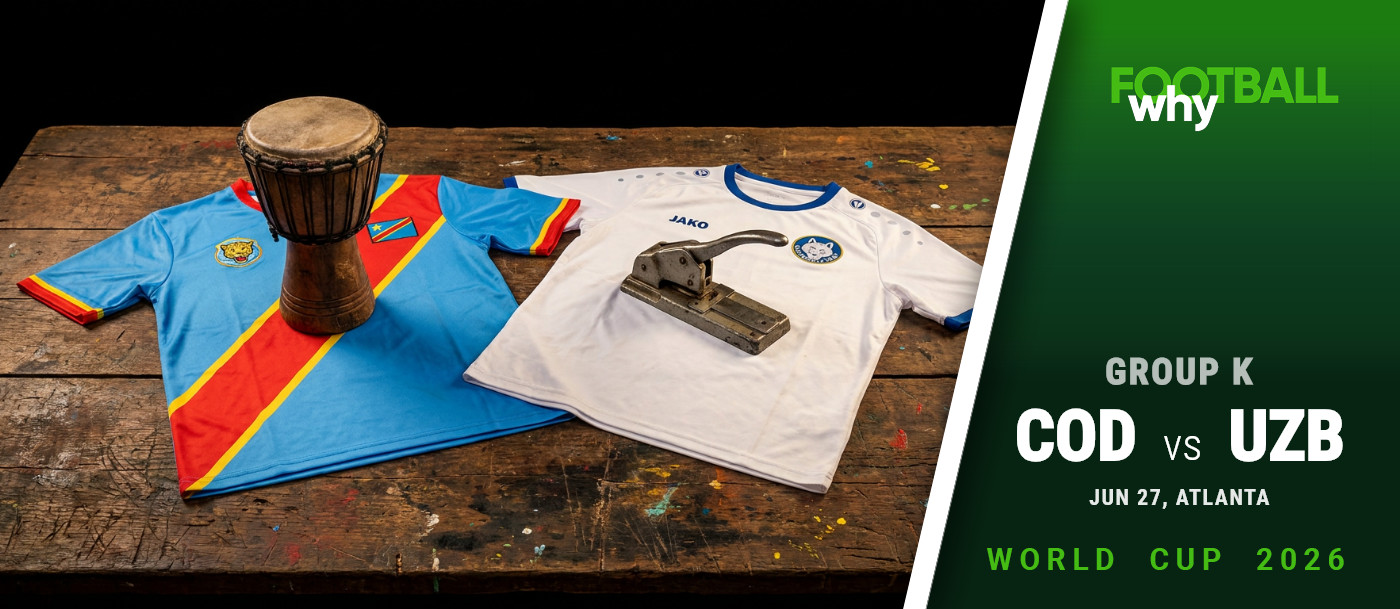
Group K, Matchday 3, Match #72
UTC

Mercedes-Benz Stadium, Atlanta

Prediction by whyFootball readers

COD
DRAW
UZB
39%
31%
30%
Not a recommendation for betting
Tap [+] to cast your expert forecast.
SCORE BY AI PREDICTION: 2:1 SEE SIMULATION

DR Congo vs Uzbekistan FIFA World Cup 2026 Group Stage Match A sudden drumbeat derails the procedural timetable Forecast generated:

A collision of street-forged improvisation and stoic, procedural geometry. It’s the vibrant hustle of the Kinshasa market squaring up against the quiet, unyielding discipline of the Central Asian steppe. When the tactical manual burns, only instinct remains.

DR Congo: One side's prayer...

A draw is a ticket to the departure lounge for DR Congo. The mood is fiercely expectant, demanding a multi-goal cushion to validate their arduous playoff journey. The background noise of Chancel Mbemba and Charles Pickel’s delayed returns to their European clubs has been firmly shut out; the squad is now a sealed unit. They are operating like a rusty pressure valve, ready to blow off steam through raw, transitional surges. The public demands nothing less than a victory forged in sheer willpower.

Uzbekistan: ...head-on with the other.

Uzbekistan’s tournament survival hangs on a mathematical knife-edge. They arrive armed with stoic, procedural discipline, desperate to silence whispers of their debutant fragility. The return of Abdukodir Khusanov from suspension bolsters their backline, but the lingering knee injury to chief creator Jaloliddin Masharipov leaves them lacking a creative spark. Consequently, they resemble a heavy freight train struggling for coal, reliant on rigid tracks and set-piece routines rather than spontaneous invention. The pressure is on to prove their methodical system can yield a vital victory.
DR Congo vs Uzbekistan Structural Collision

DR Congo: How we will host...

Dream
A draw simply isn't an option; it feels like an early flight home. The demand from the stands is a clear, multi-goal victory to validate their playoff struggles. The atmosphere is a potent mix of immense pride and simmering impatience.

Strength
Their core strength lies in a resilient, athletic spine that thrives on physical duels and set-piece chaos. Led by Chancel Mbemba, they boast a robust collective spirit that can suddenly spark into life through individual brilliance, particularly during rapid transitions down the flanks.

Plans
The strategy heavily leans on exploiting the left channel. The manager wants early, flat crosses delivered before the Uzbek defence can settle. If the ground route is blocked, they will rely on crowding the near post during corners, treating set-pieces as primary weapons rather than afterthoughts.

Fears
The overriding fear is their own emotional volatility. Under stress, pride often devolves into isolated 'hero-ball' and cheap fouls, fracturing their defensive shape. The manager must ensure they don't let the noise of the occasion drown out their structural discipline.

Uzbekistan: With what we arrive...

Dream
The objective is clear: secure a victory to keep their tournament hopes alive, ideally chasing a two-goal swing if the match dynamics allow. There is a quiet determination to silence any lingering doubts about their pedigree on this stage, validating their new managerial appointment with a credible, mistake-free performance.

Strength
Their foundation is built on stoic discipline and a collective work ethic. They excel in maintaining a compact, narrow defensive shape, shielding the central areas effectively. When in possession, they rely on patient circulation to manipulate the opposition's lines before launching sudden, vertical surges into the channels.

Plans
The tactical blueprint focuses heavily on exploiting the space behind the Congolese left-back. They intend to use early diagonal passes to isolate their right-winger, aiming for quick crosses into the box. Set-pieces are also viewed as a primary source of goals, with specific routines designed to attack the near post.

Fears
The main concern is their tendency to retreat into a passive shell when under severe pressure, particularly if they take the lead. This inherent caution can invite sustained attacks. Furthermore, a lack of elite press-resistance in midfield could lead to dangerous turnovers if the opposition adopts a high-intensity approach.

How it will be...

This fixture projects as a slow-burning fuse attached to a rather volatile powder keg. Expect Uzbekistan to establish a rigid, unyielding mid-block, treating spatial integrity with a near-religious reverence. DR Congo, conversely, will likely bypass the congested centre, looking to unpick the seams of the Uzbek structure with sudden, sweeping transitions down the flanks.

The underlying cultural tension is what elevates this from a mere tactical exercise. Uzbekistan’s commitment to face-saving procedure means they won't panic if they fall behind; they will simply consult the manual and reset their geometry. DR Congo, however, channel their street-forged resilience into raw, physical dominance, leaning heavily on the sheer gravitational pull of their captain, Chancel Mbemba, to command the penalty area.

The decisive fractures will likely stem from micro-hesitations. If an Uzbek defender pauses for a fraction of a second to check his alignment, a Congolese forward will exploit that blindside shadow. While the overarching pattern might suggest a stalemate, the sheer desperation of the group standings guarantees that the tactical straitjacket will eventually fray, offering glimpses of unfiltered, chaotic brilliance as both sides scramble for a lifeline.

DR Congo: How did they clinch it?

Congo triumphed because they capitalised on microscopic lapses in concentration. Wissa and Banza ruthlessly punished fractional delays in the Uzbek rearguard. Beyond those specific moments, their victory was anchored by Mbemba’s sheer physical dominance in his own penalty area, validating their reliance on abrasive, direct transitions.

Uzbekistan: Why not go for the win?

Uzbekistan’s defeat hinged on two fleeting, fatal misjudgements in defensive timing. A split-second hesitation in tracking a runner and a failure to command the near post unpicked their otherwise solid structure. These late defensive fractures exposed a deeper systemic flaw: an inability to improvise effectively when their rigid tactical script was torn up.

Secret mastermind intent

Desabre’s tactical patching of the Congolese drumbeat

General Strategy
Sébastien Desabre’s mandate is uncompromising: chase a multi-goal victory without sacrificing structural integrity. The primary focus is establishing a suffocating double-pivot in midfield to disrupt the Uzbek rhythm.

Once possession is secured, the objective is to launch rapid transitions down the left channel. The plan relies on generating clean, high-value opportunities rather than dominating sterile possession. It’s about patching together a solid defensive base to allow the attacking flair to flourish.
Antidote for the Opponent
The defining attacking mechanism targets Abdukodir Khusanov’s tendency to step aggressively out of the defensive line. Desabre wants his forwards to exploit the space left behind the Uzbek centre-back, using blindside diagonal runs.

Defensively, the focus is on forcing Uzbekistan out wide. The Congolese forwards will screen the central midfielders, cutting off the supply line and challenging the Uzbek full-backs to beat them with early crosses. If the ball enters the box, Mbemba is tasked with fronting the main striker.
Internal Task Solving
A crucial, team-specific directive is the implementation of a strict 'pivot-first' rule. Desabre is acutely aware of the team’s tendency to slip into individualistic 'hero-ball' when emotions run high.

To counter this, the captain is instructed to enforce a mandatory pass to the central midfielders before any dribbling surges are attempted. This acts as a cooling mechanism, ensuring the team regains its shape and composure before committing bodies forward.
Crisis Response Plans
If Khusanov repeatedly breaks the first line of pressure early in the game, Desabre will adjust immediately. The striker will drop slightly to screen his inside shoulder, and the attacking midfielder will mirror this movement to congest the central space.

Furthermore, the left-back will be instructed to reduce his starting height by five metres. This pragmatic shift aims to solidify the defensive block and prevent the Uzbeks from gaining easy momentum through the middle.
Specific Match Orders
Yoane Wissa: Hold your width initially to bait the full-back. Only cut inside across the centre-back's blindside if the holding midfielder is securely positioned behind you. Arthur Masuaku: Prioritise the underlapping run and look for early, flat deliveries into the box. If we lose the ball on your side, immediately drop one phase deeper to cut off the diagonal ball over your shoulder. Chancel Mbemba: Resist the urge to jump into front-foot duels immediately. Wait for the striker to take his second touch or show his back to goal before you engage.
/ What if the team concedes early and loses composure?

The immediate protocol is a captain-led huddle. The defensive block drops back ten metres, and the team must complete three safe passes to settle the nerves before the goalkeeper launches a long ball towards the left channel to reset field position.

/ What if they are protecting a narrow lead in the final fifteen minutes?

The shape shifts to a rigid 5-4-1, with the right-back tucking in as a third centre-half. Full-back overlaps are strictly forbidden. The focus shifts entirely to killing counter-attacks early and stacking the near post to defend set-pieces.

Secret mastermind intent

Cannavaro's stoic architecture for defensive resilience

General Strategy
Fabio Cannavaro envisions a game built on control and risk aversion. The strategy revolves around maintaining a disciplined 4-4-2 mid-block, prioritising spatial compactness over aggressive pressing.

The aim is to frustrate the opposition through methodical positioning, waiting for the right moment to strike. When possession is won, the transition must be sharp and vertical, bypassing the congested midfield to find the target man quickly.
Antidote for the Opponent
A key defensive mechanism involves creating a four-versus-three overload on the right flank to nullify the Congolese left-wing threat. The right-sided players will compress the space, forcing the opposition to recycle the ball backwards or switch play entirely.

Offensively, the instruction is to target the area vacated by the advancing Congolese left-back. Early, raking diagonal passes from the central midfielders are designed to exploit this specific vulnerability before the defensive line can reset.
Internal Task Solving
Cannavaro has implemented a strict protocol to manage the team's emotional state during turbulent periods. If they concede consecutive counter-attacks, the coaching staff will signal a 'timeout'.

This involves the entire team dropping eight to ten metres deeper for a five-minute period to re-establish their defensive distances. It’s a deliberate tactic to cool the game down, prevent panic, and protect the team's collective composure.
Crisis Response Plans
If the Congolese winger begins to consistently beat his man in one-on-one situations, the tactical setup will shift. The right-midfielder will track back deeper, almost forming a back five out of possession, while the nearest central midfielder slides across to provide immediate cover.

In this scenario, the full-back is ordered to delay rather than dive into tackles, prioritising containment over attempting to win the ball outright.
Specific Match Orders
Abdukodir Khusanov: Do not commit early to tackles. Always check the blindside run of the winger before engaging, and maintain constant communication regarding the defensive line's depth. Odiljon Hamrobekov: Force the winger towards the touchline by shading his inside lane. If a foul is necessary, ensure it happens in the wide channels, never in the central zone just outside the penalty area. Abduvohid Nematov: Avoid short distribution if the central midfielders are tightly marked. Instead, look for a clipped side-volley towards the right midfielder's outside shoulder to bypass the initial press.
/ What if the primary centre-back receives an early yellow card?

The defensive line immediately stops stepping out to intercept. Build-up play shifts away from his side, and the holding midfielder drops deeper to receive the ball facing forward, reducing the pressure on the booked defender.

/ What if the team needs a goal in the final twenty minutes?

The formation morphs into an aggressive 3-2-5. The right-back tucks inside to form a back three, allowing both wing-backs to push high up the pitch. The focus shifts to delivering a high volume of crosses towards the back post.

MAIN SIMULATION 0'-25'

Both sides settle into cautious mid-blocks around the 40-metre mark, sizing each other up. Uzbekistan immediately test their right-channel blueprint, aiming flat deliveries towards Eldor Shomurodov to pin Chancel Mbemba. DR Congo counter with their own left-lane script: Arthur Masuaku underlaps to draw the full-back, freeing Yoane Wissa. However, Uzbekistan deploy a pre-planned four-man defensive cage to suffocate this threat. With Charles Pickel anchoring the centre rather than chasing wide shadows, the opening exchanges become a gritty tactical stalemate.

MAIN SIMULATION 25'-45'

Congo begin to dominate territory through repeated left-lane cycles, eventually wearing down the Uzbek defensive cage. After delaying a few overlapping runs, Masuaku drops slightly deeper to bypass the block. On 37 minutes, Khusanov hesitates for a fraction of a second, and Masuaku whips in an early, flat cross. Wissa curves across the blindside to finish at the near post. This micro-timing error breaks the deadlock, forcing Uzbekistan to execute a shock-recovery protocol and slow the game down until half-time.

MAIN SIMULATION 45'-65'

The tactical straitjacket loosens. Uzbekistan increase their crossing volume from the right half-space. Crucially, Congo’s wingers start five metres higher to threaten counters, which inadvertently opens up Masuaku’s back shoulder. At 57 minutes, a swift diagonal ball exploits this gap, and Shomurodov angles a clinical finish past Mbemba. Congo respond by dropping deeper and introducing Simon Banza to form a heavy double-nine partnership. The match becomes stretched. Nematov parries a dangerous shot, but Odiljon Hamrobekov scrambles to smother the rebound.

MAIN SIMULATION 65'-90'

With a draw useless to both, the structure fully degrades into a chaotic sprint. Uzbekistan push bodies forward in a 4-2-4 wave, leaving their midfield pivots desperately stretched. Congo absorb the pressure, banking on Mbemba’s aerial dominance, and prepare the counter-punch. At 82 minutes, following a turnover, Masuaku delivers another early inswinger. Banza darts across the front post to glance it home. Uzbekistan lay siege to the box in the dying moments, but Congo manage the clock and survive the final scramble.

And it will come to...

If this match were to unfold according to the data, DR Congo’s abrasive, transition-heavy identity would ultimately survive the anxiety of the occasion. Uzbekistan’s methodical blueprint would hold firm for long spells, but would likely fracture during two microscopic lapses in defensive timing. Congo's ability to exploit those blindside gaps, anchored by Mbemba's towering box protection, should prove decisive. It would be a gritty victory where raw athleticism and left-flank precision ultimately dismantle a rigid, procedural defensive block.
end of Game