

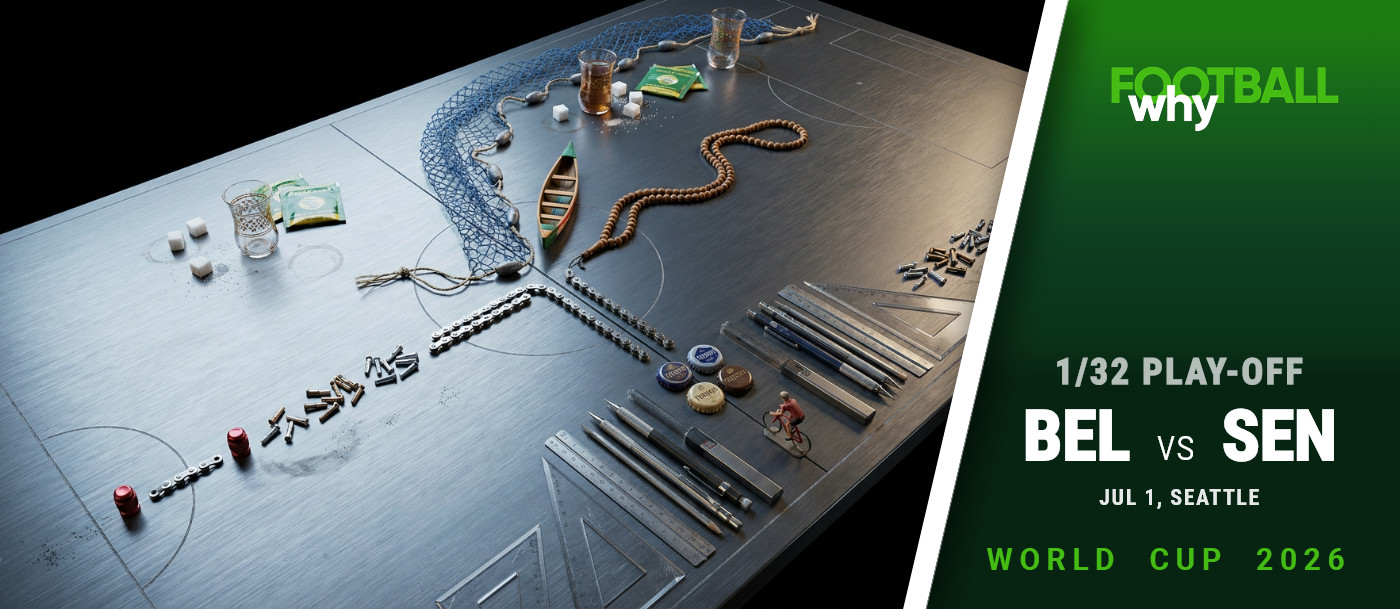
Round of 32 (C), Match #82
UTC

Lumen Field, Seattle

Prediction by whyFootball readers

BEL
DRAW
SEN
64%
0%
36%
Not a recommendation for betting
Tap [+] to cast your expert forecast.
MATCH IS FINISHED. SEE REVIEW

Belgium vs Senegal FIFA World Cup 2026 Group Stage Match Polished boardroom geometry rattled by a relentless drumbeat Forecast generated:

A collision of boardroom procedure and steadfast brotherhood. Can the quiet, measured administration of a European heavyweight dismantle the rhythmic, unyielding solidarity of African royalty? Expect a fascinating tension between clinical blueprints and raw, communal defiance.

Belgium: One side's prayer...

Belgium arrive at this knockout tie shadowed by their historical quarter-final ceiling. The public expects a clinical victory, demanding that their cosmopolitan talent finally operates without friction. Internally, the squad is managing Jérémy Doku’s minutes following his recent return from paternity leave, while Thibaut Courtois continues to bat away the persistent media circus surrounding his captaincy. The mood is calm, but the underlying tension of tournament underachievement remains palpable.

Senegal: ...head-on with the other.

Senegal enter this knockout fixture fuelled by a distinct siege mentality. Background noise regarding federation contracts has merely hardened their collective resolve, turning frustration into a binding mortar. The confirmed absence of first-choice goalkeeper Édouard Mendy due to a muscle injury is a significant blow, forcing Mory Diaw into the spotlight. Nevertheless, public expectation back home demands they stand tall against European royalty and deliver a defiant, physically imposing performance.
Belgium vs Senegal Structural Collision

Belgium: How we will host...

Dream
To secure a controlled victory within ninety minutes and dispel the lingering quarter-final anxiety. The atmosphere demands an assertive performance that proves Belgian technical superiority can comfortably manage athletic opposition without descending into a chaotic brawl.

Strength
A deep well of technical intelligence and positional play, anchored by high-end creators. They excel at holding the ball, shifting the opposition shape, and letting their star playmaker dictate the geometry of the pitch. It is a squad built on the quiet, procedural efficiency of top-level European academies.

Plans
The strategy hinges on tilting the pitch. The manager intends to funnel possession down the right side, isolating their explosive winger against the full-back. The playmaker will operate in the inside channels, feeding passes behind the defence while a reference striker pins the centre-backs to create space for late midfield arrivals.

Fears
The primary concern is structural fragility when possession breaks down. If the team commits too many bodies forward, they leave themselves hopelessly exposed to rapid counter-attacks. There is also the persistent worry that if their leading creators are suffocated, the team will revert to hopeful, disconnected long balls, betraying their footballing identity.

Senegal: With what we arrive...

Dream
To endure the European tactical audit with unbroken dignity and strike decisively when the opposition's legs grow heavy. The mood is one of defiant unity; they aim to channel the external noise surrounding the squad into a disciplined, physical resistance that eventually shatters the opponent's rhythm.

Strength
A formidable athletic core combined with an innate understanding of how to suffer together. They possess a midfield engine capable of grinding down intricate passing moves and wide forwards who can turn a simple clearance into a lethal, lung-bursting transition within seconds.

Plans
The blueprint relies on a stubborn mid-block designed to deny central supply lines. The intention is to frustrate the opposition's chief creator, forcing them into hopeful wide areas. Once possession is regained, the response will be immediate and vertical, bypassing the midfield entirely to target the vulnerable spaces behind the advancing full-backs.

Fears
The primary vulnerability lies in their own penalty area, particularly under sustained aerial bombardment. There is also the lingering anxiety that if they fall behind early, their stoic discipline might curdle into hot-headed frustration, leading to rash challenges, a stretched defensive shape, and a complete loss of tactical control.

How it will be...

The fixture should unfold as an exercise in bureaucratic containment. Belgium will likely dictate the initial geometry, using Kevin De Bruyne to lay mortar across the right half-space, searching for structural fractures in the African mid-block.

Senegal will absorb this possession without panic. They will hold a compact shape and wait to launch Ismaïla Sarr into the channels behind the Belgian full-backs. A sudden set-piece routine could easily compromise Senegal’s makeshift goalkeeping arrangement.

If the deadlock breaks, observe how the African side manages the emotional fallout. Their reflex is to pause and restore order; a failure to stall the tempo might invite a swift Belgian second goal.

The spectacle should truly ignite past the hour. Senegal’s pre-planned midfield injections are designed to shatter the procedural calm. They will push bodies forward and test Thibaut Courtois with direct shots. Ultimately, Belgium’s late bench rotations will provide the final counter-attack to finish the game.

Belgium: How did they clinch it?

They bypassed open-play friction with a rehearsed set-piece, instantly altering the risk calculus. When the opposition surged, their substitutions didn't merely patch holes; they preserved a vertical threat. That underlying academy pedigree ensured they retained enough structural composure to land the decisive transitional blow.

Senegal: Why not go for the win?

A momentary lapse during a dead-ball routine unpicked their disciplined mid-block. Forced to chase the game, their inherent lack of penalty-box guile against settled defences became apparent. Missing their clearest second-half opening meant late desperation inevitably compromised their defensive shape, inviting the final counter-attack.

Secret mastermind intent

Garcia’s procedural blueprint for a quiet victory

General Strategy
The core objective is to establish complete positional control and dictate the tempo from the first whistle. The team will operate in a compact mid-block when out of possession, aiming to smother Senegal's transition lanes.

The focus is on high-volume chance creation through sustained pressure rather than frantic, end-to-end exchanges. The ball will be circulated patiently until the right pockets of space open up, relying on a trusted technician to pull the strings in the final third.
Antidote for the Opponent
A major focal point is exploiting the space behind Senegal's right side. The plan involves early, diagonal releases to the winger, forcing the opposition's stand-in goalkeeper to deal with traffic and cutbacks.

Defensively, there is a clear mandate to double up on Ismaïla Sarr. The left-back and the defensive midfielder will form a protective bracket whenever Sarr attempts to cut inside. Simultaneous overlapping from both full-backs is strictly prohibited to maintain defensive balance.
Internal Task Solving
A crucial element of the plan is the strict workload management of key attacking personnel. The starting winger is capped at around sixty-five minutes to preserve his explosiveness and avoid muscular injuries.

This isn't merely about resting players; the bench will be used to inject fresh, direct runners to maintain vertical pressure, not just to freeze the game. Furthermore, any external noise regarding the goalkeeper situation is being deliberately ignored, treating the match as a standard logistical exercise.
Crisis Response Plans
If the primary playmaker is heavily man-marked and the build-up stagnates, the manager has a clear contingency. A central midfielder will step higher up the pitch to assume temporary playmaking duties, drawing attention away from the main creator.

Simultaneously, a versatile forward will drop between the lines to split the opposition's defensive screen. The manager is prepared to use cooling breaks to fine-tune these micro-adjustments, ensuring the team's structural integrity isn't compromised by a single tactical roadblock.
Specific Match Orders
Timothy Castagne: Drop your starting position about ten yards deeper than usual. We cannot afford you getting caught high up the pitch at the same time as the winger. If their wide man breaks the line, take the tactical foul early. Romelu Lukaku: Anchor yourself in the central lane and act as the reference point. Hold the ball up, but don't get dragged into unnecessary wrestling matches early on — we need you on the pitch, not on a yellow card. When the cutbacks come, make that dart to the near post and then peel off.
/ What if the right flank is constantly overrun?

If the opposition manages three or more entries down that side within ten minutes, the manager will trigger a structural shift. A defensive midfielder will drop into the backline, the right-back will push wider to the touchline, and the winger will tuck inside to offer the midfield some breathing room.

/ What if the team concedes an early, unexpected goal?

The immediate response is a three-minute tactical freeze. Overlapping runs are temporarily banned. The team will focus entirely on retaining the ball through the central midfielders to calm the nerves. The next two attacks will be forced down the right flank to re-establish the intended pitch tilt before resetting the counter-press at the next stoppage.

Secret mastermind intent

The rhythmic scaffolding of Senegal's resistance

General Strategy
The managerial directive is to establish a robust, immovable presence in the middle third of the pitch. The team will maintain a compact shape, prioritising defensive solidity over expansive possession. The goal is to reach the hour mark on level terms, relying on their physical endurance to outlast the opponent's early enthusiasm.

This is not a passive strategy; it is a calculated waiting game. The focus is on executing swift, direct counter-attacks the moment the ball is turned over, launching the wingers into the channels before the opposition can reorganise their defensive lines.
Antidote for the Opponent
A dedicated defensive bracket has been constructed to neutralise the Belgian playmaker. The defensive midfielder will shadow his first touch, aiming to cut off the supply line to the main striker. The forward line will also face early, physical contact to disrupt their hold-up play.

Offensively, the instructions are to relentlessly attack the space left by the Belgian right-back. The plan involves bypassing short central build-up play, which is deemed too risky under pressure, and instead favouring early, diagonal balls to isolate the wide forwards in one-on-one footraces.
Internal Task Solving
The absence of their first-choice goalkeeper necessitates a crucial adjustment to the defensive line. The centre-backs will drop a few yards deeper than usual to protect the penalty area from early crosses and limit the space behind them.

Furthermore, the manager has instituted a strict protocol regarding on-pitch discipline. To prevent frustration from boiling over into unnecessary bookings, only the captain is permitted to speak to the referee. The emphasis is on maintaining a dignified composure, regardless of the match's emotional temperature.
Crisis Response Plans
If the opposition's central creator begins to dictate the game too comfortably, the manager will tighten the defensive net. A central midfielder will step up to block the passing lanes, while the wide players will drop deeper to trap the playmaker against the touchline.

Should the initial game plan fail to produce results, the manager holds a significant trump card: a pre-planned triple substitution around the sixtieth minute. This is designed to inject fresh pace and carrying power, instantly spiking the team's attacking intensity against a tiring defence.
Specific Match Orders
Kalidou Koulibaly: Step in front of their striker the moment he tries to link play. You need to dominate the aerial battles in our box. If their winger starts making runs in behind, drop the entire defensive line back two or three yards immediately. Idrissa Gana Gueye: You are the shadow on their main creator. Be smart about when you engage — we need a foul-smart threshold. You can disrupt play in the middle third, but absolutely no pulling shirts or rash tackles near the edge of our penalty area. Ismaïla Sarr: Keep your starting position high on the right flank. Your first thought when you get the ball is to attack the outside shoulder of their full-back. If the route to goal is blocked, look for the low cutback. Do not track back beyond the forty-yard line; save your legs for the break.
/ What if the team goes a goal down early?

The immediate reaction is a captain-led huddle to reset the collective mindset. The midfield anchor will deliberately slow the tempo for two minutes to prevent a panic-induced collapse. The subsequent two attacks will be launched directly to the wide forwards, while the defensive line drops five yards deeper to avoid a knockout blow.

/ What if the stand-in goalkeeper struggles with early crosses?

If the keeper shows hesitancy in claiming the ball, the defensive strategy at set-pieces shifts. Instead of relying on the goalkeeper to catch the initial delivery, the team will drop into deeper zones, packing the six-yard box to aggressively attack and clear any second balls.

MAIN SIMULATION 0'-25'

Belgium will likely start with the handbrake on, dictating a measured tempo to probe the opposition shape. The primary friction points are Kevin De Bruyne trying to find pockets in the right half-space while Idrissa Gana Gueye attempts to shadow him. Senegal will sit in a disciplined mid-block, waiting to spring Ismaïla Sarr into the channels. Belgium’s rest-defence will be severely tested whenever Senegal bypasses the initial counter-press.

MAIN SIMULATION 25'-45'

The tactical arm-wrestle is expected to break open via a set-piece. Belgium’s rehearsed corner routines are primed to bypass Senegal’s compact central spine, likely culminating in a goal around the 36th minute. Following the concession, Senegal will deploy a shock-recovery protocol, using Gana to intentionally slow the tempo and prevent a total collapse. The half will close with Belgium retreating into a cautious shape to protect their lead.

MAIN SIMULATION 45'-65'

Senegal will inject raw carrying power and craft into the midfield just before the hour mark. This double substitution is a designated accelerator, instantly raising the transitional temperature. Belgium will experience a brief wobble as Nicolas Jackson finds space behind their defensive line. To counter this rising tide, the Belgian bench will swap their wingers, ensuring they maintain a vertical outlet and prevent Senegal from completely dominating the territory.

MAIN SIMULATION 65'-90'

The final quarter will resemble a siege. Senegal will push their pressing line aggressively, flooding the box with early crosses in a desperate bid for an equaliser. Belgium will respond by adding industrious wide players to bolt the back door. As Senegal's defensive shape stretches, the class gap will ultimately show. De Bruyne will inevitably find space to orchestrate a surgical counter-attack, feeding a fresh runner to secure the result.

And it will come to...

If this forecast holds true, Belgium’s patterned intelligence and superior bench depth would ultimately outlast Senegal’s dignified, athletic resistance. The turning point would hinge on a rehearsed set-piece, forcing the African side to abandon their comfortable mid-block. While Senegal might threaten an equaliser through a surge of second-half substitutions, Belgium's ability to execute a clinical counter-attack in the dying minutes should settle the tie. It would be a victory of calculated European boardroom planning over raw transitional power.
end of Game