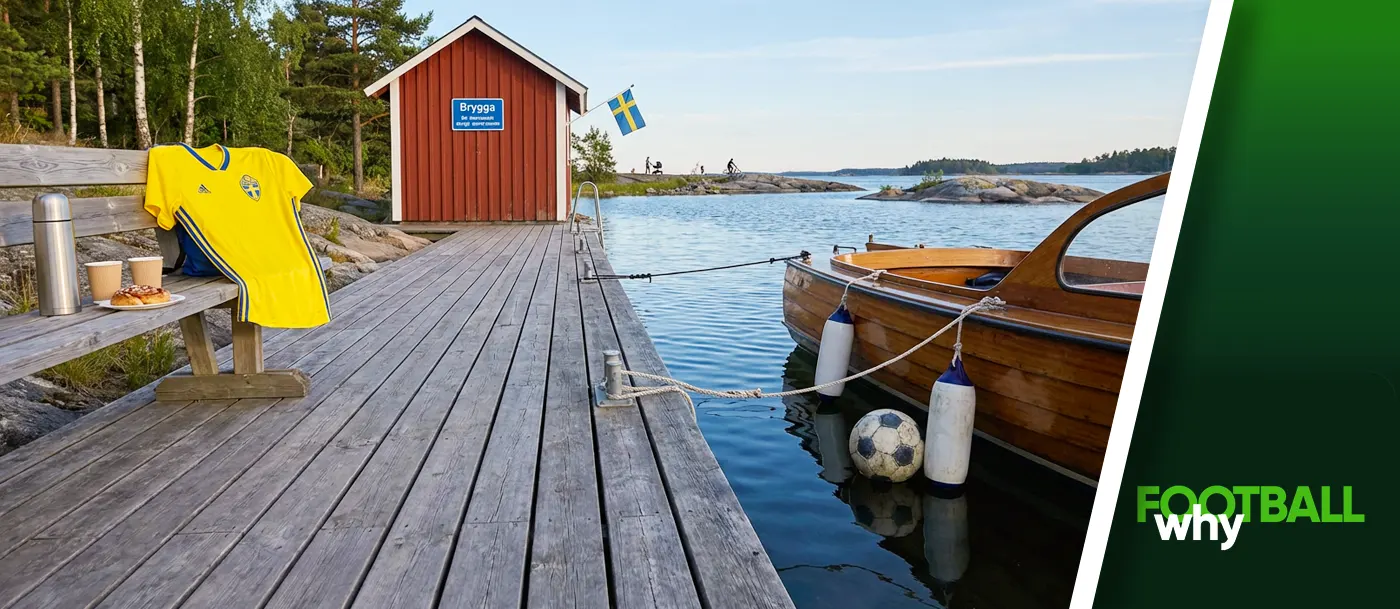
Hauling the heavy, frozen weight of past collapses, they march onto the pitch demanding absolute order. A fierce battle wages between their deep-seated dread of chaos and the explosive, aristocratic flair of their frontline mavericks. Watch a rigid, suffocating defensive wall suddenly snap, launching lightning-fast, lethal strikes through the winter air. The ice is cracking, and the predators are finally loose.
Team at a Glance
What do they want?
To restore absolute national calm while secretly hoping their star strikers score out of sheer, un-Swedish arrogance.
What are they strong at?
Deep-frozen defensive discipline perfectly paired with the explosive, world-class firepower of two lethal forwards.
What will they show?
A brutally patient, unyielding yellow wall that suddenly shatters to launch lightning-fast, aristocratic counter-attacks.
Why are they as they are?
Surviving dark, brutal winters teaches you to trust the collective plan and never boast prematurely.
What is a chance of getting title?
9%. Entirely possible if their two star forwards can somehow score without offending the national consensus.
Where it hurts?
Sweden: current status and team news
A Fragile Lamppost
in the Rain
Graham Potter has filed his paperwork with the local council, deliberately leaving the most exciting items off the agenda. Sweden prepare for their friendlies against Norway and Greece with an open audition for the goalkeeper jersey. The squad relies entirely on heavy physical endurance.
Striking Dejan Kulusevski from the minutes provoked immediate uproar among the constituents. The #Trupputtaget hashtag trended as fans debated the logic of discarding their brightest creative spark. Potter defended the cuts in dual-language press conferences, insisting his selection process remained entirely adaptable.
Alexander Isak represents the single, fragile lamppost illuminating this entire district. His groin fracture recovery dictates whether Potter can deploy a dual-striker front or must revert to a narrower shape. Viktor Gyökeres arrives late to camp, leaving the attacking combinations completely untested.
Opponents will flood the second balls around whichever unproven goalkeeper eventually wins the job. The viewing public should expect a deeply pragmatic, low-event grind. Yet there remains a touching dignity in watching eleven men collectively refuse to yield a single inch of damp grass.
The Headliner
Sweden: key player and his impact on the tactical system
Spectral Grace
in Zone Fourteen
There is a spectral quality to how Alexander Isak navigates the penalty area, moving with a languid economy that completely masks his lethal intent. He perfectly honours the national code of restraint, delivering individual brilliance while strictly maintaining the collective defensive shape. He routinely ghosts off the blind side of a centre-back, holding an upright, regal carriage. He will physically adjust his shoulders, scanning the space before receiving the ball, and then freeze the goalkeeper with a delayed side-foot finish. Tactically, he provides the magnetic presence needed to stretch opposing backlines and the half-turn link play required at the edge of the box. If starved of service, he tends to drift wide, mitigating heavy physical contact but leaving the penalty area empty. When fully engaged, his ability to slalom through a dense block with minimal exertion transforms him into an aristocratic predator. He seamlessly fuses tactical obedience with cold-blooded execution, turning a rigid system into a platform for quiet genius.
The Wild Card
Sweden: dark horse and player to watch
The Quiet Pulse of Order
Domestic observers speak of him not as a prospect, but as an already installed foundation. Hugo Larsson moves across the pitch with a panoramic, unflappable grace, his economical steps masking a fiercely sharp tactical mind. At just 21 years old, he balances risk-managed maturity with brave, line-splitting distribution. Operating as the central pivot, he constantly checks his shoulders, adjusting his body angle before the ball even arrives. He receives possession on the half-turn under intense pressure, physically using his tall frame to screen passing lanes before delivering a vertical punch pass that instantly transitions the side into attack. Rival midfields will deliberately deploy tag-and-trap markers against him, attempting to physically collide with his first touch and force turnovers in dangerous zones. Should he successfully navigate this claustrophobia, his ability to confidently dictate the tempo and provide clean exits will form the absolute bedrock of the national team's progression on the global stage.
The Proposition?
Sweden : Tactical guide - how to identify their movements and game variations on the pitch
Funnel, Trap,
and the Royal Strike
The mission for Graham Potter’s Sweden is a return to fundamental clarity. He has implemented a 4-4-2 rebuild designed to restore defensive compactness while weaponising a lethal twin-striker attack. A constant tension defines their approach: balancing this aggressive two-striker ambition against the severe stress it places on central control and rest-defence.
Operating from a horizontally compact 4-4-2 out of possession, the system deliberately shows opponents the outside. The tempo remains measured until the first line-break, after which it accelerates sharply into vertical strikes toward the front pair.
What to look at: If, in the first ten to fifteen minutes, the back four is stationed high in the middle third, the wingers are narrow, and the front two stagger to physically screen the opposing pivot, then Sweden is imposing a mid-block funnel. They are setting sideline traps to harvest second balls, preparing for immediate vertical hits into the channels for Alexander Isak or Viktor Gyökeres.
Once possession is secured, the structure morphs into a 3-2-5.
What to look at: If Emil Holm steps beyond the winger line while the ball-far fullback stays connected and Gyökeres drops into the number ten pocket, they are bypassing the first line of the press. This creates a central overload and opens a pre-switch window to the weak-side half-space before the opponent's block can reset.
The primary progression route relies heavily on wide overloads generating low, flat cutbacks.
What to look at: If the ball-carrier opens his hips inside as Emil Holm overlaps, the winger tucks in, Gyökeres pins the near centre-back, and Isak arcs off the far centre-back, anticipate pull-backs to the edge of the penalty area or flat diagonals targeting Isak in the inside-right seam.
Potter’s system warps specifically to amplify Isak as a hybrid forward.
What to look at: If Isak receives the ball between the lines, Gyökeres sprints to pin both centre-backs, the far winger times a blindside run, and the near central midfielder steps up for a third-man combination, the hidden goal is to pull coverage to the right half-space. This frees the weak side for a cutback or a late runner.
This aggressive, two-striker system, however, thins central cover alarmingly.
What to look at: If the opponent regains the ball centrally and immediately hits a long diagonal pass behind the ball-far fullback, or plays direct inside the outside shoulder of Victor Nilsson Lindelöf within five to eight seconds, the holding midfielder is left isolated. A centre-back will be dragged wide, leaving the weak-side half-space completely unprotected for a high-value cutback.
When protecting a lead, Potter commands from the touchline to tilt the side into a 4-5-1 survival mode.
What to look at: If the defensive block visibly drops deeper, the wingers flatten to the fullback line, and a lone striker stays high while pressing intensity is throttled, Sweden is trading territory for sheer box density. They will comfortably accept absorbing pressure and hacking away deeper clearances.
Watching this Swedish side offers a masterclass in calculated risk. Their commitment to defensive solidity, coupled with the explosive, vertical genius of their front two, turns them into a constantly coiled spring, ready to strike at any moment.
The DNA
Sweden: football's importance and what we will see in their game at the 2026 World Cup
The Winter Cooperative
and the Edge of Ego
A cold spring night at Strawberry Arena. The breath of the players steams under the stadium lights, and the crowd maintains a low, rhythmic drumbeat — measured, patient, and completely synchronised. This is not a place for wild carnival energy. This is a fortress of collective order, built on centuries of surviving harsh, resource-thin winters.
Imagine a typical Swedish housing cooperative meeting in November. Residents sit on folding chairs in a brightly lit community hall to decide on snow clearance schedules. No one person claims they can shovel the entire street faster than anyone else; that would be arrogant and foolish. Instead, they agree on a rigid, shared timetable. Everyone takes a shift. The survival of the community depends entirely on unshowy, dependable service to the agreed plan.
This exact cultural reflex — the famed Jantelagen, an unspoken code discouraging ego and boasting — forms the bedrock of their national footballing identity.
It manifests on the pitch as an unshakeable, system-first compactness. When the players drop into two banks of four, shifting laterally with absolute synchronisation to deny space, the Winter Cooperative is hard at work. A defender choosing to dribble out of trouble instead of clearing to a designated channel is violating a deeply held social trust. The manager will immediately shout from the touchline, demanding a return to the agreed shape.
Yet, this deep-seated risk aversion places a strict limit on chance creation against elite opposition. Their footballing economy relies on physical robustness, towering aerial dominance, and set-piece headers — safe, percentage-based actions. During the 2025 qualifying collapse against Kosovo, the tactical script failed completely. Players looked at each other, lacking the improvisational tools to rewrite the match. The subsequent public fury erupted because the visible chaos on the pitch deeply unsettled the national preference for order.
Now, observe a modern Stockholm tech startup. The egalitarian structure remains intact, but executives occasionally hire a brilliant, disruptive developer to break the mould, provided that developer still respects the core company mission.
Football mirrors this exact evolution.
The emergence of urban, diaspora-fed talents like Alexander Isak and Viktor Gyökeres introduces a thrilling tension. They are the sanctioned mavericks, granted permission to operate outside the strict defensive grid. The recent appointment of an imported coach like Graham Potter represents a deliberate attempt to raise the technical floor. He must integrate this attacking flair without destroying the cherished defensive shape.
When a Swedish defender clears a ball high into the frozen night sky, he isn't panicking. He is restoring order, trusting that the system will hold, and quietly hoping the mavericks up front can control the dropping ball and conjure a moment of magic.