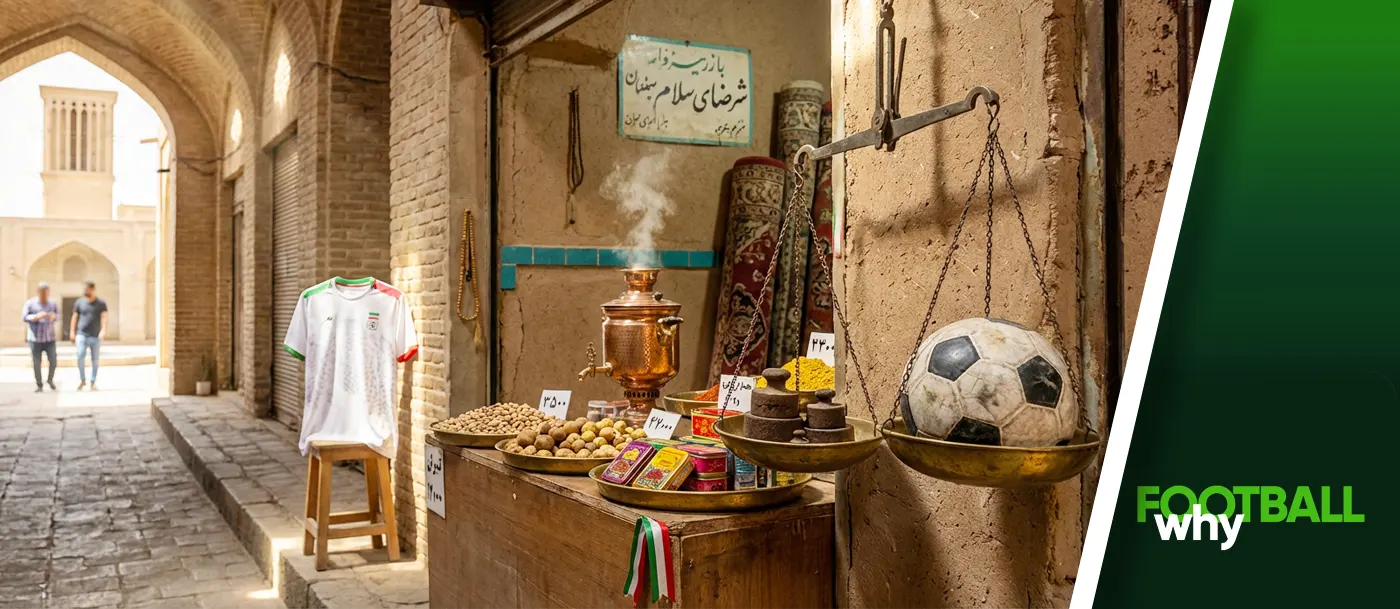
For decades, they have been the fortress of Asia, a team built on the logic of the siege and
the patience of the weaver. But the knot is tightening. The defensive wall that once
guaranteed dignity now feels like a cage, trapping a generation of attackers desperate to
breathe. In 2026, the Persian carpet must be unrolled with violence. They are done waiting
for the storm to pass; this time, they intend to be the lightning.
IR Iran: current status and team news
Unblocking the Bazaar:
New Trade Routes
Amir Ghalenoei is attempting to re-weave a section of a priceless carpet while the loom is still
running. The mandate for 2026 is to finally shatter the barrier of the group stages, but not
through the grim resistance of the past. The new vision demands proactive, assertive football —
a shift from merely holding the gate to actually sallying forth with intent. The ambition is to
secure points not by fortune, but by occupying the opponent's penalty area.
This
transition, however, grinds against a distinct mechanical failure. For too long, the team has
functioned like a narrow gate, channelling every ounce of hope through a few veteran superstars
up top. When that single spout is blocked by elite defenders, the whole system backs up into a
frustrating, goalless stalemate.
The domestic public, watching this repetitive
stagnation, has grown cynical. In the tea houses and digital forums of Tehran, the mutterings
are not just about tactics but about a 'closed circle' of selection, a belief that the squad is
a private club where meritocracy dies at the door. The fans are tired of the 'easy group'
rhetoric; they want to see a team that doesn't need a miracle to score.
To silence the
'mafia' whispers and unplug the attack, the coaching staff is clearing the supply lines. The
solution is not merely new strikers, but a complete overhaul of the service routes. Saeid
Ezatolahi has been designated as the distributor, responsible for rapid vertical releases that
bypass the clogging in midfield. He is supported by Saman Ghoddos, whose role is to turn dead
balls and half-spaces into legitimate threats. Even the goalkeeper, Alireza Beiranvand, is part
of the offensive grid, using his trebuchet of an arm to ignite counters before the opposition
can settle. The nation waits with crossed arms, desperate to see if their team has truly
modernized its arsenal or is merely polishing antique weapons for a modern war.
The Headliner
IR Iran: key player and his impact on the tactical system
The Cunning Merchant
of the Penalty Area
To watch Mehdi Taremi in the penalty area is to witness a man who has turned loitering
into a martial art. While others frantically hack at the ball, he pauses, waiting for
the defender to blink. It is a terrifying stillness, a calculated delay that forces
opponents to commit the first sin — a desperate lunge or a clumsy grab. Then, with a
sudden contortion of his frame, he is either slotting the ball into the near post or
hitting the turf, having manufactured a penalty with the shrewdness of a bazaar
negotiator.
He is the 'Son of the Persian Gulf', an avatar of streetwise
resilience who treats the pitch like a high-stakes market. He sells contact without
losing his angle, buying time and space where none should exist. This is not just
technique; it is a cultural expression of survival. He embodies the nation’s ability to
find a loophole in the blockade, to turn a gridlocked stalemate into a moment of sudden,
decisive profit.
The entire team's attack is drawn to his influence. When Taremi
drops into the midfield pocket, he isn't abandoning his post; he is luring the defence
into a trap, inviting them to bargain for a ball they can't win, while freeing the
wingers to sprint into the empty alleyways he creates. Without this focal point, the
Iranian attack is a machine with stripped gears — loud, industrious, but unable to turn
the wheel. He is their indispensable operator, but he conducts his business on the very
edge of a cliff.
The Wild Card
IR Iran: dark horse and player to watch
A New Thread in
the Ancient Weave
In a squad that tends to treat its defensive line like a protected heritage site,
Mohammad Amin Hazbavi is a jarring, necessary modern renovation. At 22, the 'Steadfast'
defender offers something the aging spine desperately lacks: the permission to step up.
He dominates the air not with frantic energy, but with a calm, front-shoulder
aggression, winning the first contact and — crucially — playing a simple vertical pass
rather than hoofing it into orbit.
He is the new thread for a team whose
defensive weave had become too rigid. His recovery speed allows the midfield to compress
the space, acting as the insurance policy for a higher defensive line that Ghalenoei
craves.
But this is a gamble played with high stakes. He is a 'Local Secret'
largely untested against the dark arts of elite global strikers. There is a genuine fear
that a clever number nine, dropping deep and spinning, could out-negotiate him in the
open field, baiting him into fouls in the wide channels. The World Cup will be his trial
by fire. The nation hopes for a broadcast-defining moment — a towering header or a
goal-line block — that proves the old fortress has finally found its new cornerstone.
The Proposition?
IR Iran : Tactical guide - how to identify their movements and game variations on the pitch
The Tilted Siege Engine
Team Melli arrives carrying a heavy contradiction: a squad built for defensive suffering is now
tasked with proactive expansion. Amir Ghalenoei is attempting to graft a modern, front-foot
attacking structure onto a chassis famous for its ability to absorb pressure. The central
conflict is physics — can they push numbers forward to break the limit of the group stage
without the engine overheating on the recovery?
What to look for: The Right-Sided
Shape-Shift. The team lists as a 4-2-3-1, but this is a polite fiction. In possession, watch
Ramin Rezaeian abandon the defensive line to charge up the right flank. This triggers a
structural warp: the remaining defenders slide across to form a back three, and the defensive
midfielder, Saeid Ezatolahi, drops in to anchor. The formation effectively becomes a 3-2-5 siege
engine. The visual cue is simple: if the right-back crosses the halfway line, the entire team
tilts, flooding the box for an early cross.
What to look for: The Vertical
Slingshot. They have no interest in sterile circulation. The progression is violent and
vertical. Watch for Alireza Beiranvand to bypass the entire midfield with a monstrous throw, or
for a sharp, driven pass from the centre-backs into the feet of the forwards. If the ball sticks
to Sardar Azmoun, the wingers don't come short — they sprint behind the defence. It is a classic
'knock-down and run' mechanic designed to catch opponents before they can
organize.
What to look for: The Taremi Effect. Mehdi Taremi operates as a '9.5' —
a hybrid of playmaker and finisher. When he drops deep into midfield to receive the ball, do not
watch him; watch the space he vacates. His movement is the trigger for Saman Ghoddos or a wide
runner to dive into the gap behind the defence. Taremi functions as the main stall in the
bazaar, drawing defenders towards him like shoppers, which opens up empty alleyways for others
to exploit.
What to look for: The Bunker and The Breach. When the attack fails,
the team snaps back into a dense 4-5-1 block, conceding the wings to protect the centre.
However, this aggression comes with a steep price. If the opponent wins the ball while the
formation is tilted right, the space behind Rezaeian is a vast, parched landscape. The veteran
centre-backs are then forced into a footrace they are unlikely to win. It is a high-wire act:
spectacular when it works, but terrifyingly fragile when the counter-balance slips.
The DNA
IR Iran: football's importance and what we will see in their game at the 2026 World Cup
The Sovereign Siege:
Dignity in the Knot
In the thin, smog-choked air of the Alborz foothills, patience is not merely a virtue; it is a
hard currency, traded with the shrewdness of a Grand Bazaar merchant. To watch Team Melli stand
against a global superpower is to witness the translation of a siege mentality into sport. This
is not the panicked parking of a bus, nor a frantic scramble to survive a storm. It is a
deliberate, structural refusal to yield, built on the premise that dignity is found in the
integrity of the wall.
For the better part of a decade, this identity was codified under
Carlos Queiroz, but its roots run deeper. The approach mirrors the logic of the carpet weaver:
an obsession with the density of the knot and the complete elimination of gaps. On the pitch,
this manifests as a suffocating 4-5-1 low block where the distance between the lines is measured
in inches, not yards. Against giants like Argentina or Spain, they do not play to win
possession; they play to negotiate space, treating the penalty box as a sovereign state that
must not be breached.
There is a profound, sweaty heroism in this methodical thrift. It
turns a football match into a stress test of their craftsmanship. The team accepts suffering as
a baseline condition. They absorb pressure, clear their lines with violent efficiency, and wait
for the opponent’s concentration to crack like parched earth. When the moment comes, the
transition is not a fluid river but a sharp, jagged knife-thrust — a long diagonal ball or a
set-piece routine rehearsed with military precision.
Yet, this iron-clad pragmatism
houses a painful contradiction. Inside the tactical straitjacket beats the heart of a street
footballer. The conflict of Iranian football is that its soldiers are actually artists in
disguise. Thanks to a robust futsal culture, even the grittiest defenders possess a startlingly
velvet touch in tight spaces. You see it in flashes: a sudden back-heel near the corner flag, a
slalom run through three markers that defies the logic of the system. This is the nation’s
internal struggle laid bare — the yearning for poetic expression constantly overruled by the
fear of chaotic exposure.
Slowly, the weave is changing. A diaspora generation, raised in
the academies of Europe rather than the dust of the plateau, is importing new expectations of
pressing and proactivity. They are bringing the game out of the fortress and into the open
field. But the old ancestral blueprint remains: survival first, negotiation second, and only
then, if the heavens allow, the poetry of the goal.