

Round of 32 (A), Match #73
UTC

SoFi Stadium, Los Angeles

Prediction by whyFootball readers

ZAF
DRAW
CAN
38%
0%
62%
Not a recommendation for betting
Tap [+] to cast your expert forecast.
MATCH IS FINISHED. SEE REVIEW

South Africa vs Canada FIFA World Cup 2026 Group Stage Match Laying heavy mortar against a freezing touchline barrage Forecast generated:

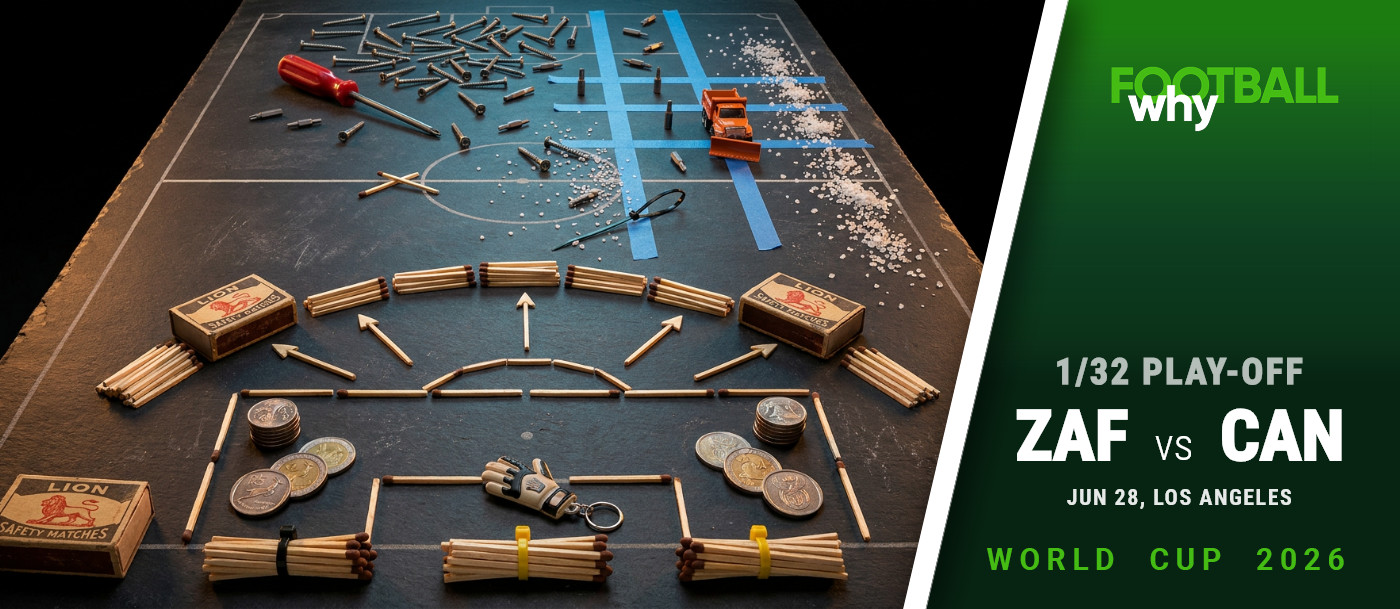
An unforgiving arctic squall batters against a tightly woven communal shelter. One side demands progress through sheer, undeniable exertion and procedural momentum. The other relies on shared sacrifice and the quiet resilience of the collective to weather the incoming storm.

South Africa: One side's prayer...

South Africa approach this knockout fixture with a sense of guarded pragmatism. The public demand is straightforward: maintain discipline, avoid foolish dismissals, and secure progression by any means necessary. The squad must navigate the absence of their creative focal point, Themba Zwane, who remains suspended following a red card against Mexico. However, the timely return of Teboho Mokoena provides crucial midfield ballast. They are preparing to drop a heavy steel shutter over the penalty area, surviving the early onslaught before hunting for scraps on the counter.

Canada: ...head-on with the other.

Canada arrive in the knockout stages surfing a wave of multicultural optimism. A historic group-stage victory over Qatar has validated their high-octane project and heightened national expectations. They are determined to impose their front-foot identity, though they face significant hurdles. The midfield must function without Ismaël Koné, who suffered a fractured leg, while Alphonso Davies requires meticulous workload management due to a lingering hamstring strain. Despite these physical limitations, the squad is primed to rev the engine early, looking to overwhelm the opposition with relentless waves of pressure.
South Africa vs Canada Structural Collision

South Africa: How we will host...

Dream
Navigate the early chaos and reach the hour mark with the clean sheet intact. The public mood is sceptical but hopeful, demanding strict discipline and zero red cards. They will accept a low-event, pragmatic grind if it secures progression.

Strength
A foundational reliance on collective resilience and structure over individual improvisation. Built around a domestic core, the team operates like a well-run community stokvel: everyone chips in, and the rewards are shared. Ronwen Williams anchors this stability, providing a calm, ice-cold presence at the back when the pressure mounts.

Plans
The manager intends to draw Canada's high press by initially playing short passes around the penalty area. Once the trap is set, they will bypass the midfield entirely, launching quick diagonal balls into the space left by Canada’s advancing full-backs, specifically targeting the left channel.

Fears
A noticeable lack of natural goal-scoring depth and a tendency to freeze under high-tempo pressing. If the game stretches and they are forced to chase, their attacking rhythm often devolves into hopeful crosses rather than structured chance creation.

Canada: With what we arrive...

Dream
Validate their multicultural ascent and prove they belong on the grandest stage. The mandate is to enforce a high-octane press, dominate the territory, and manage their own combustible energy to secure a decisive victory within ninety minutes.

Strength
Their core asset is a relentless, blue-collar athleticism. Much like a brutal Canadian winter, their pressure comes in heavy, unforgiving waves. They embrace the grinding labour of recovery runs, trusting that collective sweat and physical commitment will eventually tilt the pitch in their favour.

Plans
Marsch intends to aggressively audit the opposition's left defensive flank. By creating numerical overloads down the right side, they aim to ruthlessly expose the full-back, setting up a conveyor belt of early cut-backs and back-post deliveries before the defensive block can properly settle.

Fears
A glaring lack of subtle craft when faced with a deep, entrenched defence. If the opposition refuses to open up, their high-velocity transitions can quickly devolve into aimless, frustrated crossing. This creative drought is further compounded by the absence of key midfield orchestrators.

How it will be...

The encounter would likely unfold as a procedural stalemate before fracturing into something more visceral. Canada should dictate the early geography, applying a suffocating press that tests the mortar of South Africa’s defensive brickwork. The African side will absorb this heavy weather, leaning on Ronwen Williams to claim crosses and decelerate the tempo. They defend as a collective unit. They pool their resources rather than relying on isolated heroics.

A sudden rupture might arrive down the flanks. If Alphonso Davies manages his hamstring constraints, his surging overlaps could dismantle the right-sided scaffolding entirely. Observers should watch for Tajon Buchanan isolating his marker; a single successful feint in that channel bypasses the entire midfield structure.

Should the deficit widen, South Africa’s ingrained caution will evaporate into a desperate, aerial siege. Evidence Makgopa would become the focal point for a barrage of lofted deliveries. Yet, Canada’s response to chaos is strictly institutional. They will introduce fresh legs, drop into a structured mid-block, and ruthlessly exploit the vacated spaces on the counter. It would be a triumph of athletic process over communal endurance.

South Africa: Why not go for the win?

The isolation of their full-backs proved terminal. Buchanan’s ability to bypass Modiba on the right flank dismantled their initial defensive blueprint, resulting in the opening concession. When forced to chase, their lack of central creative depth became glaring. Relying solely on predictable, lofted deliveries left their stretched rest-defence fatally exposed.

Canada: How did they clinch it?

Unrelenting territorial dominance dictated the outcome. By sustaining a high-throttle press, they trapped the opposition deep, turning wide recoveries into immediate penalty-box entries. Larin’s header rewarded this wide-lane superiority. Crucially, the timely introduction of Eustáquio restored central control during the opponent's late aerial barrage, facilitating the decisive transition.

Secret mastermind intent

Broos builds a load-bearing defensive wall

General Strategy
Hugo Broos is setting up to absorb pressure, prioritising a stable, compact mid-block. The primary directive is to reach the 60-minute mark without conceding.

The team will sit relatively deep, engaging the opposition near the halfway line and attempting to force play out wide. Possession will be direct and functional, looking to bypass prolonged midfield battles in favour of rapid transitions.
Antidote for the Opponent
To counter Canada’s aggressive pressing, the plan is to bait the trap. The goalkeeper and defensive pivot will exchange short passes to draw the Canadian forwards in.

Once the opposition commits, the ball will be launched quickly into the left channel. The aim is to exploit the space left behind Canada's attacking right-back, creating isolated one-on-one situations for the wingers.
Internal Task Solving
With their primary playmaker unavailable, the responsibility for setting the tempo and delivering set-pieces falls squarely on Teboho Mokoena.

An unusual tactical quirk involves their attacking throw-ins. Instead of launching them into the box, they will use short, rapid routines. This is designed to draw fouls near the penalty area and completely disrupt Canada’s rhythm, turning open play into a series of staggered set-pieces.
Crisis Response Plans
If Canada successfully overloads the right flank and creates repeated entries early on, Broos will shuffle his deck. He plans to flip his wingers, sending the much faster Maseko to the right side to threaten the space behind the Canadian full-back.

If the team falls behind late in the game, the structure shifts dramatically. A traditional target man will be introduced, and the tactical nuance will be replaced by a relentless barrage of crosses into the penalty area.
Specific Match Orders
Khuliso Mudau: Keep the overlaps to a minimum. The main job is to stop the winger cutting inside on his right foot. Do not dive in if left isolated one-on-one. Teboho Mokoena: If they trap us deep twice in a row, stop playing short. Hit the long diagonal to the left winger immediately, maximum two touches. Ronwen Williams: Hold a high starting position for their out-swinging corners. When we win it, look to distribute quickly into the left-back's channel.
/ What if Canada force a succession of corners?

If the opposition begins stacking corner kicks, the defensive setup instantly shifts. The team will abandon pure zonal marking and adopt a hybrid system, dropping three men into rigid man-marking roles to disrupt the runners.

/ What if the team concedes early?

The immediate response is to kill the momentum. The goalkeeper will slow all restarts to a crawl. The team will hit the first pass long to the striker, squeeze the midfield up to win the second ball, and intentionally draw a foul to reset the defensive lines.

Secret mastermind intent

Marsch’s municipal audit of the wide corridors

General Strategy
Marsch is mandating a high-throttle, front-foot assault from the opening whistle. The core objective is to establish immediate territorial dominance through a suffocating 4-4-2 press.

They will willingly accept the risk of leaving space in behind to ensure the game is played entirely in the opposition's half. Possession will be vertical and urgent, designed to force rapid turnovers near the touchlines.
Antidote for the Opponent
The tactical crosshairs are fixed squarely on the opposition's deep-lying playmaker. The nearest striker has strict orders to smother him instantly, denying any time to launch diagonal switches.

Offensively, the blueprint demands a ruthless targeting of the left-back area. They will manufacture two-on-one overloads down this channel, aiming to bypass the defensive screen and recycle low crosses before the centre-halves can establish their marking lines.
Internal Task Solving
The physical management of their star left-sided talisman dictates the entire attacking structure. Because of lingering hamstring concerns, his sprint load is being heavily audited.

He will operate exclusively as an advanced winger rather than a surging full-back to limit his recovery mileage. If he is unable to start, the creative burden shifts entirely to the opposite flank, turning the team into a highly asymmetrical attacking unit.
Crisis Response Plans
Should the initial press fail to yield a breakthrough by the hour mark, a pre-planned triple substitution will be triggered. Marsch will inject fresh wide runners and a central orchestrator to shift into a heavy twin-striker system.

Alternatively, if the opposition successfully bypasses the high press multiple times early on, the squad will temporarily retreat. They will drop into a compact mid-block for ten minutes to recalibrate their trapping zones.
Specific Match Orders
Alphonso Davies: Restrict repetitive sprinting for the first half-hour. Stay high up the pitch rather than overlapping from deep. If there is any hint of hamstring tightness, signal the bench immediately. Stephen Eustáquio: Close down their central attacking midfielder the moment he receives the ball. Shut off his passing lane to the right side. If he manages to turn, commit a cynical tactical foul before he crosses the halfway line.
/ What if the game devolves into an ugly cycle of long clearances?

If the opposition forces a prolonged aerial battle, the wingers will be instructed to swap flanks. This simple recalibration freshens up the one-on-one matchups and forces the opposing full-backs to adjust to entirely new dribbling angles.

/ What if the team suffers the shock of conceding a goal?

The immediate protocol is emotional de-escalation. The players will form a brief huddle before resetting into a rigid 4-4-2 shape for five minutes. The midfield anchor will deliberately slow the tempo on the first pass to restore order and simplify the wide entries.

MAIN SIMULATION 0'-25'

Canada will likely initiate a heavy 4-4-2 press from the whistle, attempting to pin South Africa’s centre-backs and isolate the flanks. South Africa will absorb this in a compact, cautious mid-block, relying on Ronwen Williams to dictate a slow tempo. The tactical friction will live entirely in the wide channels. Canada’s aggressive counter-pressing will crash into South Africa’s narrow wingers and deliberate tactical fouls. Expect a gritty, congested stalemate early on.

MAIN SIMULATION 25'-45'

Following the hydration break, Canada will subtly adjust their delivery, rotating David and Buchanan to drag South Africa's Modiba out of position. This right-sided overload will eventually snap the defensive elastic. Around the 34th minute, expect Buchanan to isolate his man and deliver for Larin to convert. Rather than panicking, South Africa will likely consolidate their shape and hunt for set-piece equalisers, while Canada sensibly tempers their pressing risk approaching half-time.

MAIN SIMULATION 45'-65'

South Africa will return with slightly wider wingers to stretch the pitch. By the 60th minute, they will deploy their chase protocol, introducing Makgopa to barrage the box with crosses. However, Canada’s manager will counter this municipal siege with a clinical midfield upgrade. Introducing Eustáquio will restore central control, allowing Canada to exploit the newly vacated spaces. A rapid transition down the left around the 64th minute should allow David to double the lead.

MAIN SIMULATION 65'-90'

The final phase will see South Africa throw caution to the wind, pushing full-backs high and pumping early balls into the mixer. Canada will respond with pragmatic clock-management, dropping into a sturdy mid-block by the 75th minute. The central friction will evaporate as the game becomes an exercise in aerial bombardment versus penalty-box clearance. Canada will happily absorb the pressure, using clever fouls to fragment the rhythm until the final whistle.

And it will come to...

If Canada were to impose their high-pressing system and vertical wing play from the outset, they would likely dictate the territorial flow. Should they successfully isolate South Africa's full-backs, the resulting wide-lane creation would inevitably break the deadlock. Conversely, if South Africa were forced to chase the game, their lack of elite attacking depth would leave them reliant on predictable crosses, ultimately exposing their stretched rest-defence to Canada's clinical transitions. It would be a victory of athletic intensity over cautious structure.
end of Game