

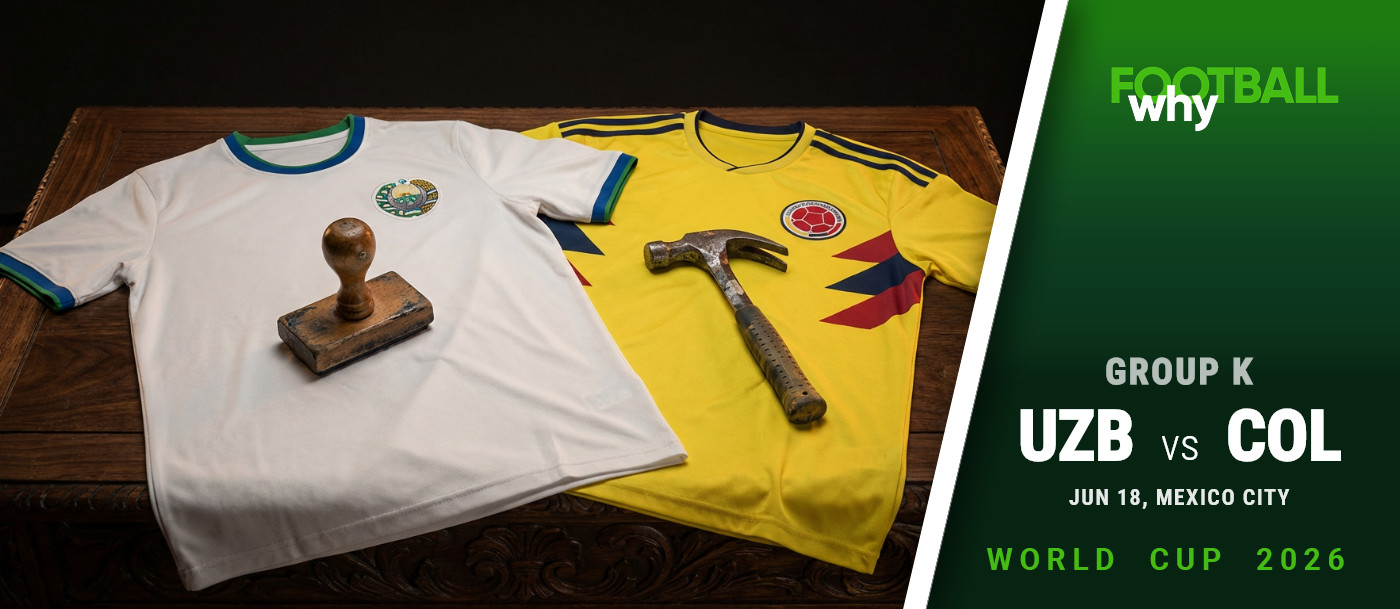
The World Cup Qualification Decider
Thursday, 18 June

Estadio Azteca, Mexico-city

Uzbekistan vs Colombia FIFA World Cup 2026 Group Stage Match A glorious rupture quickly sealed Forecast generated:

South American street-smarts stretched Central Asian stoicism to its breaking point under the thinning Mexican air. Explore how Luis Díaz’s decisive strike abruptly silenced Uzbekistan’s historic 60th-minute World Cup celebration.
Uzbekistan vs Colombia Structural Collision

What was it?

The thinning air inside the Estadio Azteca pressed down like a heavy, frayed curtain. South American pragmatism pushed against Central Asian stoicism, stretching the turf's geometry until the defensive sealant finally cracked.

Colombia probed the wide channels as if testing a rusted allotment gate. They bypassed the central traffic entirely, generating a 1.61 expected goals yield largely from lateral shifts. Daniel Muñoz broke the deadlock at 40 minutes, arriving unmarked on the blind side to finish a sweeping sequence.

Spectators expecting a routine procession missed a sudden, glorious rupture. Uzbekistan emerged from the interval with renewed friction, hitting the post before Abbosbek Fayzullaev pounced on a spilled save at 60 minutes. It was his nation’s first-ever goal on this stage.

The euphoria evaporated almost instantly through fragile goalkeeping. Utkir Yusupov left his near post unguarded just five minutes later, allowing Luis Díaz to squeeze a low finish through the gap. Néstor Lorenzo then ruthlessly managed the altitude, swapping out his playmakers for fresh runners.

Jaminton Campaz headed a third deep into stoppage time. Yet, the final whistle carried no humiliation. It offered a quiet, profound validation of the expanded tournament — a space where disparate worlds collide, leaving everyone a little prouder.

Why not go for the win?

Uzbekistan

Uzbekistan’s initial defensive blueprint functioned exactly as intended. They flattened into a low block, aggressively doubling up on the flanks to choke Colombia’s primary creators.

However, tactical discipline cannot mask individual lapses in concentration. Conceding a near-post strike entirely bypassed their structural hard work, revealing a vulnerability in their goalkeeping hierarchy that continues to unsettle the squad.

Offensively, the team struggled to sustain possession. Without a reliable playmaking hub, they defaulted to chasing second balls and launching vertical surges toward a solitary striker, an approach that demands exhausting physical labour.

This limitation points to a broader generational reality. While domestic academies reliably produce stoic, technically sound midfielders, the squad suffers from a profound lack of minutes in elite European leagues.

Operating within a somewhat isolated, centralised footballing ecosystem leaves them unprepared for the sheer processing speed required at this level. They react a fraction too late when established patterns break down.

They constructed a meticulous communal dam, only to watch the reservoir drain through a single, unsealed crack.

How did they clinch it?

Colombia

Colombia navigated the Central Asian low block by repeatedly shifting the point of attack. They deliberately overloaded the left flank, drawing the defensive gravity before exploiting the vacated space on the far side.

This lateral circulation was paired with shrewd game-state management. Néstor Lorenzo recognised the draining effects of the high altitude, executing a strict minutes cap for his veteran playmakers to maintain structural integrity.

Such pragmatic control highlights a shift in the current squad's character. While they still rely heavily on a central creative hub, the historical tendency to panic under physical duress has largely faded.

This maturity stems directly from their modern developmental pipeline. Domestic academies still foster expressive, one-on-one street instincts, but early migration to European leagues has layered those raw skills with rigorous tactical scaffolding.

Their transnational exposure means players now process transitions with cold efficiency rather than pure emotion. They understand how to kill a game late, utilising fresh legs to secure the penalty box and transition zones.

They brought their customary rhythm to the pitch, but executed the choreography with the ruthless precision of a factory floor.

Match hero...

Abbosbek Fayzullaev
Abbosbek Fayzullaev operated with the quiet diligence of a man rationing water in a drought. While others chased shadows, he waited for the precise moment the Colombian system leaked. His historic contribution required no grand theatrics, merely the pragmatic readiness to harvest a spilled save. He exploited the sudden breakdown in the opponent's rhythm, relying on a deeply ingrained positional discipline to stand exactly where the machinery failed, securing his milestone with stoic efficiency.

...and one more

Luis Díaz
Luis Díaz dismantled the Asian structure by treating their rigid lines like a crowded market alley — finding lateral workarounds where direct paths were blocked. He drew double-teams to himself, effectively pickpocketing the opposition's attention to leave the far side completely exposed. When the match briefly spiralled out of control, his immediate finish was pure streetwise audacity: a sudden acceleration that caught the goalkeeper leaning, reinstating order through sheer individual friction.