

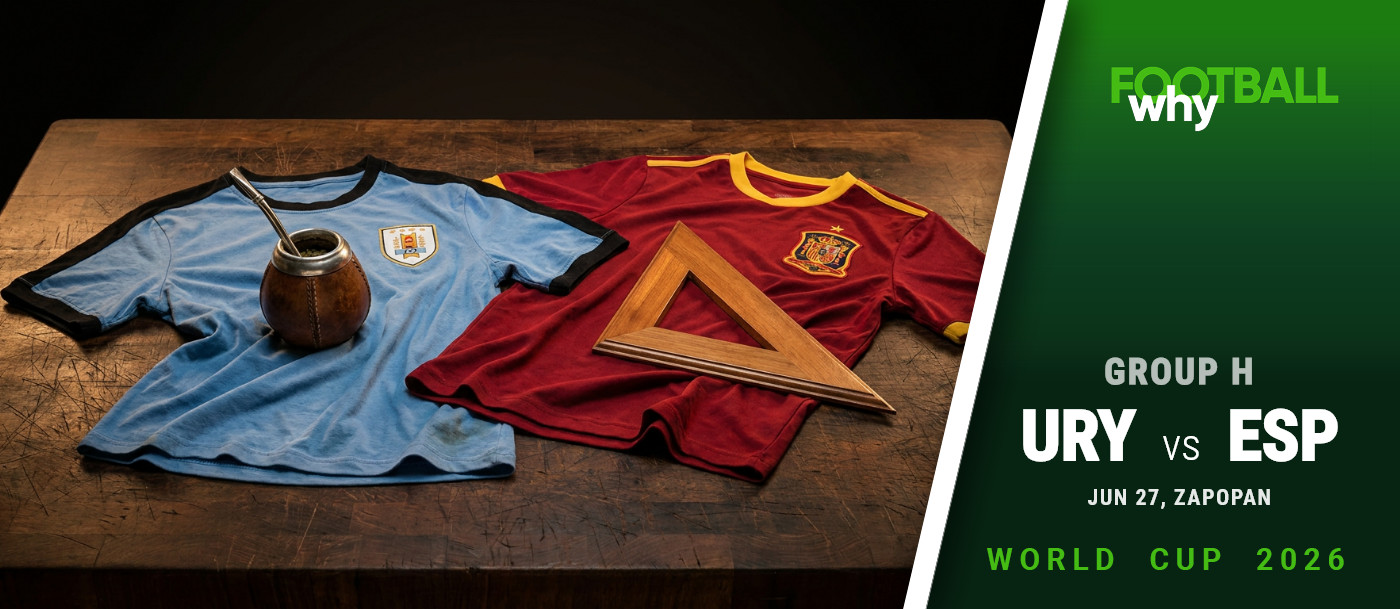
Group H, Matchday 3, Match #66
UTC

Estadio Akron, Zapopan

Prediction by whyFootball readers

URY
DRAW
ESP
26%
30%
44%
Not a recommendation for betting
Tap [+] to cast your expert forecast.
SCORE BY AI PREDICTION: 1:1 SEE SIMULATION

Uruguay vs Spain FIFA World Cup 2026 Group Stage Match Precise plaza geometry stalled by a street-corner barricade Forecast generated:

The refined choreography of the sunlit plaza collides with the unyielding heat of the street-corner firecraft. It is an eternal dispute between orchestrating a flawless civic consensus and surviving through sheer, unapologetic defiance when the odds are stacked against you.

Uruguay: One side's prayer...

Entering this Group H finale, Uruguay must win to secure top spot; a draw leaves them second. The public explicitly demands a cleansing of the 'Tampa stain' — a humiliating 5-1 defeat to the USA that recently destabilised the manager's tenure. Ronald Araújo returns to anchor the defence following a restorative mental health break, though the left-back slot remains a patched-up liability without Piquerez. The dressing room mood is uncompromising. They are ready to lay the heavy mortar, knowing only visible, blood-and-thunder commitment will satisfy the relentless domestic expectation.

Spain: ...head-on with the other.

A draw secures first place, yet national pride dictates a victory. The squad remains insulated from the 'Cornellà scandal' — a persistent backdrop of regional political infighting that perpetually destabilises the federation. Medically, the staff are strictly managing the sprint loads of Pedri and Nico Williams to prevent muscular relapses. The internal atmosphere is calm and procedural, anchored by senior figures demanding focus. They step out aiming to weave their intricate passing patterns, acutely aware that any stylistic regression will invite immediate, unforgiving scrutiny from an impatient domestic press.
Uruguay vs Spain Structural Collision

Uruguay: How we will host...

Dream
To win this match is to top the group and scrub the stain of recent underperformance clean. The public demand is simple: beat a heavyweight, silence the noise around the manager, and do it with unmistakable grit.

Strength
Their core strength lies in collective resilience and a streetwise pragmatism that treats suffering without the ball as a badge of honour. They rely heavily on aggressive transitions, elite duel-winning in midfield, and an intimidating prowess from set-pieces to compensate for a lack of pure creative fluency.

Plans
The manager intends to starve Spain's midfield pivot of time and space, aggressively screening him from the very first pass. Knowing Spain will target the flanks, Uruguay will tilt their midfield to overprotect their vulnerable left side, forming a solid two-on-one barricade to force the opposition backwards.

Fears
The primary concern is emotional discipline. When the pressure mounts, there is a historical tendency for tempers to flare, leading to needless fouls and disjointed pressing that disconnects the attack from the midfield engine.

Spain: With what we arrive...

Dream
A draw is sufficient to secure the top spot, but a victory is demanded to validate their perceived superiority. The objective is to navigate the fixture with absolute risk control, silencing the lingering noise from off-pitch institutional scandals through a commanding, unruffled performance.

Strength
Their defining characteristic is an unwavering commitment to positional play and collective composure. They excel at establishing a secure structure behind the ball, using rapid counter-pressing and triangulated passing to starve opponents of transition opportunities, relying on technique rather than raw physicality.

Plans
The manager's blueprint involves an initial "sedation phase" to neutralise the opponent's early intensity. Once the tempo is sufficiently lowered, they will look to isolate their wingers in one-on-one situations, particularly targeting the opposition's makeshift left flank to create cutback opportunities for late-arriving midfielders.

Fears
The persistent anxiety is that their controlled possession might devolve into sterile, unthreatening passing. If they fail to penetrate a deep defensive block, public impatience grows, and they risk being caught out by chaotic, direct counter-attacks that bypass their meticulously constructed midfield.

How it will be...

The fixture should unfold as a study in contrasting tempos, resembling a slow-burn industrial dispute where one side demands endless procedural dialogue while the other waits to flip the table. Spain will likely monopolise the turf with triangulated passing sequences, attempting to anaesthetise the crowd. Uruguay will absorb the territorial deficit with street-smart cynicism, trusting their set-piece gravity to bypass the midfield entirely.

Watch for Lamine Yamal attempting to unpick the makeshift Uruguayan left flank; his sudden, slaloming inside-drives are the designated skeleton key for Spain's structural rigidity. Conversely, the hosts' threat relies on Darwin Núñez lingering on the blind side of the centre-backs. If Unai Simón parries a low drive back into the penalty area, Núñez possesses the unrefined instinct to punish the spillage before the Spanish defenders can reset their plumb lines.

A late psychological fracture appears improbable. Even as fatigue blunts their counter-attacks, Uruguay's collective obstinacy rarely yields to panic. Spain, equally, will likely retreat into a protective shell of possession rather than risk a chaotic exchange, ensuring the contest concludes as a stubborn stalemate.

Uruguay: Just short of victory

Their inability to convert a fleeting period of second-half dominance ultimately denied them the victory. When Dani Carvajal smothered a crucial late rebound, it exposed Uruguay’s heavy reliance on dead-ball situations. Without a natural playmaker to unpick a set defence, their patched-up left flank simply lacked the attacking thrust required to sustain a consistent threat.

Spain: Just short of victory

A momentary lapse during a chaotic second-phase corner unravelled their early advantage. After conceding the equaliser, a deep-seated instinct to protect the draw superseded their attacking ambition. This risk-averse posture highlighted their systemic vulnerability: an abundance of sterile territorial control that frequently lacks the decisive penalty-box incision needed to dispatch resilient opponents.

Secret mastermind intent

Marcelo Bielsa’s patchwork repair in the engine room

General Strategy
The primary objective is to secure a win to top the group, prioritising structural solidity over expansive possession. The team will operate in a controlled mid-block, engaging the opposition near the halfway line rather than committing to an exhausting, constant high press.

Upon winning the ball, the immediate focus is verticality. The plan relies on early diagonal passes to isolate the striker against the opposition's recovering full-backs, aiming to generate enough attacking volume through rapid transitions and dead-ball situations.
Antidote for the Opponent
A major defensive focus is shadowing Spain's central pivot. Nicolás de la Cruz is tasked with screening his hips to disrupt the first passing phase, effectively starving the opposition's main orchestrator of the ball.

To counter Spain's threat on the right flank, the team will deliberately tilt their defensive block. Federico Valverde will slide across to create a two-on-one overload with the left-back, forcing the dangerous winger to stay on the outside and denying him the opportunity to cut inside.
Internal Task Solving
The emergency at left-back dictates a highly conservative brief for that corridor, prioritising defensive stability over any involvement in the build-up play. It is a necessary load-bearing wall in a patched-up defence.

During any VAR delays, the captain is instructed to gather the team, using the pause to explicitly reaffirm set-piece marking assignments and transition lanes.

To manage the team's notorious emotional volatility, referee interactions are strictly limited to the captain. If tempers threaten to boil over, a predefined 'cooling' sequence will be triggered, involving time-wasting hygiene and a temporary double pivot to restore calm.
Crisis Response Plans
If Spain consistently overload the left corridor and isolate the centre-back, the manager is prepared to shift Valverde permanently into a five-man midfield. This adjustment aims to lock down the wide-to-inside access, forcing the opposition into attempting low-percentage, outside-of-the-boot crosses.

Should the team find themselves chasing a goal late in the game, the flexibility is there to switch to an aggressive back three. This involves pushing both wingers high and adding a second forward to bombard the penalty area with early crosses.
Specific Match Orders
Mathías Olivera: Show the winger outside only; delay and double up. No lunging on the front foot. Keep hands behind the back when near the penalty area to avoid conceding cheap free-kicks. Darwin Núñez: Hold the run for a half-beat to ensure you stay onside. Attack across the centre-back's body, pin the full-back in the right channel, and ensure you make the first contact on the ball. Federico Valverde: Slide across to the left central midfield position on the signal to create a two-on-one with the left-back. Do not abandon the central zone to become an emergency right-back unless explicitly cued from the touchline.
/ What if Spain establish an early monopoly on the ball?

If a goal is conceded or Spain control possession for ten consecutive minutes, the team must slow all restarts and compress the pitch vertically by 25 metres. The captain will call for 90 seconds of risk-free circulation to reset the rhythm before forcing the next three entries exclusively down the channels.

/ What if Spain settle into a period of sterile, unthreatening control?

Should the opposition retreat into a pattern of sterile possession to protect a draw, the team will execute a pre-planned eight-to-ten minute shock phase. This involves pushing the full-backs inside, advancing the central midfielders, and pinning the wingers high to aggressively disrupt the rhythm.

Secret mastermind intent

Luis de la Fuente’s plumb line of positional control

General Strategy
The strategy is anchored in establishing absolute risk control before attempting any incisive attacking moves. The team will maintain a disciplined structure behind the ball, prioritising territorial dominance and immediate counter-pressing over end-to-end exchanges.

Attacking patterns will focus on circulating the ball to isolate a winger, triggering third-man runs and cutbacks. The emphasis is on rapid flank switches and allowing late-arriving midfielders to finish from the edge of the penalty area, ensuring the defensive shape remains intact.
Antidote for the Opponent
A deliberate tactic is to target the opposition's makeshift left-back position. This involves isolating the winger in one-on-one situations, supported by underlapping runs from the full-back and quick combination play with the interior midfielders.

Defensively, the central striker is instructed to block the passing angle to the opposition's defensive midfielder. Furthermore, the centre-backs are tasked with defending the space near the near post, rather than tightly marking the man, to counter the threat of blind-side diagonal runs.
Internal Task Solving
The opening fifteen minutes are designated as a 'sedation phase'. The explicit instruction is to maintain sterile, safe control of the ball to defuse the opposition's anticipated early intensity and altitude-fuelled pressing.

Set-pieces will involve crowding the near post to act as a screen. This deliberate congestion is designed to free up a designated runner at the far post, specifically countering the opposition's tendency to heavily guard the back-post areas.
Crisis Response Plans
If the opposition successfully execute a man-oriented high press that forces errors in the build-up, the defensive midfielder will drop deep to form a back three. This creates a numerical advantage for exiting the defensive third and allows for early diagonal passes to the opposite winger.

Should the team struggle to penetrate the central areas and the striker becomes isolated, the attacking midfielder will tuck inside to act as a second number ten. This adjustment aims to increase the volume of cutbacks by creating a heavier attacking presence in the final third.
Specific Match Orders
Rodri: Anchor the midfield triangle at all times to guard against diagonal counter-attacks. Drop into the back line only upon a specific cue from the bench or if the opposition triggers an aggressive high press. Dani Carvajal: Maintain a conservative starting position. Execute an underlapping run when the winger is double-teamed, but reset your defensive position immediately afterwards to avoid leaving space exposed down the right channel. Lamine Yamal: Attack the inside shoulder of the left-back on your first action. If double-teamed, release the ball to the underlapping full-back and re-accelerate to receive the return pass in the cutback window.
/ What if the match descends into emotional chaos and heavy tackling?

If tempers fray or a goal is conceded, the team must execute a fifteen-pass reset sequence using the full width of the pitch. The tempo must be frozen for ninety seconds, and the subsequent attack must end with a shot, cross, or corner, entirely avoiding risky central passes.

/ What if the opposition switch to a highly aggressive, three-man pressing line?

If the opponent commits to a high press late in the game, the team will respond with long diagonal passes to the weak-side winger. A double pivot will be established to stabilise against counter-attacks, and players will actively seek to draw fouls to relieve pressure and move up the pitch.

MAIN SIMULATION 0'-25'

Spain open with a deliberate "sedation phase", using Rodri to anchor a conservative shape behind the ball while capping their full-backs' forward runs. Uruguay counter this by sitting in a compact mid-block, heavily tilting their midfield left to double-team Lamine Yamal. The resulting tactical friction heavily favours Spain's risk-averse blueprint, denying Uruguay the central turnovers they crave. The hosts attempt direct diagonal balls toward Darwin Núñez, but Spain's deep defensive positioning easily smothers these early probes, reducing the opening quarter to a sterile stalemate.

MAIN SIMULATION 25'-45'

Spain shift gears, isolating Yamal to trigger overlapping runs from Dani Carvajal. This right-sided rotation finally pries open Uruguay's defensive tilt, culminating in Dani Olmo arriving late to finish a clinical cutback. Uruguay immediately initiate a shock-recovery protocol, compressing the pitch to slow the tempo. When Spain’s counter-press stifles their build-up, the hosts lean heavily into their set-piece gravity. Successive corners isolate Robin Le Normand at the back post, allowing Ronald Araújo to nod down for Núñez to stab home an equaliser just before the interval.

MAIN SIMULATION 45'-65'

Uruguay emerge with a pre-planned tactical surge, pushing Valverde higher and instructing Núñez to arc into the right-back corridor. This aggressive ten-minute spell peaks when Nicolás de la Cruz releases Núñez for a low drive. Simón parries it centrally, but Carvajal expertly bodies out the rebound. Spain immediately adapt by dropping their full-backs and reinstating their ritual possession to kill the noise. A tactical yellow card from Manuel Ugarte finally halts a Spanish break, forcing Uruguay to retreat into a stable defensive block.

MAIN SIMULATION 65'-90'

Tournament stakes push Uruguay to chase the win, redeploying an aggressive high press with an extra forward to flood the box. Spain, content to protect the draw, introduce a double pivot to stabilise the midfield and concede the wide areas. The resulting late-phase instability stretches both sides. Valverde drags a cutback wide, while Mikel Oyarzabal tests the keeper on a counter. Uruguay’s final push sees Núñez denied by a crucial Carvajal block, allowing Spain to run down the clock with a sterile passing freezer.

And it will come to...

Should this forecast hold true, Spain’s structural identity would largely survive the ordeal, utilising disciplined rest-defence to secure the point they require. They would likely control the tempo but struggle to convert sterile possession into a multi-goal cushion. Conversely, Uruguay’s trademark grit would extract parity through sheer set-piece gravity and a brief, aggressive open-play surge. However, their systemic inability to consistently break down compact elite blocks would ultimately deny them the repeated premium chances required to steal a victory.
end of Game