

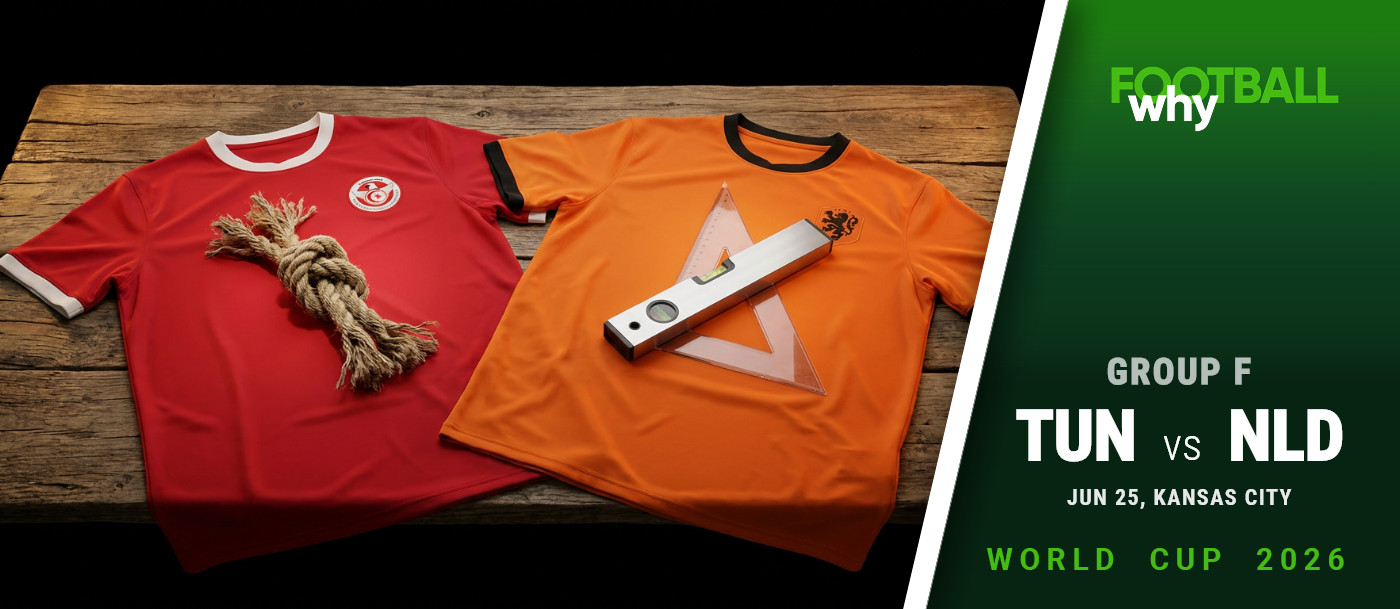
Group F, Matchday 3, Match #58
UTC

Arrowhead Stadium, Kansas City

Prediction by whyFootball readers

TUN
DRAW
NLD
19%
26%
55%
Not a recommendation for betting
Tap [+] to cast your expert forecast.
SCORE BY AI PREDICTION: 1:2 SEE SIMULATION

Tunisia vs Netherlands FIFA World Cup 2026 Group Stage Match Positional geometry eroding the stubborn communal barricade Forecast generated:

The cold, mercantile calculus of the polder confronts the fate-tinged solidarity of the Maghreb. It is a compelling collision between pristine architectural geometry and a defiant, load-bearing brotherhood that views collective suffering as a badge of profound honour.

Tunisia: One side's prayer...

Tunisia arrive at this final group fixture knowing a victory is essential to control their own destiny. Two previous draws have secured defensive solidity, but the public are growing deeply impatient with the sterile lack of goals. The squad’s preparations are further clouded by Youssef Msakni’s recent family bereavement, while young talisman Hannibal Mejbri is still nursing a delicate hamstring. The mandate is clear: they must suffer without panic, winding the clock down like a stubborn market haggler before finally striking late.

Netherlands: ...head-on with the other.

The Netherlands approach this group finale aiming to secure top spot without expending unnecessary emotional energy. The public expect a clean, professional performance, devoid of late-game drama against a deep-sitting opponent. Ronald Koeman is meticulously managing his squad’s physical load: Frenkie de Jong operates under a strict minutes cap following his hamstring recovery, while Denzel Dumfries must curb his attacking instincts to avoid a suspension. The Dutch intend to drain the opposition's resolve, operating their passing network like a perfectly calibrated system of canal locks.
Tunisia vs Netherlands Structural Collision

Tunisia: How we will host...

Dream
A victory is non-negotiable to control their qualification destiny. The public are tired of pointless stalemates and demand a tangible end product.

Strength
This squad operates like a tight-knit trade union, bound by communal accountability. They excel at absorbing pressure in a compact defensive shape. Individual egos are happily sacrificed for the structural integrity of the collective.

Plans
The tactical blueprint relies on absorbing the Dutch possession and striking through choreographed set-pieces. They will use the ball purely to rest their legs. A sudden, calculated escalation in attacking intent is planned for the final third of the match.

Fears
The existential dread is that their cautious framework becomes a tactical straitjacket. If forced to chase the game early, their midfield links often vanish. Desperation tends to stretch their lines and replace measured passing with hopeful, low-percentage long balls.

Netherlands: With what we arrive...

Dream
Topping the group without unnecessary drama is the absolute baseline. The public expect a clean, professional audit of the opposition, preserving crucial energy and avoiding suspensions ahead of the knockout stages.

Strength
Their football is an exercise in collective geometry. Rooted in a pragmatic, mercantile logic, they trust positional schooling and shared responsibility over chaotic individualism. The ball is made to do the sweating, wearing down opponents through relentless, calculated circulation.

Plans
The manager aims to construct an impenetrable passing network. They will patiently recycle possession to unbalance the defensive block, deliberately isolating their left-sided forwards for one-on-one situations. A strict risk floor is imposed on the goalkeeper to prevent gifting cheap transitions.

Fears
A historic anxiety lurks in the final minutes. When matches descend into physical brawls and aerial bombardment, their pristine structure can sometimes fracture. Perfectionism occasionally breeds hesitation, turning a comfortable lead into a nervous, chaotic endgame.

How it will be...

The fixture should initially unfold like a protracted union dispute over a tea-break mandate. We would likely see the Netherlands monopolising the ball, constructing their positional architecture with the patience of clock-tower maintenance. Tunisia will happily absorb this, relying on their load-bearing communal grit to weather the possession.

You might expect the deadlock to fracture around the hour mark. Once the Dutch geometry finally isolates Cody Gakpo on the left, his inside strides and flat deliveries should dismantle the North African picket line.

Yet, the ensuing European comfort could prove fragile. Should Hannibal Mejbri be introduced to salvage the operation, his kinetic, streetwise urgency might override the established tactical blueprints. His arrival would likely stretch the Tunisian shape, inviting further Dutch punishment, but also injecting a frantic, desperate energy into the final third.

In those dying embers, observe Ellyes Skhiri. While the Dutch attempt to apply a mercantile freeze to the contest, Skhiri’s penchant for blindside darts at set-pieces could suddenly rupture the script. It promises an absorbing transition from sterile diplomatic protocol to raw, unearned amateur dramatics.

Tunisia: Why not go for the win?

Tunisia ultimately succumbed because their mid-match tactical escalation eroded their primary defensive screen. By abandoning their load-bearing shape to chase the deficit, they gifted the Dutch the exact half-space corridors they had previously denied. Their reliance on set-piece opportunism simply could not compensate for a glaring deficit in open-play invention.

Netherlands: How did they clinch it?

The Dutch prevailed through the sheer, repetitive automation of their positional schooling. By persistently isolating their left flank, they engineered high-yield cutback opportunities that eventually breached the deep block. Koeman’s strict risk-floor protocols during the chaotic final exchanges prevented the late Tunisian surge from unravelling their earlier structural investments.

Secret mastermind intent

Trabelsi’s incremental bargaining on the defensive picket line

General Strategy
The overarching strategy is a stubborn exercise in load-bearing grit. Trabelsi wants a clean sheet secured for the first hour of the contest. The team will sit in a narrow, compact shape to protect the central lanes at all costs.

Once the clock hits sixty minutes, the tactical shackles are removed. A ten-minute window of controlled risk will be triggered regardless of the scoreline. This sudden escalation is designed to catch a fatigued opponent completely off guard.
Antidote for the Opponent
The specific attacking focus is firmly fixed on the space left by the advancing Dutch right-back. The left winger is instructed to start high and wide to receive early diagonal passes. They will prioritise flat cutbacks into the penalty area rather than floating hopeful crosses.

Defensively, the midfield must operate like a rusted escapement, deliberately slowing the European rhythm. If the primary Dutch playmaker enters the pitch, he will be tightly shadowed. The designated marker will sit on his inside shoulder to deny any return passes.
Internal Task Solving
The manager will use language as an active tactical lever from the touchline. Colloquial Arabic will be shouted to encourage solidarity and maintain defensive caution. French terminology is strictly reserved for high-stakes, precise structural reorganisations.

Furthermore, the team will orchestrate pre-planned pauses every fifteen minutes. Goalkeepers will delay restarts and players will seek touchline hydration. This deliberate friction is designed to completely derail the fluid passing rhythm of the opposition.
Crisis Response Plans
If the initial passing structures are suffocated by a high press, the team will abandon short distribution. The goalkeeper will immediately launch early diagonal balls towards the wide forwards. This bypasses the congested middle third entirely.

Should the team concede a goal, an emergency stabilisation routine is instantly activated. They will drop into a flat bank of four in midfield for two minutes. The aim is to hold safe possession at the back and draw a cynical foul to reset the tempo.
Specific Match Orders
Ali Abdi (Left-back): Overlap only on the specific trigger word. Default to an underlapping run to protect the defensive transition. Recover ten metres immediately upon losing possession, and absolutely no dissent towards the referee. Elias Achouri (Left Winger): Start out wider than the full-back to attack the space behind the defensive line. Prioritise flat cutbacks over floated balls to the far post. Sell any physical contact to win set-pieces, then reset your position immediately. Ellyes Skhiri (Defensive Midfielder): Do not drop into the defensive line under the first wave of pressure. Stay central to block the opposition's attacking combinations. Arrive late and blindside on all attacking set-piece routines.
/ What if the Dutch press completely suffocates the defensive third?

The short build-up is immediately scrapped. The right-sided centre-back will hit a flat diagonal pass directly to the left winger. The defensive midfielder stops dropping deep and instead pushes up to contest the second ball in the central zone.

/ What if the opposition introduces a towering striker late in the game?

The defensive line will match the height by shifting to a back five. The tallest available central defender is brought off the bench. Clearances are strictly aimed toward the far touchline to set up throw-in traps, and pulling shirts in the box is strictly prohibited.

Secret mastermind intent

Koeman’s mercantile calculus and strict positional water-control

General Strategy
The overarching logic is to dictate the tempo through sustained, methodical possession. Koeman demands a high-mid press to suffocate the opposition's midfield pivot, establishing territorial dominance from the first whistle.

This is not possession for vanity. Risk is meticulously managed in the opening phases, ensuring the structure behind the ball remains secure before committing bodies forward. The aim is to drain the opponent's resolve through endless geometric circulation.
Antidote for the Opponent
The primary attacking vector targets the space vacated by the opposition's aggressive left-back. The Dutch will deploy rapid weak-side switches to isolate their wingers, aiming to deliver flat cutbacks from the byline.

Defensively, the mandate is to slam the door on wide transitions. The right-sided players are instructed to delay the ball carrier, showing him down the touchline while the midfield screen cuts off the inside passing angles.
Internal Task Solving
A strict risk floor is enforced upon the goalkeeper for the opening twenty minutes. Deliberately baiting the press is categorically banned. He must bypass the midfield entirely if the central passing lanes are obscured.

Furthermore, minute-management protocols are firmly in place for returning key players. If a comfortable lead is established by the hour mark, planned substitutions will be executed to preserve legs and maintain structural discipline without emotional hesitation.
Crisis Response Plans
If the opposition's pressing trap successfully neutralises the midfield pivot, the build-up shape instantly morphs. The right-back will tuck inside, creating a temporary back three to manufacture a numerical advantage and bypass the pressure.

Should the wide channels become dangerously exposed to counter-attacks, a tactical handbrake is applied. The full-backs will immediately halt their overlapping runs, and the team will patiently recycle the ball down the opposite flank until stability returns.
Specific Match Orders
Denzel Dumfries (Right-back): Refrain from sliding tackles when defensive cover is present. Delay the attacker and force him toward the touchline. If cautioned, automatically reduce the volume of overlapping runs and alert the bench immediately. Bart Verbruggen (Goalkeeper): Avoid inviting pressure with short passes during the opening exchanges. Hit a diagonal ball to the wide areas if the central midfielder is marked twice consecutively. Chipped passes into the middle third are strictly forbidden. Cody Gakpo (Left Winger): Take up a starting position in the inside-left channel and drive centrally on the first touch. If the overlapping full-back is blocked, receive the ball wider and attack the defender directly. Counter-press instantly after any shot or cross.
/ What if the team suffers a sudden collapse in possession?

If three consecutive sloppy phases occur or a goal is conceded, the team drops into a rigid 4-1-4-1 shape. The goalkeeper is instructed to clear the ball long for two cycles. The captain will then call a brief sideline huddle to reset the collective focus before resuming normal play.

/ What if the opposition parks a deep defensive block late on?

Should the opponent retreat into a five-man defensive line, the attacking structure shifts to a front five. An extra striker is introduced to pin the centre-backs. The team will relentlessly recycle possession and run double cutback patterns until a clear shooting lane finally emerges.

MAIN SIMULATION 0'-25'

The Netherlands build their familiar 3-2-5 shape. They look to isolate Gakpo on the left, using Schouten and Reijnders to screen the transitions. Tunisia sit deep in a compact 4-1-4-1, playing patient passes through Skhiri. It is a slow, methodical opening. Dutch full-backs are told to curb their forward runs. This denies Achouri the space to counter-attack down the flanks.

MAIN SIMULATION 25'-45'

Koeman shifts the focus to sustained left-sided isolations. Van Dijk and Aké feed Gakpo, who recycles the ball until an inside lane opens. Tunisia accept this sterile containment. They are hunting for cheap fouls to trigger their choreographed set-pieces. Dahmen makes a sharp save from a Reijnders shot, keeping the sheet clean. The half ends as a tactical arm-wrestle.

MAIN SIMULATION 45'-65'

The dam finally breaks. Van Dijk hits a switch, Gakpo drives inside, and Reijnders finishes a cutback to make it 0-1 at 54 minutes. Tunisia attempt a rehearsed mid-block recovery, but the scoreboard pressure stretches their spacing. Dumfries picks up a booking, prompting the Dutch to trim their right-sided attacks. Tunisia then throw the dice. Hannibal comes on as a number ten to force the issue.

MAIN SIMULATION 65'-90'

Tunisia leave the back door open in their desperate push. Schouten intercepts a pass, feeds Gakpo, and a classic cutback routine makes it 0-2 on 74 minutes. Koeman flattens his midfield to protect the lead. Tunisia abandon caution, launching a wave of set-pieces. Skhiri glances in a near-post header at 82 minutes to spark a chaotic finale. The Dutch throw on an extra centre-back to survive the late aerial bombardment.

And it will come to...

If this forecast holds true, we would see a methodical Dutch machine dismantle a stubborn Tunisian barricade. The Netherlands would dictate the tempo, using automated positional play and rehearsed cutbacks to secure their goals. Tunisia would likely rely on their trademark grit, absorbing immense pressure before snatching a late goal from a clever set-piece. Ultimately, the superior technical schooling of the European side would outlast the raw, margin-hunting resolve of the North Africans.
end of Game