

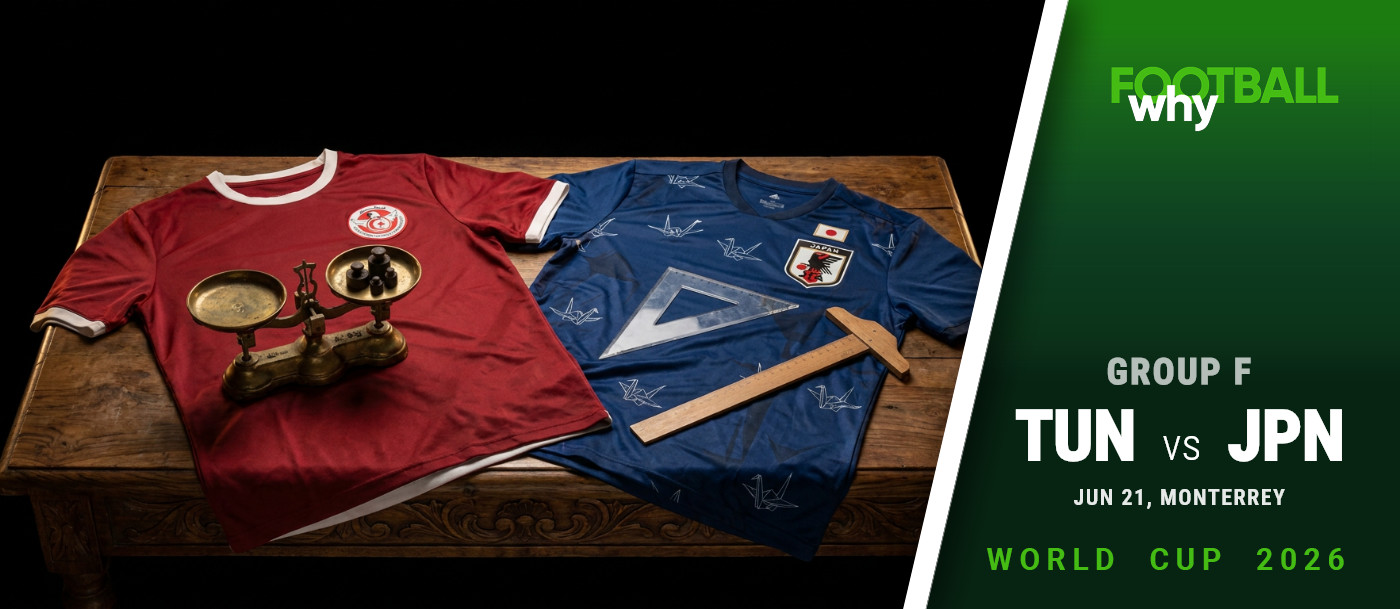
The World Cup Qualification Decider
Sunday, 21 June

Estadio BBVA, Monterrey

Tunisia vs Japan FIFA World Cup 2026 Group Stage Match A mechanical steamroller flattens a paper-thin resistance Forecast generated:

Japan paved over the pitch with the relentless efficiency of a municipal steamroller, restricting a shell-shocked Tunisia to a microscopic 0.05 expected goals. Step inside to see how this four-goal demolition was so quietly engineered.
Tunisia vs Japan Structural Collision

What was it?

The evening felt suffocating, as though the pitch was being paved over by heavy machinery before the crowd had even settled. Nakamura accelerated down the left flank like a steamroller on a steep decline, squaring for Kamada to finish from close range inside four minutes.

Their opponents retreated and crumpled like damp plywood under the weight. They generated a microscopic 0.05 expected goals and failed to register a single shot on target.

Ayase Ueda sliced through the defensive lines as if cutting through loose threads. The striker scored twice and provided an assist. Behind him, a back three anchored by Ko Itakura distributed possession with flawless, uninterrupted rhythm.

The sheer apathy of the trailing side was staggering to witness. Aside from Hannibal Mejbri, who drew seven fouls snapping at ankles, his compatriots jogged as though their contracts strictly forbade sprinting.

When Ueda nodded in a fourth from a clipped far-post cross, the stands exhaled a collective sigh. It was a brutal exposure of what happens when a clockwork mechanism dismantles a group of men merely going through the motions.

Why not go for the win?

Tunisia

Tunisia’s collapse began the moment Japan aggressively pinned Ali Abdi on the left flank. By suffocating this primary exit route, the opposition immediately short-circuited the only rehearsed transition pattern available to the North African side.

Without a recognized centre-forward to aim for, the midfield found themselves entirely devoid of focal points. Consequently, possession devolved into a cautious, lateral exercise, as players hesitated to make penetrating runs that might expose them to rapid counter-attacks.

This immediate retreat into a defensive shell reflects a squad deeply unsettled by early disruption. When the primary script fails, their collective reaction is not to improvise, but to throttle down and wait for the system to restore order.

Such paralysis stems from a profound cultural aversion to individual exposure. In a footballing ecosystem where communal accountability is paramount, breaking rank to attempt a risky, unscripted pass carries a heavy burden of public shame if it goes wrong.

Faced with a superior force and a broken game plan, the players instinctively opted to share the blame through collective inaction. It is easier to fail quietly as a unified block than to fail loudly as a daring individual.

They chose the quiet safety of the waiting room over the chaotic vulnerability of the open stage.

How did they clinch it?

Japan

Japan systematically dismantled their opponents by deploying natural attackers as wing-backs. This aggressive positional choice stretched the Tunisian defensive block to breaking point, constantly forcing their wide centre-backs into uncomfortable, isolated decisions.

This width was secured by the absolute reliability of the Tomiyasu-led back three. Their measured circulation in the first phase acted as a steady metronome, allowing the midfield pivot to patiently calibrate the timing of their forward entries.

Remarkably, the absence of marquee European creators barely altered the attacking rhythm. The squad operates on a pre-aligned consensus, where specific tactical triggers — like the left-sided cutback — function perfectly regardless of the specific personnel executing them.

This seamless interchangeability is the direct product of a highly codified developmental pipeline. From high school tournaments to the professional ranks, players are rigorously drilled to prioritize the structural blueprint over any individual desire for the spotlight.

The federation has cultivated an environment where technical craft serves the group harmony above all else. Consequently, the team maintains its relentless, driving efficiency late into the match, refusing to drop their standards or succumb to ego-driven deviations.

They function as a perfectly calibrated loom, weaving the same intricate pattern no matter which threads are fed into the machine.

Match hero...

Hannibal Mejbri
Hannibal refused to sign the collective treaty of surrender. While his teammates folded into a quiet, fate-accepting lethargy, he snapped and snarled, drawing seven fouls in total isolation. He operated on pure anti-hogra — a visceral rejection of public humiliation. Lacking runners to pass to, he used his body as a blunt instrument, turning every midfield duel into an abrasive street-corner dispute to protest the total lack of communal effort around him.

...and one more

Ayase Ueda
Ayase Ueda operated with the terrifying efficiency of a pre-stamped municipal blueprint. He scored twice and set up another not through explosive individualism, but by repeatedly exploiting the exact tolerances of the opposition's defensive joints. His timing relies on an absolute, ingrained trust that the pass will arrive precisely as the system dictates. He simply slid into the designated gaps, executing his shifts on the assembly line with a quiet, lethal devotion to the collective design.