

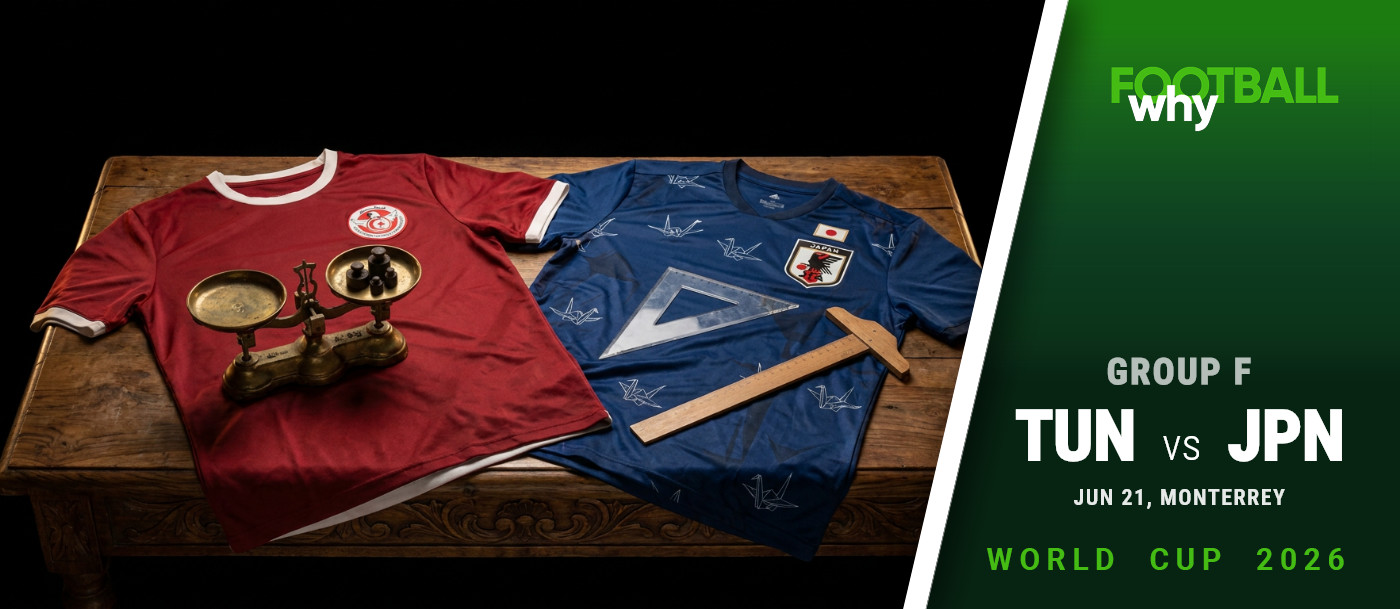
Group F, Matchday 2, Match #36
UTC

Estadio BBVA, Monterrey

Prediction by whyFootball readers

TUN
DRAW
JPN
27%
32%
41%
Not a recommendation for betting
Tap [+] to cast your expert forecast.
SCORE BY AI PREDICTION: 1:1 SEE SIMULATION

Tunisia vs Japan FIFA World Cup 2026 Group Stage Match Shattered Drafting Rulers on a Worn Market Scale Forecast generated:

A collision of profound philosophies. The unwavering belief in collective, pre-approved harmony confronts a stubborn, fate-buffered brotherhood forged in adversity. Will procedural craftsmanship dismantle the barricades, or can sheer survivalist willpower disrupt the immaculate blueprint?

Tunisia: One side's prayer...

Tunisia approach Matchday 2 knowing a draw keeps the Group F arithmetic alive, but a defeat practically books their flight home. The squad’s mental resilience is being stress-tested by the recent bereavement and absence of their talisman, Youssef Msakni, leaving a creative void. With Hannibal Mejbri also nursing a returning hamstring, public expectation demands they rely on their gritty, survivalist DNA. They are essentially laying sandbags against a rising tide. Their entire tournament hinges on frustrating superior opposition and scavenging points from set-piece margins.

Japan: ...head-on with the other.

Japan arrive at this second fixture seeking a clinical victory to assert absolute control over Group F before facing Sweden. The mood is one of composed affirmation following a strong opening, though the medical staff are carefully managing structural cracks. Wataru Endo is on a strict seventy-minute cap, and Ko Itakura is carrying a lingering back issue. The public expects a seamless exhibition of rapid, wide-to-central transitions. They must weave their intricate passing patterns through a dense defensive block without allowing the match to degenerate into a physical brawl.
Tunisia vs Japan Structural Collision

Tunisia: How we will host...

Dream
The absolute minimum requirement is survival. A draw keeps the group-stage arithmetic alive, though it leaves a steep mountain to climb against the Netherlands. Claiming all three points, however, would radically shift the qualification landscape.

Strength
This squad relies on a deeply ingrained, almost familial solidarity to patch over any gaps in elite flair. They are a stubborn, pragmatic unit that thrives on suffering together without losing shape. Their true power lies in the margins: set-pieces and sudden wide transitions are valued far more than sterile possession.

Plans
To bypass the opponent's anticipated pressing traps, the blueprint dictates skipping the midfield entirely. Goal kicks will be sent long into the left channel, creating a physical contest for the second ball. Furthermore, there is a clear intent to crowd the opposition goalkeeper on every corner, exploiting a known aerial vulnerability.

Fears
The overriding anxiety is a breakdown in emotional discipline. A perceived injustice from the referee could easily trigger a spiral of dissent, leading to cheap fouls and a loss of defensive focus. Moreover, their heavy reliance on wide transitions means that if the flanks are neutralised, they lack the central creativity to unlock a deep defence.

Japan: With what we arrive...

Dream
The baseline ambition is a straightforward victory. Earning three points guarantees control before the final group fixture. A draw is only palatable if mathematics elsewhere fall perfectly into place.

Strength
They operate with the precision of a municipal committee. Every movement is pre-approved, valuing collective harmony over individual heroism. Their transitions are rapid, grounded, and executed with clinical detachment.

Plans
The tactical design revolves around stretching the defensive shape to create low cutbacks. They intend to overload the flanks, utilise underlapping runs, and stubbornly keep the ball on the turf to avoid physical aerial duels.

Fears
The underlying anxiety stems from a potential penalty-box brawl. If the match devolves into ugly, floating crosses and heavy physical contact, their structural composure could easily fracture into hesitant, sterile possession.

How it will be...

The forecast suggests an affair resembling a fraught municipal zoning dispute. Japan will monopolise territorial possession, circulating the ball with bureaucratic exactitude while probing the flanks. You should expect Kaoru Mitoma to repeatedly isolate his marker, deploying those sudden decelerations and hip-swivels to pry open the byline.

Yet, the script harbours a distinct fragility. Should the Asian side's passing sequences momentarily stagnate, their structural aversion to physical penalty-box brawls offers a clear vulnerability. Tunisia will gleefully bypass the midfield congestion, launching industrial diagonals to manufacture set-piece scenarios.

Observe how the North Africans crowd Zion Suzuki at corners, stacking bodies in the six-yard box to test his command under severe spatial constraint. If a single defensive rotation falters when Wataru Endo’s stamina wanes, a rehearsed near-post flick could easily bypass the entire Japanese rearguard.

Ultimately, it projects as a stalemate born of mutual stubbornness. Japan's reluctance to abandon their floor-based cutback blueprints will collide with Tunisia's refusal to commit men forward in open play. It remains a testament to the enduring power of risk-aversion over expansive ambition.

Tunisia: Just short of victory

Tunisia secured a stalemate but fell short of victory due to a momentary tracking lapse on their weak side, which gifted the opening goal. Their heavy dependence on left-channel transitions rendered their open-play threat predictable. Fundamentally, an enduring absence of elite central creativity restricts them to scavenging set-piece margins.

Japan: Just short of victory

Japan dropped points because they failed to engineer a definitive penalty-spot pullback during their final attacking siege. Their inherent reluctance to commit bodies into the penalty area blunted their territorial dominance. Ultimately, a historical, systemic brittleness when defending crowded set-pieces allowed a scrappy equaliser to dismantle their procedural control.

Secret mastermind intent

Sami Trabelsi’s pragmatic mortar for the defensive wall

General Strategy
Sami Trabelsi is approaching this fixture like a cautious site manager inspecting load-bearing walls: the foundation must be secure before any grand designs are considered. The primary tactical focus is establishing a deeply compact mid-block, sitting roughly forty metres from their own goal.

Rather than risking intricate passing through the centre, the team will rely on direct, long distribution to bypass the initial press. The aim is to secure the second ball high up the pitch, accepting periods without possession in exchange for defensive solidity.
Antidote for the Opponent
To counter the threat of Kaoru Mitoma, the defensive scheme relies on funnelling him towards the touchline. A systematic double-team will be employed from the inside out, specifically designed to cut off his preferred route into the penalty area.

Offensively, the plan targets the space left by Japan's advancing right-wing-back. Tunisia will look to exploit this channel immediately upon regaining possession, aiming to deliver early, deep crosses toward the back post to test a backline that historically struggles with aerial bombardment.
Internal Task Solving
The coaching staff are carefully monitoring the physical load on key personnel, particularly regarding Youssef Msakni's recent bereavement and Hannibal Mejbri's returning hamstring. Furthermore, there is a strict, non-negotiable directive regarding referee interactions.

Any escalation of dissent is strictly prohibited to prevent the kind of emotional unravelling that has cost them in the past. Only the captain is authorised to speak with the officials, ensuring the team remains focused on the tactical plan rather than perceived injustices.
Crisis Response Plans
If the initial structure fails and a goal is conceded, the emergency protocol involves an immediate shift to a 4-2-3-1 formation. Elias Achouri will be instructed to drift centrally into the number 10 role, acting as the pivot for quick cutback routines.

This shift will be accompanied by a deliberate spike in attacking intensity designed purely to force a high volume of set-pieces. The manager knows that chaotic, open-play chasing is a recipe for disaster; salvation lies in rehearsed dead-ball routines.
Specific Match Orders
Ellyes Skhiri: Do not drop between the centre-backs during the first phase of build-up. Play the ball first-time out wide or hit the diagonal pass immediately. Tactical fouls in the central areas are completely off-limits; if you have to bring a man down, do it out wide. Ali Abdi: Only overlap when you hear the specific code word. Otherwise, tuck inside and look for the underlapping run or the cutback. Do not argue with the referee under any circumstances; leave all dialogue to the captain. Aymen Dahmen: For the first twenty minutes, kick long into the left channel every single time. Absolutely no short, central passes from goal kicks. Keep your positioning disciplined and guard the near post against tight-angle shots.
/ What if the midfield picks up early yellow cards?

If Aïssa Laïdouni or the right-back are booked within the first twenty-five minutes, the team will immediately drop into a rigid 4-4-2 block. The winger on that side will drop deeper to provide cover, and Skhiri will shift across earlier to prevent isolated one-on-one duels.

/ What if Japan relentlessly attack the byline late on?

If the opposition introduces fresh wingers and begins to dominate the wide areas, the team will temporarily shift to a 5-4-1 formation for a ten-minute spell. The goal is to completely block the inside passing lanes, accepting that harmless, floating crosses will come into the box.

Secret mastermind intent

Hajime Moriyasu’s meticulous paperwork for penalty-box access

General Strategy
Moriyasu is treating this fixture like a rigid council planning application, where every attacking phase must follow the correct procedural sequence before execution. The overarching strategy relies on a mid-height engagement line, squeezing the central areas to force turnovers.

Once possession is secured, the focus shifts entirely to rapid wide-to-central surges. The team is instructed to avoid hopeful crosses entirely, instead working the ball meticulously into the penalty area along the floor.
Antidote for the Opponent
To dismantle the opposition's anticipated deep defensive shell, the focus is on drawing their defensive midfielder out of position. The squad will utilise decoy short corners to pull the screen away from the penalty spot.

Defensively, a specific trap is set for the opposing left flank. The instruction is to show the winger towards the touchline and immediately double-team him from the inside, entirely denying the cutback lane.
Internal Task Solving
The coaching staff have implemented a strict energy conservation protocol to counter the intense evening heat. Scheduled micro-pauses for water intake and controlled, low-tempo possession spells are mandated after the hour mark.

This metabolic management is explicitly tied to the captain's playing load. Wataru Endo is on a strict physical limit, meaning the team must preserve enough collective stamina to cover his eventual substitution without losing their structural integrity.
Crisis Response Plans
Should the initial passing rhythms stagnate and the scoreline remain unfavourable, the contingency involves shifting seamlessly to a 3-4-2-1 system. This structural tweak pushes the wing-backs much higher up the pitch to stretch the play.

Consequently, the primary playmakers can tuck inside to occupy the crucial pockets of space behind the opponent's midfield. The manager expects this transition to happen without panic, maintaining possession for a few calming sequences before accelerating the tempo.
Specific Match Orders
Wataru Endo: Maintain the defensive screen and do not get dragged into high-pressing traps. When defending corners, clear the ball at the near post on the first attempt without getting drawn into wrestling matches. Zion Suzuki: If the opposition attempts to jump the short build-up, drive flat passes directly into the wingers' channels. On late defensive set-pieces, call your area early and punch the ball clear through the traffic. Kaoru Mitoma: Attack the defender's inside shoulder on your first touch. If a second marker arrives, immediately bounce the ball to the underlapping teammate rather than forcing a dribble against two men.
/ What if the central passing lanes become completely blocked?

If the required cutback zones are denied early on, the right-sided centre-back will begin making aggressive underlapping runs. The creative midfielders will rotate into the central pockets, increasing the speed of wall-passes around the edge of the penalty area to pry the defence apart.

/ What if an aerial siege materialises in the final stages?

Should the opposition launch a barrage of high balls, a defensive substitute will replace the tiring captain to hunt second balls. Simultaneously, the most dominant aerial defender will be assigned a primary man-marking role to clear the danger before it reaches the six-yard box.

MAIN SIMULATION 0'-25'

The opening exchanges resemble a cautious municipal planning meeting. Tunisia bypass Japan's central pressing trap by repeatedly launching long balls from their goalkeeper into the left channel. Japan hold a measured midfield line, waiting patiently to spring their press only when Ellyes Skhiri receives with his back to goal. Kaoru Mitoma attempts to drive inside but instantly meets a rigid double-marking system. It is a slow, methodical calibration where Japan probe for flat deliveries and Tunisia happily sweep up the scraps.

MAIN SIMULATION 25'-45'

Japan accelerate the tempo by allowing Kubo to roam centrally, which slightly unpins Tunisia's midfield screen. Tunisia respond by freezing their fullbacks to maintain a compact defensive block. However, a momentary lapse in concentration on Tunisia's right flank breaks the stalemate. Mitoma seizes a loose ball, drives to the byline, and delivers a low cutback for Ayase Ueda to score. Tunisia immediately trigger their shock-recovery protocol, shifting to a 4-2-3-1 shape to chase the game.

MAIN SIMULATION 45'-65'

Tunisia lean heavily into their street-fighting instincts to force a sequence of set-pieces. They push their wide midfielders higher and move Elias Achouri into a central playmaking pocket. Japan, managing the stifling heat, drop their intensity slightly to preserve energy for the final quarter. This passive phase invites a flurry of Tunisian corners. Eventually, a rehearsed near-post flick bypasses the crowded six-yard box, allowing a late runner to bundle home the equaliser.

MAIN SIMULATION 65'-90'

The final stages become a stubborn arm-wrestle. Japan commit to a 3-2-5 attacking shape, desperately trying to manufacture one perfect cutback. Tunisia temporarily drop into a rigid 5-4-1 shell to kill the inside passing lanes, surviving the surge before stepping back out. Takehiro Tomiyasu commands the penalty area to defuse Tunisia's late aerial threat. Both teams ultimately choose preservation over chaos, with Japan refusing to hit hopeful crosses and Tunisia avoiding risky central passes.

And it will come to...

If this forecast holds true, the match would be a perfect clash of unyielding identities. Japan’s meticulous, cutback-focused pragmatism would meet Tunisia’s gritty, margin-betting discipline. Should Japan fail to find that one clinical penalty-spot delivery late on, their inherent vulnerability to crowded set-pieces would inevitably invite a Tunisian equaliser. Ultimately, the tactical structure would smother individual flair, resulting in a low-scoring draw where neither side's systemic fears are fully realised, but neither's dreams are achieved.
end of Game