

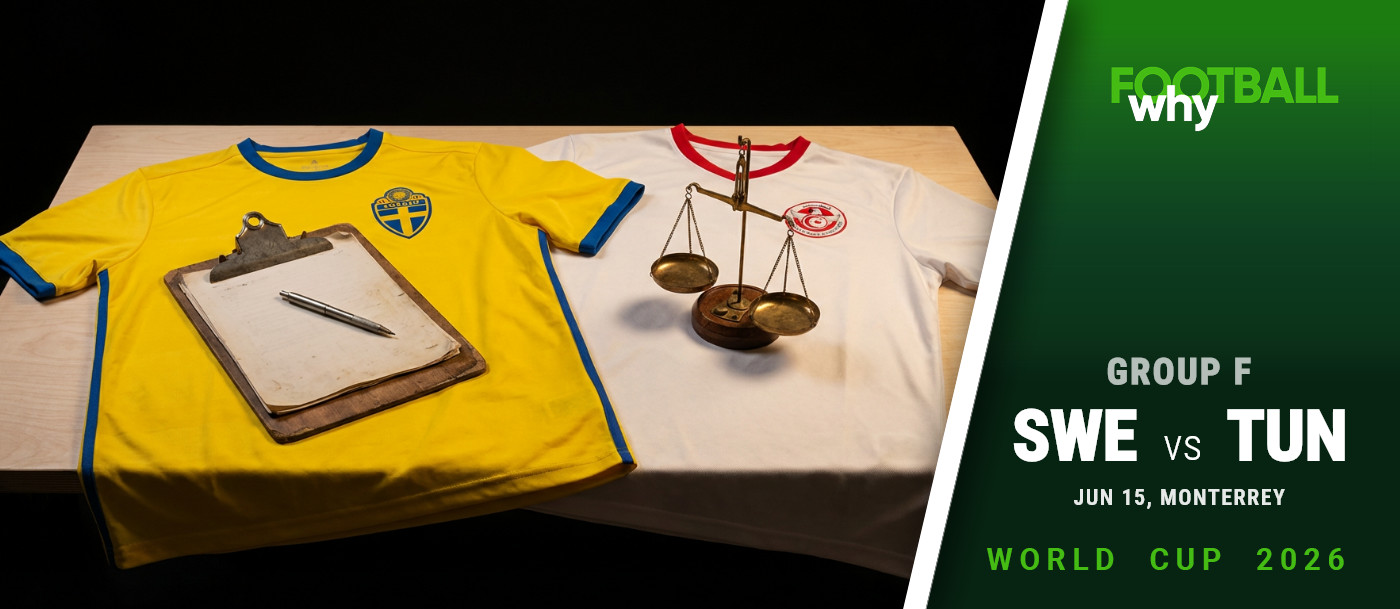
The World Cup Qualification Decider
Monday, 15 June

Estadio BBVA, Monterrey

Sweden vs Tunisia FIFA World Cup 2026 Group Stage Match Industrial precision crushes a crumbling Tunisian scaffold Forecast generated:

A ruthless industrial press crushing a crumbling scaffold. Sweden extracted five goals from just 1.26 expected goals, punishing every Tunisian slip. Step inside to see how clinical execution dismantled panicked improvisation.
Sweden vs Tunisia Structural Collision

What was it?

The humid air inside Estadio BBVA hung heavy, but the structural collapse happened in an instant. A routine catch slipped through Abdelmouhib Chamakh’s gloves at seven minutes, and the North African scaffolding gave way entirely.

Sweden operated like a synchronized industrial press, stamping out errors with chilling precision. They generated a mere 1.26 expected goals across the evening. They scored five.

Viewers missed a contest but witnessed a masterclass in spatial exploitation. Alexander Isak and Viktor Gyökeres did not dominate possession; instead, they waited for the Tunisian midfield to fray. They stepped into the jagged splices of their opponents' structure to deliver two goals and three assists between them.

Tunisia’s conservative blueprint relied on tight margins. Once the goalkeeper's early fumble short-circuited that plan, panic set in. This anxiety manifested in six mistimed offside runs and a desperate, isolated Hannibal Mejbri chasing shadows.

By the time VAR confirmed Mattias Svanberg’s late strike, the disparity felt almost cruel. It was the quiet, brutal beauty of a collective executing its duty, leaving a brave but broken opponent sifting through the rubble.

How did they clinch it?

Sweden

Sweden secured the victory by turning the match into a brutal exercise in resource management. They deployed selective pressing traps rather than chasing the ball continuously. This allowed them to control the game’s temperature without needing heavy possession.

The current squad is perfectly calibrated for this detached approach. They boast elite, transition-ready forwards supported by a midfield that instinctively defaults to a compact two-line block. They absorb pressure comfortably and strike vertically the moment an opponent over-commits.

Their conversion rate was terrifying, turning minimal expected goals into maximum output. This tactical patience stems from a deeply ingrained national sporting character. Swedish football development prioritizes positional discipline, collective labor, and game intelligence over early individualism.

There is a profound cultural suspicion of flashy, high-risk football. Consequently, the national team rarely panics under pressure. They trust their documented processes and structural shape, viewing any deviation as a collective failure.

The players are educated to view tactical adherence as a shared civic responsibility, where individual flair is strictly a tool for efficiency.

They simply executed a flawless winter protocol, conserving their energy in the cold until the exact moment required to extract the seam.

Why not go for the win?

Tunisia

Tunisia’s collapse was rooted in an inability to recalibrate once their primary defensive script was torn up. Accumulating six offsides highlighted a panicked, mistimed desperation to immediately rectify the deficit against a settled line.

The squad’s tactical framework relies heavily on a conservative shape designed to frustrate. However, an early midfield booking entirely blunted their ability to apply physical friction in the central third, leaving their back five dangerously exposed to vertical transitions.

This fragility under sudden stress points to a deeper squad limitation. Tunisia possesses a glaring deficit in elite final-third creators. When forced to chase a game, they cannot rely on sustained, intricate possession, instead defaulting to hopeful diagonal crosses and isolated individual surges.

These limitations are born from a national footballing identity anchored in underdog resilience. Historically, they have survived by turning matches into a grinding war of attrition. There is a deep-seated loss aversion that prioritizes avoiding humiliation over expressive risk-taking.

When their organized consensus breaks down, the structural trust vanishes. Players revert to frantic, localized problem-solving rather than trusting a collective recovery plan.

They tried to negotiate a desperate street-market bargain with an opponent that only accepted exact change.

Match hero...

Yasin Ayari
Yasin Ayari operated less like a traditional playmaker and more like a municipal safety inspector. He identified the structural flaws in the opponent's defensive zoning and filed his reports from distance. His strikes were not acts of ego, but the logical conclusion of a transparent process: the space was left unattended, so he utilized it. He thrived because the Swedish system delegates authority to whoever holds the ball in the correct tactical quadrant, allowing individual brilliance as long as it serves the collective ledger.

...and one more

Hannibal Mejbri
Hannibal Mejbri ran himself into the ground like a desperate merchant trying to honor a family debt in a collapsing market. He provided the only genuine spark, engaging in constant, abrasive friction to protect his team's dignity. When the collective consensus failed and the tactical script tore apart, he bypassed the formal channels entirely. He relied on pure, nervous energy and an anti-hogra refusal to be humiliated, trying to weave a patched repair out of absolute chaos.