

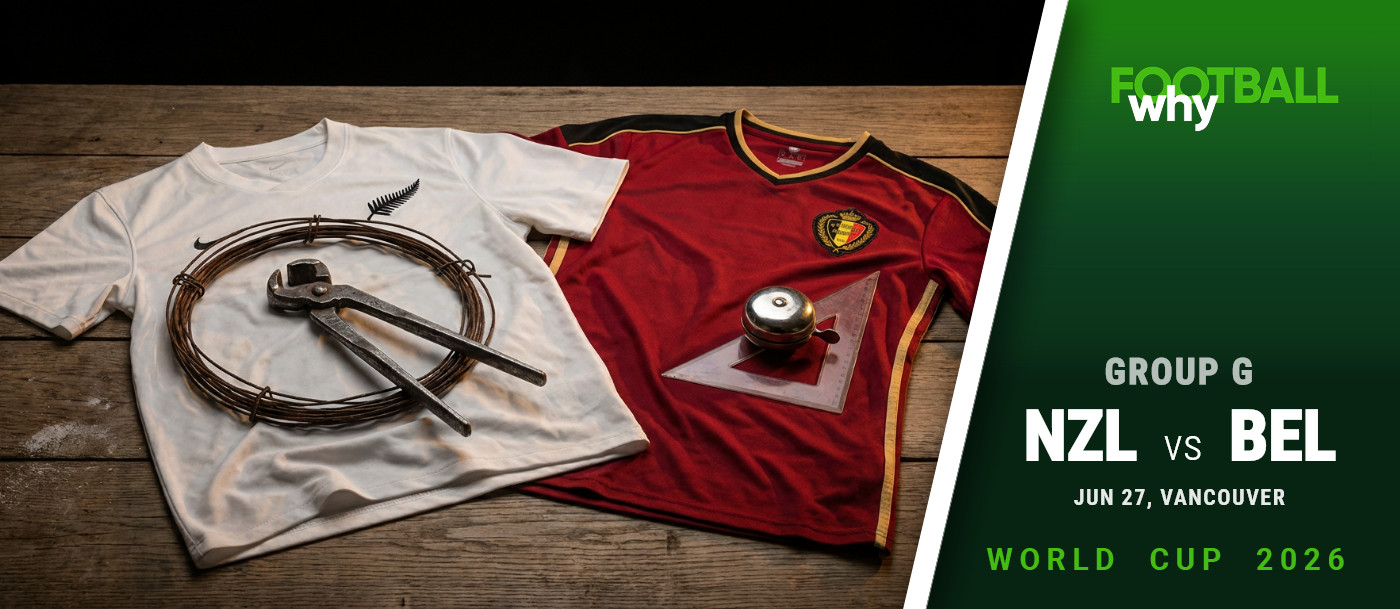
Group G, Matchday 3, Match #64
UTC

BC Place, Vancouver

Prediction by whyFootball readers

NZL
DRAW
BEL
14%
23%
63%
Not a recommendation for betting
Tap [+] to cast your expert forecast.
SCORE BY AI PREDICTION: 1:3 SEE SIMULATION

New Zealand vs Belgium FIFA World Cup 2026 Group Stage Match Drafting table precision under a hail of dockyard shrapnel Forecast generated:

The makeshift pragmatism of the No.8 wire confronts the symmetrical discipline of a cycling peloton. It is the raw sweat of the isolated seafarer against the administrative hum of a technocracy determined to close the file without staining its cuffs.

New Zealand: One side's prayer...

New Zealand arrive at this final group fixture staring down the barrel of elimination, desperately needing points to keep their tournament pulse beating. The mood is one of stoic, blue-collar defiance. Medical staff are carefully managing Chris Wood following his knee surgery, treating his minutes like rationing out the last drops of fresh water on a lifeboat. With Liberato Cacace also nursing a hamstring issue, the public expectation is stripped of any stylistic demands; they simply want to see an honest, bruising shift to drag the team over the line.

Belgium: ...head-on with the other.

Belgium approach this tie seeking to secure top spot in the group and safely file the preliminary stage into the archives. The camp is attempting to steamroller over lingering background noise regarding Thibaut Courtois’s absence — a situation that has reopened old dressing-room fractures over goalkeeping hierarchy. With Romelu Lukaku also being carefully eased back from a hamstring injury, the pressure from back home is clear: deliver a clinical, low-variance victory that silences the internal politics and proves this highly-strung peloton can actually ride in a straight line under tournament pressure.
New Zealand vs Belgium Structural Collision

New Zealand: How we will host...

Dream
The minimum requirement is to scrape a point to keep the tournament pulse beating. The public expects a proper fight and an honest display of effort. Snatching a win via a late corner is the ultimate, gritty goal.

Strength
Built on travel-hardened resilience, they are a physical unit treating aerial duels as their natural domain. Chris Wood acts as the focal point. He turns hopeful, desperate long balls into genuine territorial gains.

Plans
To counter slick European passing, the manager has constructed a double-team trap for the opposition's quickest winger. They will bypass their own midfield entirely. Hitting early diagonals and using long throw-ins will drag the opposition into a physical scrap.

Fears
The glaring worry is a lack of composure when pressed high up the pitch. Without a reliable central creator, they often panic under pressure and sink deep into their own box. This isolates the striker and invites a gruelling siege.

Belgium: With what we arrive...

Dream
The objective is to secure the group summit without engaging in any unnecessary diplomatic incidents. The public demands a clinical, bureaucratic victory that safely files the preliminary stages into the archives. Maintaining a clean sheet is viewed as a mandatory administrative task.

Strength
Built on elite academy polish, they operate as a highly calibrated peloton. Their true power lies in patterned possession and the ability to dictate the rhythm of the contest. Kevin De Bruyne serves as the chief architect, threading the play together with an unnerving, cold precision.

Plans
The blueprint involves baiting the opposition down one flank before swiftly shifting the ball to isolate their most explosive winger. They will prioritise low, driven cut-backs over hopeful crosses. Rehearsed corner routines are specifically designed to bypass the ugly, physical brawl in the penalty area.

Fears
The lingering anxiety involves their composure unravelling when subjected to a relentless physical barrage. If the game loses its structure and descends into a scrap, their defensive transitions can look alarmingly fragile. This vulnerability often triggers unwelcome, historical debates about their collective mental resilience.

How it will be...

The contest promises a stark collision of incompatible matrices. If the New Zealand full-back succumbs to an early feint and incurs a booking, their perimeter fencing will fray. Within that newly acquired acreage, the Belgian winger should locate the seam to drill those low, punitive cut-backs from the byline.

Expect a fixture where the European holding midfielder operates as an uncompromising customs officer, confiscating second balls and dampening the aerial barrage. Yet, the Oceanian target man, carrying the heft of an older vintage, ensures the physical toll in the penalty box remains a constant tax. Each long throw hurled into the mixer will act as a referendum on the Belgian rearguard’s nerve.

Despite the deficit in technical ledgers, there will be no white flags hoisted. The instinct for self-preservation will propel New Zealand to overcrowd the final third, forcing a scruffy, breathless climax that briefly disrupts the bureaucratic pulse.

However, that very defiance will leave vast, unpoliced tracts of grass behind their centre-backs. In those desolate spaces, the visiting substitutes will likely administer the final counter-punch, proving that laboratory geometry usually outlasts the emotional surge of the dockyard.

New Zealand: Why not go for the win?

An early caution for their right-back dismantled the wide trap, conceding the opening blow. Subsequently, a lapse in concentration during a rehearsed corner forced them into a desperate chase. They succumbed because raw aerial endeavour cannot entirely mask a chronic deficit of central creativity against European structure.

Belgium: How did they clinch it?

They prevailed because sustained wide isolation unlocked the perimeter early, and a set-piece blueprint anaesthetised the middle phase. When Oceanian pride narrowed the deficit, they deployed their contingency: absorbing the squall in a compact shape before executing a ruthless transition. A victory of administrative design.

Secret mastermind intent

Darren Bazeley’s No.8 wire barricade against the tide

General Strategy
The primary directive is to grind out a result and protect the goal difference, keeping knockout hopes alive. Bazeley is setting up a compact 4-4-2 mid-to-low block, designed to shrink the space and force the game into a physical slog.

A draw is perfectly acceptable. The team will look to survive the initial waves and steal a goal late on through a set-piece, relying on their traditional aerial grit rather than expansive possession.
Antidote for the Opponent
The main defensive focus is building a cage around Jérémy Doku. The right-back and right midfielder are instructed to double up on the winger immediately. They must constantly show him towards the touchline to prevent inside cuts.

In the centre, the holding midfielder will cast a shadow over Kevin De Bruyne to block cut-back lanes. When New Zealand win the ball, they will immediately launch diagonal passes into the space left behind Belgium’s attacking left-back.
Internal Task Solving
A unique weapon in the arsenal is the coordinated long-throw package activated after the opening fifteen minutes. Both full-backs have the green light to launch the ball into the penalty area. This effectively turns throw-ins into corner kicks.

There is also a pre-agreed verbal trigger from the bench to halt any risky short passing. If the pressure builds too much, this call tells the team to bypass the midfield entirely and go direct to the target man for a couple of cycles to reset the pitch geography.
Crisis Response Plans
If De Bruyne starts breaking the lines and dictating the half-spaces, Bazeley will not hesitate to pull the emergency cord. The number ten will drop alongside the holding midfielder to form a flat 4-5-1. This sacrifices attacking width to plug the central gaps.

Beyond that, the manager is ready to adapt to the scoreboard. If trailing late on, the shape goes out the window in favour of raw physical pressure, throwing an extra striker up top and launching early crosses.
Specific Match Orders
Tim Payne (Right-Back): Double up on the left winger at the source and show him the outside lane. Do not lunge in on the front foot. Only overlap if there is a massive advantage; otherwise, stay tucked in to form a back three when the team attacks. Max Crocombe (Goalkeeper): Skip the short central build-up entirely. Hit immediate diagonal balls into the right channel within three seconds of regaining possession. Claim high crosses with authority and deliberately slow down the restarts if the team concedes. Joe Bell (Holding Midfielder): Guard the edge of the penalty area and block the cut-back lanes. Stagger positions underneath the ball. Use one tactical foul per half if the opposition playmaker spins free in the pocket.
/ What if the team is pinned deep without an out-ball?

The right midfielder will push five to eight yards higher to offer a transition outlet. The instruction is to aim early passes straight at the striker's chest. They will actively invite fouls to flip the field position and set up long throws.

/ What if the opposition introduces a true target man late in the game?

The defensive line will drop eight to ten metres deeper. The holding midfielder will drop to screen the front-post zone. A fresh centre-back will be subbed on specifically for aerial duels, and all risky short passing from the back will be completely banned.

Secret mastermind intent

Rudi Garcia’s diplomatic blueprint for wide isolation

General Strategy
The manager intends to impose authority immediately with a high press for the opening fifteen minutes. Once a lead is established, the side will downshift into a structured 4-1-4-1 mid-block. This is an exercise in risk management and schedule control.

The primary focus is starving the opposition of set-piece opportunities by keeping the ball. They want to dictate the geographical terms of the contest without engaging in unnecessary physical skirmishes.
Antidote for the Opponent
The bespoke tactical adjustment centres on isolating Jérémy Doku against the opposition full-back. Kevin De Bruyne will operate primarily in the right half-space to act as the supply line. He is instructed to drill low cut-backs rather than floating crosses into an aerially dominant defence.

Off the ball, the full-backs will step up a few yards earlier than usual. This proactive positioning aims to smother the source of the opponent's early deliveries before they leave the boot.
Internal Task Solving
A fascinating cultural quirk is the bench issuing a 'Peloton' command during chaotic spells. This cycling-derived instruction tells the players to tuck into a compact shape and ride out the turbulence for three minutes before accelerating again.

Furthermore, a strict diplomatic protocol surrounds the goalkeeper to suppress any media noise. Defenders are forbidden from playing risky back-passes under pressure, instructed instead to clear the ball into the stands to protect the returning custodian.
Crisis Response Plans
Garcia has drawn up a clear contingency if the opposition successfully exploit the space behind his attacking left-back. The defender will simply drop his starting position by five metres to seal the breach. Simultaneously, the holding midfielder will slot into the defensive line to create a temporary back three.

Should their own central striker struggle against the towering centre-backs, the approach will shift entirely. They will flood the edge of the box and rely exclusively on pull-backs.
Specific Match Orders
Amadou Onana (Holding Midfielder): Dominate the second balls dropping off their target man. Commit absolutely no cheap fouls within thirty yards of our goal. Drop into the backline as an auxiliary defender if they throw on a second striker late in the game. Kevin De Bruyne (Playmaker): Anchor yourself in the right half-space. Look for early diagonal switches to the weak side as soon as their defensive block shuffles across. Prioritise low cut-backs from the byline rather than floating crosses into the middle. Thibaut Courtois (Goalkeeper): Avoid launching long goal-kicks directly into their central striker's aerial zone. Prioritise short to medium distribution to the defenders. Choose to catch the ball rather than punching it when the penalty area gets crowded.
/ What if the opposition repeatedly hit diagonals behind the left-back?

The defensive structure undergoes a swift recalibration. The left-back lowers his starting position to deny the space, while the far-side full-back tucks inside. The holding midfielder then drops permanently to form a back three, restoring the numerical advantage behind the ball.

/ What if the opposition flood the box with two strikers late on?

The team shifts into a rigid 5-4-1 formation for all defensive set-pieces. The holding midfielder slots between the centre-backs to add aerial presence. The wingers are ordered to stay narrow to protect the back-post lanes, and the goalkeeper takes a higher starting position to claim crosses.

MAIN SIMULATION 0'-25'

Belgium start by squeezing the pitch, pushing their line up to 55 metres. They immediately isolate Doku against Tim Payne on the flank. It is a foot-race masked as a tactical plan. An early booking for Payne softens the New Zealand double-team, breaking their defensive shape. With the wide trap loosened, Kevin De Bruyne finds a pocket of space and cuts the ball back for Openda to score. New Zealand retreat into a deep, stubborn 4-5-1 to stop the bleeding.

MAIN SIMULATION 25'-45'

Belgium lower the temperature. They settle into a compact 4-1-4-1 mid-block, effectively putting a lid on the game to deny New Zealand cheap set-pieces. Accepting the reality of the situation, New Zealand bypass the midfield entirely. They launch long diagonals towards Chris Wood, hoping to fight for the scraps. Onana acts as a human breakwater, sweeping up everything that drops near the Belgian box. The half ends in a state of managed, sterile control.

MAIN SIMULATION 45'-65'

Belgium step on the gas again and score from a rehearsed routine. De Bruyne swings a corner out, Onana wins the near-post flick, and De Ketelaere taps it in at the back post. A perfect piece of flat-pack football. New Zealand respond by throwing caution to the wind, sending Waine up top to partner Wood. Belgium simply shrug, drop Onana between the centre-backs, and form a five-man wall to soak up the pressure.

MAIN SIMULATION 65'-90'

The match descends into a messy scrap. New Zealand bombard the penalty area with crosses, eventually forcing a scruffy, second-phase header from Wood to cut the deficit. Belgium call for calm from the bench, bring on Lukaku, and reset their shape. With New Zealand desperately pushing forward and their defensive shape in ruins, Doku finds a massive gap. He sprints away on the counter and squares it for Lukaku to kill the game off.

And it will come to...

If this forecast holds true, we would see Belgium's procedural discipline survive New Zealand's raw physical effort. The Europeans would dictate the play through clever half-space passing and wide dribbling, but they would look uncomfortable when the game turns into a chaotic aerial battle. New Zealand would eventually find joy through sheer, stubborn grit and long balls. Ultimately, however, individual quality would tell in the spaces left behind. It would be a victory for calculation over sweat, but an honest fight nonetheless.
end of Game