

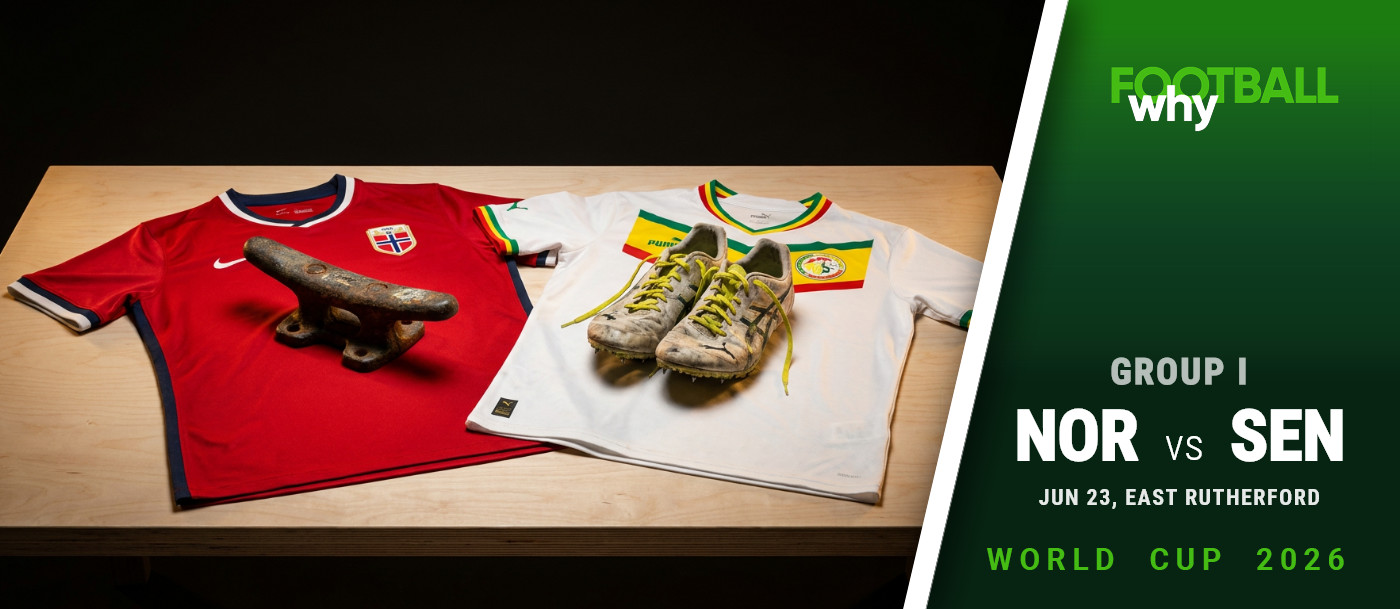
Group I, Matchday 2, Match #41
UTC

MetLife Stadium, East Rutherford

Prediction by whyFootball readers

NOR
DRAW
SEN
39%
30%
31%
Not a recommendation for betting
Tap [+] to cast your expert forecast.
SCORE BY AI PREDICTION: 2:1 SEE SIMULATION

Norway vs Senegal FIFA World Cup 2026 Group Stage Match Dropping a heavy anchor on the transitional sprint Forecast generated:

Winter pragmatism collides with incandescent pride. The Nordic austerity, budgeting every drop of sweat as a finite resource, meets a Senegalese brotherhood that flatly refuses to yield. A fixture where the geometry of the ice measures itself against the rhythm of the drum.

Norway: One side's prayer...

Norway arrive with the strict mandate to secure knockout progression without any unnecessary fuss. The public mood is utterly pragmatic, stripped of aesthetic demands following recent misfires on the difficult Ullevaal turf. The camp’s primary anxiety revolves around Martin Ødegaard’s heavily strapped knee, forcing a clinical micromanagement of his minutes to avoid midfield friction. They are treating this group stage fixture like a hazardous winter commute, prioritising safe passage and set-piece efficiency over expansive risks to navigate their way into the last sixteen.

Senegal: ...head-on with the other.

Senegal step onto the pitch fuelled by a potent mix of wounded pride and righteous defiance. The squad remains tightly bonded, insulating themselves from the lingering administrative noise of the recent AFCON legal dispute where their title was stripped by the boardroom. Crucially, regional suspensions for Ismaïla Sarr and Iliman Ndiaye do not apply to this FIFA fixture, leaving their attacking arsenal fully stocked. The diaspora expects a dignified, full-throttle response, demanding the team channel their grievances into devastating, coiled-spring transitions.
Norway vs Senegal Structural Collision

Norway: How we will host...

Dream
Secure the points needed for the knockout stages without unnecessary theatrics; a sensible draw is perfectly acceptable. The Norwegian public expects a serious, efficient shift that justifies the presence of their elite striker, having little patience for sterile passing.

Strength
A profound, almost civic commitment to collective discipline and structural resilience. They operate like a well-audited sovereign wealth fund, minimising risk in central areas, maintaining a compact shape, and relying on their towering physical presence to dominate the airspace.

Plans
The blueprint is to bypass the midfield scrap entirely. They will use deliberate, wide build-ups and treat every throw-in like a corner kick to bombard the Senegalese box, hoping to drag defenders out of position with decoy runs before delivering clinical crosses.

Fears
A deep-seated dread of chaotic, end-to-end basketball matches. If the game stretches and descends into a pure footrace against Senegalese wingers, their pragmatic system risks looking terribly sluggish and painfully outdated.

Senegal: With what we arrive...

Dream
Secure the points required to keep their destiny in their own hands, with a victory strongly preferred. There is a palpable siege mentality following recent off-pitch administrative battles; the diaspora crowd demands a dignified, defiant performance on the grass that rises above the noise.

Strength
A profound sense of brotherhood coupled with devastating athletic endurance. They possess an elite transitional engine, capable of absorbing heavy pressure before springing forward with frightening pace, all underpinned by a fierce collective pride and a refusal to be bullied.

Plans
The strategy relies on aggressive verticality and wide isolation. They aim to feed their rapid wingers against exposed full-backs, using swift diagonal passes to bypass the midfield scrap entirely and strike before the opposition can organise their defensive shape.

Fears
The threat of righteous indignation boiling over into indiscipline. If perceived injustices or refereeing decisions spark emotional protests, their compact shape will quickly unravel, inviting unnecessary bookings and leaving them horribly vulnerable to dead-ball deliveries.

How it will be...

The encounter looms as an unavoidable tollbooth: an exercise in patience where the ticking clock will weigh heavier than the ball itself. If you tune in, expect to observe a Scandinavian unit rationing their resources with the bloodless efficiency of a provincial bank manager, standing opposite an African collective tightening their sinews, awaiting the barest sliver of space to unleash their rebellious verticality.

The underlying architecture of the game will heavily penalise the microscopic lapse. The viewer’s gaze should be fixed on the penalty arc whenever Norway earn an attacking throw-in; there, the broad-shouldered chassis of Haaland will prowl for the rebound, ready to feast on any hesitation from a defensive line that has a habit of sinking too deep after the initial aerial duel.

Conversely, Senegalese pride will sprout from the boots of Ismaïla Sarr. Should the winger manage to untangle his stride from the double-marking traps, he promises bursts of electric, unscripted street-football, forcing one-on-one footraces that could splinter the Nordic composure and inject a shot of pure jeopardy into the scoreline.

It will be a collision of distinct doctrines. The heavily-strapped knee of Ødegaard, relying on a two-touch rhythm to evade the friction, will attempt to domesticate the tempo. Across the pitch, the effervescence of a squad that fundamentally rejects submission ensures the tension will hum like a taut wire until the final whistle.

Norway: How did they clinch it?

Norway prevailed because they successfully monetised the ensuing scramble. The deadlock was broken by a momentary lapse in away concentration following a long throw, where the striker's predatory instinct pounced on the loose ball. This validated their core blueprint: compensating for a lack of open-play invention with a relentless aerial supremacy built on their sheer physical profile.

Senegal: Why not go for the win?

Senegal faltered by losing their bearings in the defensive airspace. A fatal hesitation from the goalkeeper underneath a high delivery sealed their fate. While they caused genuine alarm with their rapid transitions, a blunt edge in the final third and sheer exhaustion under the Scandinavian bombardment eventually fractured their structural resistance.

Secret mastermind intent

Solbakken’s Winter Budget for a Hostile Climate

General Strategy
The overarching strategy is rooted in risk-averse pragmatism. Norway will deploy a compact 4-5-1 mid-block, designed to suffocate central passing lanes and force the game out wide.

They view possession not as a tool for dominance, but as a method of weatherproofing the match against sudden transitions.

The side will patiently circulate the ball to secure territory, aiming to earn cheap set-pieces rather than forcing risky through-balls.
Antidote for the Opponent
To neutralise Sadio Mané, the right-back and nearest midfielder will form a double-team to deny him the inside channel. They will happily concede the touchline to prevent him turning towards goal.

At the other end, the focus is entirely on manipulating Kalidou Koulibaly. The striker will drop deep to bait the defender into stepping out.

Once the gap appears, wingers will immediately dart into the vacated space to receive early diagonal crosses.
Internal Task Solving
A highly specific feature of this setup is the transformation of attacking throw-ins into rudimentary corner kicks. They will launch the ball towards the near post for a flick-on, hunting second balls in a chaotic penalty area.

There is also a strict physical audit being conducted on the captain's knee. His minutes and contact levels are being micromanaged.

He will operate strictly on a two-touch basis early on, avoiding heavy tackles to ensure he survives the group stage.
Crisis Response Plans
If Ismaïla Sarr begins to terrorise the left flank, the manager will activate a strict containment protocol. The left-back will be ordered to stay permanently deep, while the midfield anchor shifts across to create an impassable bottleneck.

This flexibility extends to their attacking shape. Should the match remain deadlocked, an extra target man will be thrown on to create a heavy 4-4-2.

This shift trades midfield control for sheer blunt-force trauma in the penalty area.
Specific Match Orders
Martin Ødegaard: Stick to a strict two-touch limit for the first half hour and avoid any 50/50 challenges. If the knee flares up, move higher into the number 10 pocket to escape the midfield friction. Julian Ryerson: Prioritise holding your defensive position over making overlapping runs until the hour mark. Maintaining absolute vigilance on the back post against late runs from the wingers is non-negotiable. Erling Haaland: Make early, deceptive drops deep into midfield to tempt the centre-back into stepping out. As soon as he commits, spin sharply and attack the near-post seam at full pace.
/ What if the captain's knee cannot handle the midfield friction?

He will immediately be pushed further up the pitch into an advanced playmaker role, removing him from the physical demands of the engine room. The deepest midfielder will assume full responsibility for linking the play, and the team will switch to hitting earlier, longer diagonals to bypass the congested central third entirely.

/ What if the left flank is repeatedly breached by isolated dribbles?

The attacking full-back will be ordered to hold his position permanently, and the nearest central midfielder will drop deeper to form a double-layer of protection. The team's exit strategy will instantly change to hitting long, sweeping passes to the opposite wing, forcing the opposition winger to sprint backwards.

Secret mastermind intent

Thiaw’s Dignified Net to Snare the Northern Storm

General Strategy
The foundation relies on a fiercely compact mid-block that functions like a tightly woven net. They will gladly concede the wider areas to protect the penalty box, waiting for the right trigger to launch forward.

Once possession is regained, the transition must be immediate and ruthless. There will be no lingering on the ball in the central third.

Instead, the side will execute rapid, vertical thrusts to catch retreating defenders off-balance.
Antidote for the Opponent
To neutralise the opposition's primary playmaker, the nearest midfielder will aggressively screen his preferred left foot. The intention is to force him down the touchline or into negative passes backward.

Defending the penalty area requires absolute discipline against the striking talisman. The centre-backs are ordered to stay tight, while a defensive midfielder sweeps just in front of them.

They will refuse to be dragged out of position by decoy movements, maintaining a solid wall to block low cut-backs.
Internal Task Solving
The technical staff have established a pre-agreed silent signal from the touchline to instantly kill any player protests following controversial VAR reviews. This cooling mechanism is vital to preserve their collective dignity.

By channelling all grievances exclusively through the captain, the team avoids cheap bookings.

They will also look to exploit quick throw-ins and rapid free-kicks, catching the opposition's defensive structure before it has time to settle.
Crisis Response Plans
Should the opposition deploy a second towering striker to bombard the penalty area, Senegal will immediately pivot to a back-three. This structural shift adds crucial height to repel the aerial assault.

Simultaneously, the wing-backs will push higher to maintain a wide outlet for counter-attacks.

The manager is fully prepared to sacrifice midfield bodies to ensure the six-yard box remains heavily guarded during late defensive sieges.
Specific Match Orders
Kalidou Koulibaly: Hold the defensive line and refuse the temptation to follow the striker's decoy drops into midfield. Protect the adductor muscle by avoiding extended recovery sprints into the wide channels. Édouard Mendy: Bypass short central build-ups and distribute the ball directly to the wide forwards. Take a slightly higher starting position on corner kicks to aggressively claim outswinging deliveries before they reach the danger zone. Nicolas Jackson: Time your curved runs strictly on the blind shoulder of the right-sided centre-back. If an early chance is missed, consciously delay your foot plant on the next attempt and finish across the goalkeeper's body.
/ What if the penalty area is overwhelmed by repeated corner kicks?

A tall midfielder will be instructed to drop into the six-yard box to reinforce the zonal marking scheme. The wingers will flatten out to provide an extra layer of defensive cover. Counter-attacks will be entirely suspended until the ball is cleanly secured and the defensive lines can breathe.

/ What if the opposition playmaker begins to dictate the tempo from the half-spaces?

The nearest central midfielder will be dispatched to permanently shadow his stronger foot. The wide player on that side will tuck inwards to completely block the central passing lane. The team will accept the risk of the ball being recycled out wide, preparing to spring traps near the touchline.

MAIN SIMULATION 0'-25'

The opening exchanges will be a deliberate exercise in patience. Norway plan to keep the center sterile, funneling the ball to the right half-space before pinging quick switches. Senegal will counter this by tucking their wingers to block the inside passing lanes, forcing recirculation. When Senegal win possession, they will immediately look to spring Ismaïla Sarr down the left, but Norway’s disciplined rest-defence should smother these early transitions.

MAIN SIMULATION 25'-45'

The match will tilt towards Norway’s set-piece laboratory. By accumulating territory and forcing wide clearances, the hosts will stack corners to stress Senegal’s hybrid marking system. Around the 33-minute mark, a rehearsed near-post block is heavily favoured to free a Norwegian center-back for the opener. Senegal will likely absorb the blow without losing their heads, relying on a captain-led huddle to reset and funnel their frustration into sharper, direct transitions.

MAIN SIMULATION 45'-65'

The tempo will spike sharply after the break. Senegal are expected to hit a higher gear, cleanly isolating their wingers out wide to pull Norway's defence apart and force a 55th-minute equaliser. Norway will immediately deploy a shock-recovery routine, freezing their fullbacks to slow the bleeding. By the hour mark, both managers will twist: Norway adding a second striker for a heavy 4-4-2, and Senegal shifting to a back-three to cope with the impending aerial bombardment.

MAIN SIMULATION 65'-90'

The final act will descend into an attritional scrap. Norway will bypass the midfield entirely, using long throw-ins as a blunt instrument to batter the Senegalese box. Metabolic decay will eventually fray Senegal’s marking, allowing Erling Haaland to sweep home a second-phase rebound around the 76th minute. Senegal will throw men forward in a desperate surge, but Norway are projected to drop into a rigid 4-5-1 shell, starving the space and bleeding the clock dry.

And it will come to...

Should this forecast hold true, Norway’s disciplined, low-volatility blueprint would ultimately outlast Senegal’s proud transitional surges. The contest would be decided by the minutiae of set-piece governance rather than open-play flair. If Senegal were to lose focus during the messy second phases of long throw-ins, the Scandinavian aerial advantage would exact a heavy toll. Ultimately, a Norwegian victory would be built on structural resilience, proving that a well-drilled restart can reliably dismantle the most spirited of counter-attacks.
end of Game