

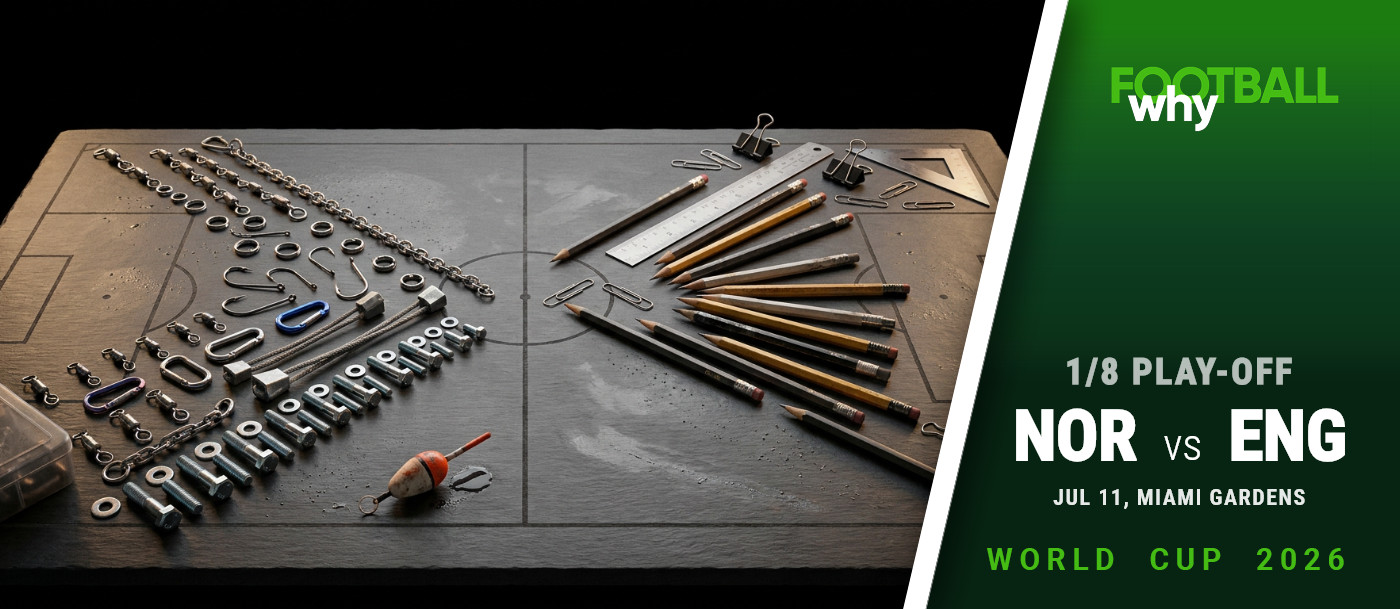
The World Cup Qualification Decider
Saturday, 11 July

Hard Rock Stadium, Miami-gardens

Norway vs England FIFA World Cup 2026 Group Stage Match Tactical Politeness, Saturated Topsoil, and Bellingham’s Snap Forecast generated:

A stiflingly polite procedural exercise in the Miami heat was only shattered when Jude Bellingham bypassed the queue. Discover how his 93rd-minute extra-time strike finally broke Norway’s rigid tactical obedience.
Norway vs England Structural Collision

What was it?

The Miami humidity clamped down on the stadium, forcing twenty-two players to move as if wading through saturated topsoil. They circulated possession with the unhurried caution of clerks filing municipal paperwork. Norway recorded an 85 percent completion rate; England hit 91.

Ståle Solbakken’s men adhered to their positional diagrams with fatal obedience. They bypassed Erling Haaland entirely, leaving him to sprint into empty channels until a dead leg ended his afternoon at 106 minutes.

Andreas Schjelderup did bend in an opener following a Martin Ødegaard diagonal. The advantage dissolved instantly. Jude Bellingham crashed through the penalty area to meet an Anthony Gordon cut-back just before the interval.

Thomas Tuchel adjusted his midfield at the break, withdrawing Declan Rice to leave Elliot Anderson screening alone. Norway briefly thought they had reclaimed the lead, only for VAR to penalise a shove in the box.

Extra time required someone to snap the polite, walking-pace rhythm. Bellingham reacted first when Morgan Rogers fired a long-range shot on 93 minutes, tapping in the rebound. Tuchel immediately sent on Dan Burn to bolt a five-man defence together.

Why not go for the win?

Norway

Norway suffocated inside their own structural discipline. Facing extreme heat, the team retreated into a compact mid-block, prioritising spatial symmetry and collective safety over attacking risk.

This strict adherence to the positional map resulted in the complete isolation of Erling Haaland. The centre-forward was left to make endless, unrewarded sprints until his muscles literally seized up in extra time.

This isolation was not a mechanical glitch, but a deliberate choice by the coaching staff to maintain defensive consensus rather than gamble on chaotic vertical transitions. When their primary left-sided combinations eventually stalled, the squad lacked the improvisational depth to rewrite the tactical script.

Such rigidity stems directly from their domestic development pathways. The national infrastructure, heavily reliant on indoor synthetic arenas to survive long winters, produces highly coachable, athletically robust professionals. They execute tactical instructions perfectly and dominate aerial duels.

Yet, that same highly structured environment struggles to manufacture spontaneous problem-solvers. When the pre-planned passing circuits hit a blockade against elite opposition, the collective instinct is to fall back on safety-first circulation and set-piece routines rather than individual rebellion.

They constructed a perfectly insulated tactical shelter, only to realise they had firmly locked their best weapon outside in the cold.

How did they clinch it?

England

England advanced because they possessed the structural cynicism to simply outlast the opposition. Rather than forcing the issue against a deep defensive line, they used measured possession to drain the physical energy from the pitch.

Thomas Tuchel’s half-time adjustments demonstrated a ruthless, unromantic pragmatism. By withdrawing a senior defensive midfielder to leave a single pivot, he calculated that the risk of a transition was lower than the reward of cleaner interior circulation.

This subtle shift allowed the team to bypass the rigid Scandinavian block without committing unnecessary bodies forward. Later, the moment the lead was secured, the immediate introduction of extra centre-backs shut down the wide channels completely.

Such calculated game management reflects a definitive shift in the national footballing character. The current generation no longer relies on frantic emotional surges, touchline roars, or desperate long balls to salvage a knockout result.

These players have been hardened within elite club academies, absorbing continental tactical frameworks week after week. They are entirely comfortable operating within highly structured, low-risk environments, treating tournament football not as a passionate crusade, but as an exercise in risk mitigation.

They simply filed the necessary procedural paperwork, waited for the opposition’s legs to fail, and quietly bolted the office door.

Match hero...

Martin Ødegaard
Martin Ødegaard operated like a meticulous treasurer allocating the village winter supplies. He logged ninety-three passes, carefully circulating possession through the left channels to ensure everyone had a fair touch. He rarely demands the spotlight; his entire game is built on the dugnad principle of shared effort. By constantly scanning and resetting the tempo, he kept the collective structure intact under the Miami sun, even if that strict politeness ultimately starved their main striker of a chaotic final ball.

...and one more

Jude Bellingham
Jude Bellingham is the only man permitted to ignore the queue. While his teammates circulated possession with the cautious incrementalism of a local council planning committee, he simply crashed the penalty area. He scored twice because he refused to wait for precedent. Exploiting the heavy heat and the opposition’s fatigue, he used sheer kinetic violence to shatter the polite walking pace. In a national side desperate to manage risk, Bellingham provides the necessary, sanctioned rudeness to actually finish the job.