

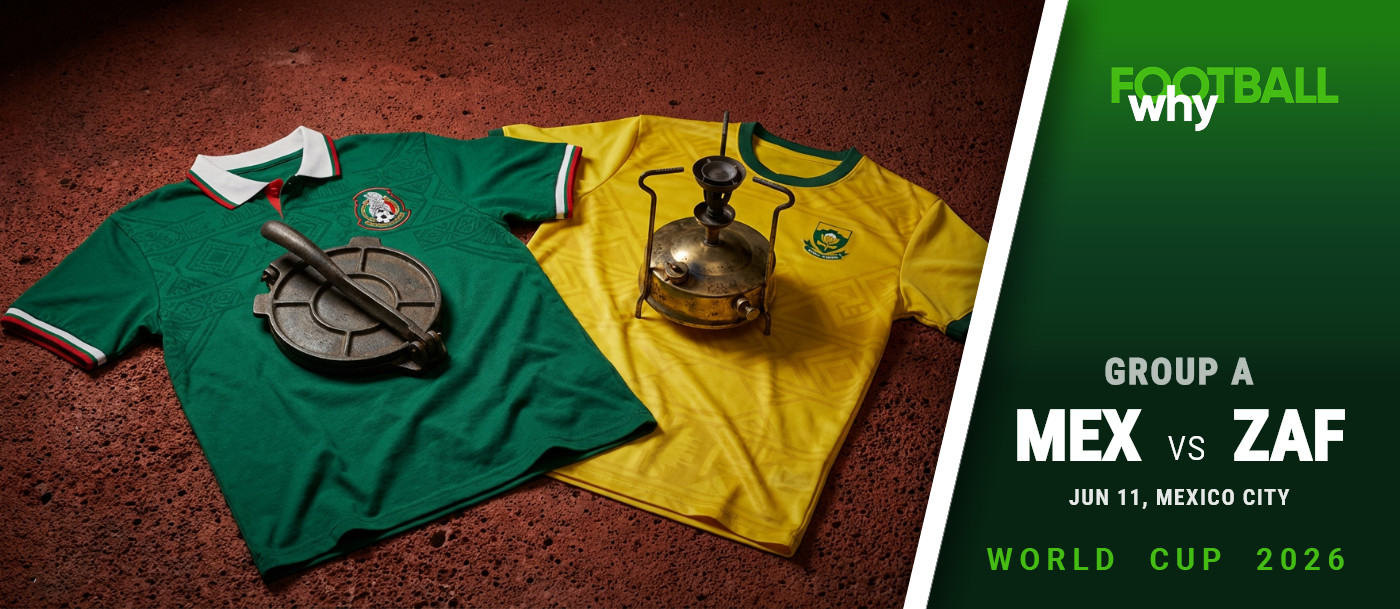
The World Cup Qualification Decider
Thursday, 11 June

Estadio Azteca, Mexico-city

Mexico vs South Africa FIFA World Cup 2026 Group Stage Match Civil service strolling amidst a three-card brawl Forecast generated:

A civil servant calmly filing paperwork amidst a collapsing building. Mexico casually dictated a 2-0 win with 61 percent possession, while South Africa's desperate improvisation yielded three red cards. Step inside the anatomy of an asymmetrical brawl.
Mexico vs South Africa Structural Collision

What was it?

The evening felt like a senior civil servant calmly filing paperwork while a pub brawl spilled through the front door. Mexico held 61 percent possession. They restricted their opponents to a mere 0.07 expected goals.

The ninth-minute opener established the grim reality. Siphephelo Sithole received a short pass inside his own penalty area and was instantly swallowed by a high press. Julián Quiñones slotted the turnover away. From there, the hosts simply managed the clock.

Anyone skipping the broadcast missed a bizarre study in structural asymmetry. The visitors operated entirely on pure, unscripted desire. Every time they gained possession, they had to invent a solution from scratch.

This sheer desperation birthed a statistical freak show. Three straight red cards punctured the evening. Sithole dragged a runner at 49 minutes, Themba Zwane caught a face at 84, and César Montes added a late lunge in stoppage time.

Yet, there was a touching honesty in the chaos. Down to nine men, four South Africans sprinted shoulder-to-shoulder down a single narrow lane on a doomed counter-attack. It was utterly naive, structurally absurd, and incredibly brave.

How did they clinch it?

Mexico

Mexico’s structural dominance stemmed from Javier Aguirre’s deliberate use of a 4-1-4-1 shape, anchoring the midfield with a single pivot to release advanced runners. This created an immediate numerical superiority on the flanks, forcing the opposition to constantly shift their heavy defensive block.

They repeatedly overloaded the wide channels, specifically utilizing Roberto Alvarado to stress the opposing left side. By committing fullbacks to overlapping sprints, the hosts stretched the defensive lines horizontally, patiently waiting for gaps to appear in the vulnerable half-spaces.

This wide-focused approach perfectly masks the current generation’s lack of elite central playmakers. Instead of forcing intricate passes through a crowded middle, they rely on rehearsed, wing-led combinations to manufacture crossing opportunities and secure second balls.

It is a deeply pragmatic blueprint forged in the domestic Liga MX environment. The squad is entirely comfortable maintaining a cautious holding pattern. They prioritize a solid rest-defence and strict risk-management over engaging in chaotic, unscripted exchanges.

This cultural affinity for methodical control allowed them to dictate the tempo without expending unnecessary energy at altitude. They knew exactly when to accelerate the play and when to simply circulate possession to drain the opponent's resolve.

They operated like a seasoned foreman managing a familiar building site, knowing exactly which load-bearing walls to remove without ever risking a structural collapse.

Why not go for the win?

South Africa

South Africa’s structural collapse began with the inherent passivity of their deeper 5-3-2 setup. The distances between the midfield trio and the retreating wingbacks were simply too vast to support any meaningful, cohesive transition when possession changed hands.

Whenever possession was regained, the receiving player found himself completely isolated against multiple pressing bodies. The tactical framework demanded a quick, vertical outlet, but the players instinctively paused, searching for a communal alignment that the opposition's aggressive stance entirely denied.

This hesitation highlights a deeper friction within the current squad's mechanics. They rely heavily on domestic continuity and peer-weighted decision-making. The players prefer to build rhythm through shared touches and mutual validation rather than exploiting immediate, risky avenues alone.

When the formal system fractured under pressure, the players attempted to manually patch the holes. But improvising solutions against an organized, high-pressing opponent only resulted in desperate, late challenges and entirely disconnected lines across the pitch.

This points to a systemic vulnerability in their footballing upbringing. The domestic schooling emphasizes street flair and collective problem-solving, yet it rarely exposes players to the suffocating, relentless intensity of elite international pressing structures.

They arrived expecting a rhythmic, consultative gathering to sort out the issues, only to find themselves trapped in a brutal, high-speed interrogation of their reflexes.

Match hero...

Julián Quiñones
Julián Quiñones did not merely start the fixture; he bypassed the formal queue entirely. His early pressing trigger was less about tactical instruction and more akin to the sharp hustle of an informal market trader claiming the best street corner before dawn. Recognising the hesitation in the opposition's backline, he simply stepped in to collect the toll. His ability to instantly convert a fractured transition into cold currency set the emotional temperature for the evening, allowing the hosts to coast comfortably on their early profits.

...and one more

Siphephelo Sithole
Siphephelo Sithole became the tragic victim of a communal system suffering from sudden load shedding. Tasked with receiving possession in the deepest, most dangerous zones, he was left waiting for an indaba — a gathering to decide the next pass — that the opposition simply did not allow time for. His eventual dismissal was the desperate act of a man trying to manually patch a blown fuse. He possessed the physical grit, but structural isolation forced him to carry the collective burden entirely alone in the dark.